
Online Database of Chemicals from Around the World
| Taizhou Crene Biotechnology Co., Ltd. | China | |||
|---|---|---|---|---|
 | www.pharm-intermediates.com | |||
 | +86 (576) 8881-3233 8820-5808 +86 13396860566 | |||
 | +86 (576) 8822-9589 | |||
 | sales@pharm-intermediates.com | |||
 | QQ Chat | |||
| Chemical manufacturer since 2011 | ||||
| chemBlink Standard supplier since 2009 | ||||
| BOC Sciences | USA | |||
|---|---|---|---|---|
| www.bocsci.com | |||
| +1 (631) 485-4226 | |||
| +1 (631) 614-7828 | |||
| info@bocsci.com | |||
| Chemical manufacturer | ||||
| chemBlink Standard supplier since 2010 | ||||
| Active biopharma Corp | China | |||
|---|---|---|---|---|
| www.activebiopharma.com | |||
| +86 (571) 8161-2335 | |||
| support@activebiopharma.com | |||
| Chemical manufacturer | ||||
| chemBlink Standard supplier since 2012 | ||||
| Apexbio Technology LLC | USA | |||
|---|---|---|---|---|
| www.apexbt.com | |||
| +1 (832) 696-8203 | |||
| +1 (855) 527-3928 | |||
| info@apexbt.com | |||
| Chemical manufacturer since 2012 | ||||
| chemBlink Standard supplier since 2013 | ||||
| Selleck Chemicals LLC | USA | |||
|---|---|---|---|---|
| www.selleckchem.com | |||
| +1 (713) 535-9129 | |||
| +1 (832) 582-8590 | |||
| info@selleckchem.com | |||
| Chemical manufacturer | ||||
| chemBlink Standard supplier since 2014 | ||||
| Amadis Chemical Co., Ltd. | China | |||
|---|---|---|---|---|
| www.amadischem.com | |||
| +86 (571) 8992-5085 | |||
| +86 (571) 8992-5065 | |||
| sales@amadischem.com | |||
| Chemical manufacturer since 2010 | ||||
| chemBlink Standard supplier since 2015 | ||||
| Carbosynth China Ltd. | China | |||
|---|---|---|---|---|
| www.carbosynth.cn | |||
| +86 (512) 6260-5585 | |||
| +86 (512) 6260-5576 | |||
| sales@carbosynth.com | |||
| QQ Chat | |||
| Chemical manufacturer since 2006 | ||||
| chemBlink Standard supplier since 2016 | ||||
| Targetmol China | China | |||
|---|---|---|---|---|
| www.targetmol.cn | |||
| +86 (400) 820-0310 | |||
| sales@targetmol.cn | |||
| Chemical manufacturer since 2015 | ||||
| chemBlink Standard supplier since 2025 | ||||
| Santa Cruz Biotechnology, Inc. | USA | |||
|---|---|---|---|---|
| www.scbt.com | |||
| +1 (831) 457-3800 | |||
| +1 (831) 457-3801 | |||
| scbt@scbt.com | |||
| Chemical manufacturer | ||||
| LKT Laboratories, Inc. | USA | |||
|---|---|---|---|---|
| www.lktlabs.com | |||
| +1 (888) 558-5227 | |||
| +1 (651) 644-8357 | |||
| peacerli@mbolin-lktlabs.com | |||
| Chemical manufacturer | ||||
| Toronto Research Chemicals Inc. | Canada | |||
|---|---|---|---|---|
| www.trc-canada.com | |||
| +1 (416) 665-9696 | |||
| +1 (416) 665-4439 | |||
| info@trc-canada.com | |||
| Chemical manufacturer since 1982 | ||||
| Classification | Biochemical >> Inhibitor >> Apoptosis >> Bcl-2 inhibitor |
|---|---|
| Name | ABT 263 |
| Synonyms | 4-[4-[[2-(4-Chlorophenyl)-5,5-dimethyl-1-cyclohexen-1-yl]methyl]-1-piperazinyl]-N-[[4-[[(1R)-3-(4-morpholinyl)-1-[(phenylthio)methyl]propyl]amino]-3-[(trifluoromethyl)sulfonyl]phenyl]sulfonyl]benzamide |
| Molecular Structure | 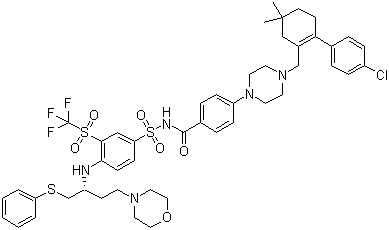 |
| Molecular Formula | C47H55ClF3N5O6S3 |
| Molecular Weight | 974.61 |
| CAS Registry Number | 923564-51-6 |
| SMILES | CC1(CCC(=C(C1)CN2CCN(CC2)C3=CC=C(C=C3)C(=O)NS(=O)(=O)C4=CC(=C(C=C4)N[C@H](CCN5CCOCC5)CSC6=CC=CC=C6)S(=O)(=O)C(F)(F)F)C7=CC=C(C=C7)Cl)C |
| Density | 1.4±0.1 g/cm3 Calc.* |
|---|---|
| Solubility | 10mM in DMSO (Expl.) |
| Index of refraction | 1.655 (Calc.)* |
| * | Calculated using Advanced Chemistry Development (ACD/Labs) Software. |
| Hazard Symbols |  GHS07 Warning Details GHS07 Warning Details |
|---|---|
| Risk Statements | H302-H315-H319-H335 Details |
| Safety Statements | P261-P305+P351+P338 Details |
| SDS | Available |
 chemBlink Chemical Story
|
ABT-263, also known by its generic name navitoclax, is a small-molecule inhibitor that targets members of the B-cell lymphoma 2 (Bcl-2) family of proteins. These proteins are crucial regulators of the apoptotic pathway, which governs programmed cell death. ABT-263 was developed to restore the natural cell death process in cancer cells that evade apoptosis by overexpressing anti-apoptotic Bcl-2 family proteins. The compound was developed by scientists at Abbott Laboratories, now part of AbbVie, as part of an effort to create targeted therapies for hematological malignancies and solid tumors. The discovery of ABT-263 followed earlier work on ABT-737, a potent Bcl-2/Bcl-xL inhibitor that demonstrated strong preclinical activity but lacked oral bioavailability. ABT-263 was designed as an orally bioavailable derivative of ABT-737, retaining its binding affinity for the anti-apoptotic proteins Bcl-2, Bcl-xL, and Bcl-w. These proteins promote cancer cell survival by binding and sequestering pro-apoptotic factors such as Bim, Bad, and Bid, thereby preventing the activation of caspases and cell death. ABT-263 disrupts these interactions, releasing the pro-apoptotic proteins and initiating the intrinsic apoptotic pathway. In preclinical models, ABT-263 demonstrated potent antitumor activity against a range of malignancies, particularly in hematological cancers such as chronic lymphocytic leukemia (CLL), small lymphocytic lymphoma (SLL), and acute lymphoblastic leukemia (ALL). These cancer types often exhibit overexpression of Bcl-2 proteins, making them especially susceptible to Bcl-2 inhibition. The compound was also tested in solid tumors, including small cell lung cancer and certain subtypes of breast cancer, although its efficacy in these contexts has been more limited due to variability in Bcl-2 family protein expression. One of the major limitations encountered in the clinical development of ABT-263 was on-target toxicity, particularly thrombocytopenia. This adverse effect arises because platelets depend heavily on Bcl-xL for survival. Inhibition of Bcl-xL by ABT-263 leads to a rapid and dose-dependent decrease in platelet count, which limits the maximum tolerated dose and complicates long-term therapy. Despite this, the drug demonstrated clear evidence of biological activity in patients, including reduction in tumor burden and increased rates of apoptosis in malignant cells. To address the issue of thrombocytopenia, researchers developed a more selective Bcl-2 inhibitor, ABT-199 (venetoclax), which spares Bcl-xL and thereby reduces the risk of platelet toxicity. Venetoclax has since been approved for the treatment of CLL and acute myeloid leukemia, illustrating the value of the original ABT-263 research in guiding the development of clinically successful agents. ABT-263 continues to be studied in various experimental and clinical contexts. It is used in combination regimens with chemotherapeutics, targeted therapies, and radiation to enhance antitumor efficacy. The rationale behind such combinations lies in the ability of ABT-263 to lower the apoptotic threshold of cancer cells, making them more susceptible to other treatment modalities. Additionally, it has been employed as a tool in research to investigate mechanisms of apoptosis, drug resistance, and the role of Bcl-2 family proteins in tumor biology. The compound has also been evaluated for its senolytic activity, which refers to the selective elimination of senescent cells. In aging research, ABT-263 has been used in animal models to demonstrate that clearance of senescent cells can improve tissue function and delay age-related pathologies. This opens the possibility of non-oncological applications for navitoclax, although such uses remain under investigation and require careful assessment of safety and efficacy. ABT-263 stands as a significant milestone in the development of targeted cancer therapeutics. Its design and mechanism of action illustrate the potential of rational drug development aimed at reactivating fundamental cellular processes such as apoptosis. While challenges remain in its clinical use, particularly due to its hematological toxicity profile, ABT-263 continues to inform the development of next-generation Bcl-2 family inhibitors and holds promise for enhancing the therapeutic arsenal against cancer. References 2012. SS18-SSX2 and the mitochondrial apoptosis pathway in mouse and human synovial sarcomas. Oncogene, 32(22). DOI: 10.1038/onc.2012.247 2020. Aurora A Kinase Inhibition Destabilizes PAX3-FOXO1 and MYCN and Synergizes with Navitoclax to Induce Rhabdomyosarcoma Cell Death. Cancer Research, 80(4). DOI: 10.1158/0008-5472.can-19-1479 2021. Antagonizing the spindle assembly checkpoint silencing enhances paclitaxel and Navitoclax-mediated apoptosis with distinct mechanistic. Scientific Reports, 11(1). DOI: 10.1038/s41598-021-83743-7 |
| Market Analysis Reports |