
Online Database of Chemicals from Around the World
| BOC Sciences | USA | |||
|---|---|---|---|---|
 | www.bocsci.com | |||
 | +1 (631) 485-4226 | |||
 | +1 (631) 614-7828 | |||
 | info@bocsci.com | |||
| Chemical manufacturer | ||||
| chemBlink Standard supplier since 2010 | ||||
| Creative Peptides | USA | |||
|---|---|---|---|---|
| www.creative-peptides.com | |||
| +1 (631) 624-4882 | |||
| +1 (631) 614-7828 | |||
| info@creative-peptides.com | |||
| Chemical manufacturer | ||||
| chemBlink Standard supplier since 2010 | ||||
| Apexbio Technology LLC | USA | |||
|---|---|---|---|---|
| www.apexbt.com | |||
| +1 (832) 696-8203 | |||
| +1 (855) 527-3928 | |||
| info@apexbt.com | |||
| Chemical manufacturer since 2012 | ||||
| chemBlink Standard supplier since 2013 | ||||
| Hangzhou Leap Chem Co., Ltd. | China | |||
|---|---|---|---|---|
| www.leapchem.com | |||
| +86 (571) 8771-1850 | |||
| market19@leapchem.com | |||
 | QQ Chat | |||
| Chemical manufacturer since 2006 | ||||
| chemBlink Standard supplier since 2015 | ||||
| Targetmol China | China | |||
|---|---|---|---|---|
| www.targetmol.cn | |||
| +86 (400) 820-0310 | |||
| sales@targetmol.cn | |||
| Chemical manufacturer since 2015 | ||||
| chemBlink Standard supplier since 2025 | ||||
| Enzo Life Sciences International Inc. | USA | |||
|---|---|---|---|---|
| www.enzolifesciences.com | |||
| +1 (610) 941-0430 | |||
| +1 (610) 941-9252 | |||
| info-usa@enzolifesciences.com | |||
| Chemical manufacturer | ||||
| Peptides International, Inc. | USA | |||
|---|---|---|---|---|
| www.pepnet.com | |||
| +1 (502) 266-8787 (800) 777-4779 | |||
| +1 (502) 267-1329 | |||
| peptides@pepnet.com | |||
| Chemical manufacturer since 1983 | ||||
| Crescent Chemical Co. Inc. | USA | |||
|---|---|---|---|---|
| www.crescentchemical.com | |||
| +1 (631) 348-0333 | |||
| +1 (631) 348-0913 | |||
| crescent@creschem.com | |||
| Chemical distributor | ||||
| Santa Cruz Biotechnology, Inc. | USA | |||
|---|---|---|---|---|
| www.scbt.com | |||
| +1 (831) 457-3800 | |||
| +1 (831) 457-3801 | |||
| scbt@scbt.com | |||
| Chemical manufacturer | ||||
| VDM Biochemicals | USA | |||
|---|---|---|---|---|
| www.vdmbio.com | |||
| +1 (330) 252-8181 | |||
| +1 (330) 252-8171 | |||
| sales@vdmbio.com info@vdmbio.com | |||
| Chemical manufacturer | ||||
| Classification | Biochemical >> Inhibitor >> Proteases |
|---|---|
| Name | CA-074 methyl ester |
| Synonyms | L-trans-Epoxysuccinyl-isoleucyl-proline methyl ester propylamide; L-trans-Epoxysuccinyl-Ile-Pro-OMe propylamide; (L-3-trans-(Propylcarbamyl)oxirane-2-carbonyl)-L-isoleucyl-L-proline methyl ester |
| Molecular Structure | 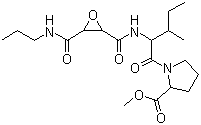 |
| Molecular Formula | C19H31N3O6 |
| Molecular Weight | 397.47 |
| Protein Sequence | IP |
| CAS Registry Number | 147859-80-1 |
| SMILES | CCCNC(=O)[C@@H]1[C@H](O1)C(=O)N[C@@H]([C@@H](C)CC)C(=O)N2CCC[C@H]2C(=O)OC |
| Density | 1.2±0.1 g/cm3 Calc.* |
|---|---|
| Boiling point | 666.3±55.0 °C 760 mmHg (Calc.)* |
| Flash point | 356.8±31.5 °C (Calc.)* |
| Index of refraction | 1.52 (Calc.)* |
| * | Calculated using Advanced Chemistry Development (ACD/Labs) Software. |
| Hazard Symbols |  GHS07 Warning Details GHS07 Warning Details |
|---|---|
| Risk Statements | H302-H315-H319-H335 Details |
| Safety Statements | P261-P305+P351+P338 Details |
| SDS | Available |
 chemBlink Chemical Story
|
CA-074 methyl ester is a potent, membrane-permeable inhibitor of the lysosomal cysteine protease cathepsin B, a member of the papain-like family of proteases involved in various cellular processes including protein degradation, antigen presentation, and cell death. It is the methyl ester derivative of CA-074, designed specifically to improve cellular uptake by enhancing lipophilicity while retaining inhibitory activity against cathepsin B. CA-074 was initially discovered as a highly selective irreversible inhibitor of cathepsin B, with minimal cross-reactivity toward related proteases such as cathepsin L, H, and S. However, its cell-impermeable nature limited its utility in studying intracellular functions. The development of CA-074 methyl ester addressed this limitation, enabling researchers to explore the intracellular roles of cathepsin B in various physiological and pathological contexts, such as neurodegeneration, inflammation, cancer progression, and apoptosis. The methyl ester modification allows the compound to traverse cell membranes more effectively. Once inside the cell, esterases cleave the methyl ester to regenerate the active CA-074 form, which then covalently binds to the active-site cysteine of cathepsin B. This mechanism results in the selective and irreversible inactivation of the enzyme, providing a powerful tool for dissecting the specific contributions of cathepsin B in complex cellular environments. One significant application of CA-074 methyl ester has been in neurobiological research, where it has been used to evaluate the role of cathepsin B in neuronal death following ischemic or traumatic brain injury. Inhibition of cathepsin B with CA-074 methyl ester has been shown to reduce neuronal damage, suggesting a role for this protease in mediating lysosomal membrane permeabilization and subsequent cell death cascades. In cancer biology, cathepsin B is known to be overexpressed in several tumor types and is implicated in extracellular matrix degradation, tumor invasion, and metastasis. The use of CA-074 methyl ester in tumor models has enabled the identification of cathepsin B as a critical contributor to these processes. Inhibition of cathepsin B activity with this compound has been observed to impair tumor cell invasion and reduce metastatic potential, indicating its utility as a research probe for anti-metastatic therapeutic strategies. Additionally, CA-074 methyl ester has been utilized to investigate the involvement of cathepsin B in inflammatory pathways. In macrophages and other immune cells, cathepsin B has been implicated in the activation of pro-inflammatory cytokines and the regulation of inflammasome signaling. Through selective inhibition by CA-074 methyl ester, studies have demonstrated reduced cytokine release and attenuated inflammatory responses in models of sepsis and autoimmune disease. The specificity of CA-074 methyl ester for cathepsin B, along with its ability to penetrate cellular membranes, distinguishes it from broader-spectrum cysteine protease inhibitors. However, care must be taken in experimental interpretation, as under certain conditions and concentrations, the compound may exhibit off-target effects or partial inhibition of related enzymes. Therefore, it is commonly used alongside controls or complementary methods such as genetic knockdown to validate findings. CA-074 methyl ester remains a widely employed chemical probe in the study of lysosomal function and cathepsin B biology. Its use has expanded the understanding of protease involvement in disease mechanisms and has helped identify potential therapeutic targets in neurodegeneration, cancer, and inflammation. References 2000. Rac1-Induced Endocytosis Is Associated with Intracellular Proteolysis during Migration through a Three-Dimensional Matrix. Experimental Cell Research, 260(2). DOI: 10.1006/excr.2000.5031 2016. Protective mechanisms of CA074-me (other than cathepsin-B inhibition) against programmed necrosis induced by global cerebral ischemia/reperfusion injury in rats. Brain Research Bulletin, 120. DOI: 10.1016/j.brainresbull.2015.11.007 2021. A target-agnostic screen identifies approved drugs to stabilize the endoplasmic reticulum-resident proteome. Cell Reports, 35(4). DOI: 10.1016/j.celrep.2021.109040 |
| Market Analysis Reports |