
Online Database of Chemicals from Around the World
| Changzhou Ditong Chemical Co., Ltd. | China | |||
|---|---|---|---|---|
 | www.edengenechem.com | |||
 | +86 (519) 8829-8848 +86 18118010980 | |||
 | info@edengenechem.com sale@edengenechem.com | |||
 | QQ Chat | |||
 | WeChat: 18118010980 | |||
| Chemical manufacturer since 2006 | ||||
| chemBlink Premium supplier since 2026 | ||||
| Classification | Organic raw materials >> Carboxylic compounds and derivatives >> Carboxylic esters and their derivatives |
|---|---|
| Name | 2-Propylheptyl prop-2-enoate |
| Molecular Structure | 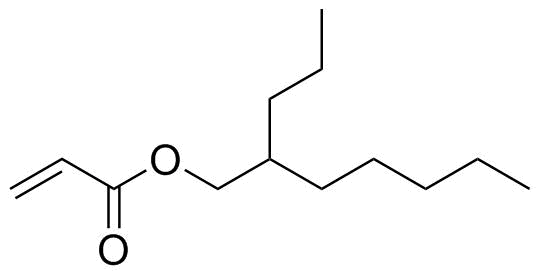 |
| Molecular Formula | C13H24O2 |
| Molecular Weight | 212.33 |
| CAS Registry Number | 149021-58-9 |
| EC Number | 604-669-5 |
| SMILES | CCCCCC(CCC)COC(=O)C=C |
| Density | 0.9±0.1 g/cm3 Calc.* |
|---|---|
| Boiling point | 266.1±9.0 °C 760 mmHg (Calc.)* |
| Flash point | 92.1±12.0 °C (Calc.)* |
| Index of refraction | 1.439 (Calc.)* |
| * | Calculated using Advanced Chemistry Development (ACD/Labs) Software. |
| Hazard Symbols |   GHS07;GHS09 Warning Details GHS07;GHS09 Warning Details | ||||||||||||||||||||||||||||||||
|---|---|---|---|---|---|---|---|---|---|---|---|---|---|---|---|---|---|---|---|---|---|---|---|---|---|---|---|---|---|---|---|---|---|
| Risk Statements | H315-H317-H319-H335-H411 Details | ||||||||||||||||||||||||||||||||
| Safety Statements | P261-P264-P264+P265-P271-P272-P273-P280-P302+P352-P304+P340-P305+P351+P338-P319-P321-P332+P317-P333+P317-P337+P317-P362+P364-P391-P403+P233-P405-P501 Details | ||||||||||||||||||||||||||||||||
| Hazard Classification | |||||||||||||||||||||||||||||||||
| |||||||||||||||||||||||||||||||||
| SDS | Available | ||||||||||||||||||||||||||||||||
 chemBlink Chemical Story
|
2-Propylheptyl prop-2-enoate is an aliphatic ester formed from acrylic acid (prop-2-enoic acid) and 2-propylheptan-1-ol. It belongs to the family of acrylic esters, a class of compounds widely used as monomers and intermediates in the production of polymers, coatings, adhesives, sealants, and pressure-sensitive adhesives. Structurally, the molecule consists of two principal components: an acrylate ester group and a branched C10 alkyl chain derived from 2-propylheptanol. These two portions are connected through an ester linkage (–COO–), which is the defining functional group of the molecule. The acrylic acid portion contains an α,β-unsaturated carbonyl system with the structure CH2=CH–C(=O)–O–. This conjugated arrangement consists of a carbon–carbon double bond directly adjacent to the carbonyl group, allowing π-electron delocalization across the unsaturated ester system. The conjugation increases the electrophilic character of the β-carbon and is responsible for the characteristic reactivity of acrylate esters. The ester carbonyl carbon is sp2-hybridized and adopts a trigonal planar geometry. The carbonyl oxygen serves as a hydrogen bond acceptor, while the alkoxy oxygen of the ester also contributes electron density through resonance with the carbonyl group. Together, these oxygen atoms create the primary polar region of the molecule. The alcohol-derived portion is the 2-propylheptyl group, a branched ten-carbon alkyl substituent. It consists entirely of saturated carbon atoms connected by single bonds, with a propyl branch attached to the second carbon of the main heptyl chain. All carbon atoms in this alkyl fragment are predominantly sp3-hybridized, allowing extensive rotational freedom and considerable conformational flexibility. The long branched alkyl chain contributes pronounced hydrophobic character to the molecule. Compared with linear alkyl esters of similar molecular weight, branching generally reduces molecular packing efficiency and can influence physical properties such as viscosity, melting behavior, and volatility. The most chemically significant feature of 2-propylheptyl prop-2-enoate is the activated carbon–carbon double bond of the acrylate group. Because this double bond is conjugated with the ester carbonyl, it readily undergoes free-radical polymerization. During polymerization, the double bond opens to form carbon–carbon single bonds linking repeating units into long polymer chains, while the ester substituent remains attached as a pendant side group. The ester linkage itself is relatively stable under neutral conditions but can undergo hydrolysis in strongly acidic or strongly basic environments, producing acrylic acid (or its corresponding salt under basic conditions) and 2-propylheptanol. From a physicochemical perspective, the molecule is amphiphilic but predominantly hydrophobic. The ester group provides localized polarity and hydrogen bond acceptor capability, whereas the large branched hydrocarbon chain dominates the overall molecular behavior, resulting in limited water solubility and good compatibility with many organic materials. The conjugated acrylate system also exhibits characteristic ultraviolet absorption arising from π→π* electronic transitions. The resonance between the alkene and carbonyl groups stabilizes the molecule and influences its chemical reactivity toward nucleophiles and free radicals. Chemically, the principal reactive site is the vinyl group of the acrylate moiety. Under appropriate initiation conditions, it undergoes chain-growth polymerization to produce polyacrylate materials. The ester functional group remains largely unchanged during this process and contributes flexibility and hydrophobicity to the resulting polymer. Overall, 2-propylheptyl prop-2-enoate is a branched acrylic ester composed of a conjugated α,β-unsaturated ester linked to a hydrophobic C10 branched alkyl group. Its combination of a polymerizable acrylate double bond and a flexible, lipophilic ester substituent makes it an important monomer for the synthesis of acrylic polymers with tailored physical properties. References 2010. Pyrolysis of poly(2-propylheptyl acrylate). Journal of Thermal Analysis and Calorimetry. DOI: 10.1007/s10973-009-0638-7 |
| Market Analysis Reports |