
Online Database of Chemicals from Around the World
| Hangzhou Wanjing New Material Co., Ltd. | China | |||
|---|---|---|---|---|
 | www.veking.cn | |||
 | +86 (571) 8535-1209 | |||
 | +86 (571) 8790-8550 | |||
 | weking6@163.com | |||
| Chemical manufacturer | ||||
| chemBlink Standard supplier since 2007 | ||||
| Simagchem Corporation | China | |||
|---|---|---|---|---|
| www.simagchem.com | |||
| +86 13806087780 | |||
| +86 (592) 268-0237 | |||
| sale@simagchem.com | |||
| Chemical manufacturer since 2002 | ||||
| chemBlink Standard supplier since 2008 | ||||
| Hefei TNJ Chemical Industry Co., Ltd. | China | |||
|---|---|---|---|---|
| www.tnjchem.com | |||
| +86 (551) 6541-8684 | |||
| +86 (551) 6541-8697 | |||
| sales@tnjchem.com | |||
| Chemical manufacturer since 2001 | ||||
| chemBlink Standard supplier since 2010 | ||||
| Ningbo EST Chemical Co., Ltd. | China | |||
|---|---|---|---|---|
| www.estchemical.com | |||
| +86 18868651166 | |||
| +86 (574) 5670-2932 | |||
| sales@estchemical.com | |||
| Chemical manufacturer | ||||
| chemBlink Standard supplier since 2010 | ||||
| Yixing Liao Yuan Chemical Co., Ltd. | China | |||
|---|---|---|---|---|
| www.liaoyuanchem.com | |||
| +86 (510) 8750-1562 8750-8213 8750-6338 | |||
| +86 (510) 8750-3371 / 8750-3371 | |||
| miranda@liaoyuanchem.com | |||
| Chemical manufacturer | ||||
| chemBlink Standard supplier since 2010 | ||||
| Stan Chemical Co., Ltd. | China | |||
|---|---|---|---|---|
| www.stan-chem.com | |||
| +86 (571) 8805-9671 | |||
| info@stan-chem.com | |||
| Chemical manufacturer since 2008 | ||||
| chemBlink Standard supplier since 2014 | ||||
| Jiangsu Zhongbang Pharmaceutical Co., Ltd. | China | |||
|---|---|---|---|---|
| www.zhbpharm.com | |||
| +86 (25) 8715-1996 +86 18013378039 | |||
| +86 (25) 8715-1970 | |||
| sales@chinaredsun.com | |||
 | QQ Chat | |||
| Chemical manufacturer since 2001 | ||||
| chemBlink Standard supplier since 2014 | ||||
| Wuxi Honor Shine Chemical Co., Ltd. | China | |||
|---|---|---|---|---|
| www.honorshinechem.com | |||
| +86 (510) 8359-3736 | |||
| +86 (510) 8357-4932 | |||
| sales@honorshinechem.com | |||
| Chemical distributor since 2013 | ||||
| chemBlink Standard supplier since 2014 | ||||
| Kylin Chemicals Co., Ltd. | China | |||
|---|---|---|---|---|
| www.kylinchemicals.com | |||
| +86 (519) 6878-1297 +86 15995066920 | |||
| +86 (519) 8158-3863 | |||
| info@kylinchemicals.com | |||
| QQ Chat | |||
| Chemical distributor since 2015 | ||||
| chemBlink Standard supplier since 2015 | ||||
| Zhejiang Regen Chemical Co., Ltd. | China | |||
|---|---|---|---|---|
| www.regenchem.com | |||
| +86 (576) 8851-7095 8851-7096 | |||
| +86 (576) 8851-7175 | |||
| regenkm@163.com | |||
| Chemical manufacturer since 1993 | ||||
| chemBlink Standard supplier since 2017 | ||||
| Bais Chemical Technology Co., Ltd. | China | |||
|---|---|---|---|---|
| www.baischem.com | |||
| +86 (571) 8610-8202 +86 18158502261 | |||
| +86 (571) 8610-8202 | |||
| kinghu@baischem.com | |||
| Chemical manufacturer since 2018 | ||||
| chemBlink Standard supplier since 2019 | ||||
| Leinai (Changxing) New Material Co., Ltd. | China | |||
|---|---|---|---|---|
| www.lunacide.com.cn | |||
| +86 (510) 8179-8880 +86 13771391885 | |||
| +86 (510) 8179-8880 | |||
| nancy@lunacide.com.cn | |||
| QQ Chat | |||
| Chemical manufacturer since 2020 | ||||
| chemBlink Standard supplier since 2022 | ||||
| Wuhan Korobio Chemicals Co., Ltd. | China | |||
|---|---|---|---|---|
| www.korobio.com | |||
| +86 (027) 8652-3081 | |||
| +86 (027) 8652-3081 | |||
| tracy@korobio.com | |||
| QQ Chat | |||
 | Skype Chat | |||
 | WeChat: +8618086649478 | |||
 | WhatsApp:+8618086649478 | |||
| Chemical manufacturer since 2014 | ||||
| chemBlink Standard supplier since 2023 | ||||
| Classification | Pharmaceutical intermediate >> Heterocyclic compound intermediate >> Pyridine compound >> Pyridine derivative |
|---|---|
| Name | Bis(1-hydroxy-1H-pyridine-2-thionato-O,S)copper |
| Synonyms | copper bis(1-oxidopyridine-2-thione) |
| Molecular Structure | 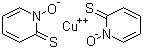 |
| Molecular Formula | 2(C5H4NOS).Cu |
| Molecular Weight | 315.86 |
| CAS Registry Number | 14915-37-8 |
| EC Number | 238-984-0 |
| SMILES | C1=CC(=S)N(C=C1)[O-].C1=CC(=S)N(C=C1)[O-].[Cu+2] |
| Hazard Symbols |     GHS05;GHS06;GHS07;GHS09 Danger Details GHS05;GHS06;GHS07;GHS09 Danger Details | ||||||||||||||||||||||||||||||||||||
|---|---|---|---|---|---|---|---|---|---|---|---|---|---|---|---|---|---|---|---|---|---|---|---|---|---|---|---|---|---|---|---|---|---|---|---|---|---|
| Risk Statements | H302-H315-H318-H330-H400 Details | ||||||||||||||||||||||||||||||||||||
| Safety Statements | P260-P264-P264+P265-P270-P271-P273-P280-P284-P301+P317-P302+P352-P304+P340-P305+P354+P338-P316-P317-P320-P321-P330-P332+P317-P362+P364-P391-P403+P233-P405-P501 Details | ||||||||||||||||||||||||||||||||||||
| Hazard Classification | |||||||||||||||||||||||||||||||||||||
| |||||||||||||||||||||||||||||||||||||
| SDS | Available | ||||||||||||||||||||||||||||||||||||
 chemBlink Chemical Story
|
Bis(1-hydroxy-1H-pyridine-2-thionato-O,S)copper is a copper complex formed from two bidentate 1-hydroxy-1H-pyridine-2-thionate ligands coordinated to a central copper ion through oxygen and sulfur donor atoms. The ligand is derived from 2-mercaptopyridine N-oxide, which can exist in tautomeric equilibrium between thiol and thione forms. Upon deprotonation, it acts as an O,S-chelating ligand, binding metal ions through the oxygen of the N-oxide group and the sulfur atom at the 2-position. The resulting complex is commonly isolated as a stable, colored solid and has been extensively characterized in coordination chemistry. Systematic investigation of pyridine N-oxides and their sulfur analogues developed during the mid-20th century as part of broader research into heterocyclic ligands capable of forming stable chelate complexes. The ability of 1-hydroxy-2-pyridinethione derivatives to coordinate metals through two adjacent donor atoms was demonstrated through analytical and spectroscopic studies. Copper complexes of such ligands attracted particular attention because copper readily forms stable chelates with mixed oxygen and sulfur donors. Structural analysis using techniques such as infrared spectroscopy, electronic absorption spectroscopy, and X-ray crystallography confirmed the bidentate coordination mode and the formation of five-membered chelate rings. The copper center in bis(1-hydroxy-1H-pyridine-2-thionato-O,S)copper is typically in the +2 oxidation state. Coordination by two monoanionic ligands provides a four-coordinate environment, often described as approximately square planar or distorted tetrahedral depending on solid-state packing and specific experimental conditions. Crystallographic studies have established that each ligand binds through the deprotonated oxygen and sulfur atoms, forming two chelate rings around the metal ion. The delocalized electronic structure of the ligand contributes to the stability of the complex. One of the most widely documented applications of copper complexes of 1-hydroxy-2-pyridinethione derivatives is in the field of antifouling and antimicrobial materials. Related metal complexes have been used as biocidal agents in coatings and wood preservation formulations. Their activity has been evaluated in standardized laboratory tests against fungi and bacteria, and their performance has been correlated with controlled release of the active species from treated surfaces. The stability of the chelate complex influences both durability and efficacy in such applications. In addition to practical uses, bis(1-hydroxy-1H-pyridine-2-thionato-O,S)copper has served as a model compound in coordination chemistry. Studies of its electronic spectra have provided insight into ligand-to-metal charge transfer transitions and d–d transitions characteristic of copper(II) complexes. Magnetic susceptibility measurements have confirmed the presence of an unpaired electron consistent with a d9 electronic configuration. These experimental observations align with established ligand field theory for copper(II) complexes in four-coordinate geometries. The ligand framework has also been examined for its ability to stabilize different metal ions beyond copper. Comparative investigations with zinc, iron, and other transition metals have highlighted how donor atom identity and chelate ring formation influence complex stability constants. Such work has contributed to the broader understanding of structure–property relationships in O,S-donor ligand systems. From a synthetic perspective, preparation of bis(1-hydroxy-1H-pyridine-2-thionato-O,S)copper typically involves reaction of a soluble copper(II) salt with the deprotonated ligand in aqueous or alcoholic solution. The complex often precipitates as a colored solid that can be purified by recrystallization. Elemental analysis and spectroscopic characterization confirm stoichiometry and coordination mode. The discovery and characterization of this copper chelate illustrate the development of mixed-donor ligand chemistry and its practical implications. By combining oxygen and sulfur coordination in a rigid heterocyclic framework, the ligand forms stable complexes whose structural and functional properties have been validated through extensive experimental study. References 2001. Bis[1-hydroxypyridine-2(1H)-thionato-S,O]copper(II). Acta Crystallographica Section C: Crystal Structure Communications. DOI: 10.1107/s0108270101012306 |
| Market Analysis Reports |