
Online Database of Chemicals from Around the World
| Simagchem Corporation | China | |||
|---|---|---|---|---|
 | www.simagchem.com | |||
 | +86 13806087780 | |||
 | +86 (592) 268-0237 | |||
 | sale@simagchem.com | |||
| Chemical manufacturer since 2002 | ||||
| chemBlink Standard supplier since 2008 | ||||
| BOC Sciences | USA | |||
|---|---|---|---|---|
| www.bocsci.com | |||
| +1 (631) 485-4226 | |||
| +1 (631) 614-7828 | |||
| info@bocsci.com | |||
| Chemical manufacturer | ||||
| chemBlink Standard supplier since 2010 | ||||
| Alfa Chemistry | USA | |||
|---|---|---|---|---|
| www.alfa-chemistry.com | |||
| +1 (516) 734-6573 | |||
| +1 (516) 927-0118 | |||
| support@alfa-chemistry.com | |||
| Chemical manufacturer since 2005 | ||||
| chemBlink Standard supplier since 2012 | ||||
| Hangzhou Leap Chem Co., Ltd. | China | |||
|---|---|---|---|---|
| www.leapchem.com | |||
| +86 (571) 8771-1850 | |||
| market19@leapchem.com | |||
 | QQ Chat | |||
| Chemical manufacturer since 2006 | ||||
| chemBlink Standard supplier since 2015 | ||||
| Chengdu Youngshe Chemical Co., Ltd. | China | |||
|---|---|---|---|---|
| www.youngshechem.com | |||
| +86 (28) 6232-8193 +86 17380623303 | |||
| +86 (28) 6232-8193 | |||
| caroline@youngshechem.com | |||
| QQ Chat | |||
 | Skype Chat | |||
| Chemical manufacturer since 2013 | ||||
| chemBlink Standard supplier since 2015 | ||||
| Cellmano Biotech Co., Ltd. | China | |||
|---|---|---|---|---|
| www.cellmano.com | |||
| +86 (551) 6532-6643 | |||
| qilin@cellmano.com | |||
| Chemical manufacturer since 2013 | ||||
| chemBlink Standard supplier since 2019 | ||||
| Chinapeptides Co., Ltd. | China | |||
|---|---|---|---|---|
| www.chinapeptides.com | |||
| +86 (027) 6552-1228 | |||
| cps036@chinapeptides.net | |||
| QQ Chat | |||
| Skype Chat | |||
 | WeChat: 15026478984 | |||
 | WhatsApp:+86 15026478984 | |||
| Chemical manufacturer since 2008 | ||||
| chemBlink Standard supplier since 2023 | ||||
| Ningbo Kilo Biotechnology Co., Ltd. | China | |||
|---|---|---|---|---|
| www.kilobio.com | |||
| +8613989352104 | |||
| terry.zhang@kilobio.com | |||
| QQ Chat | |||
| WeChat: Wenzhou Medical University | |||
| Chemical distributor since 2023 | ||||
| chemBlink Standard supplier since 2023 | ||||
| Tocris Bioscience Inc. | USA | |||
|---|---|---|---|---|
| www.tocris.com | |||
| +1 (636) 207-7651 | |||
| +1 (636) 207-7683 | |||
| customerservice.na@bio-techne.com | |||
| Chemical manufacturer since 1982 | ||||
| Alsachim SAS | France | |||
|---|---|---|---|---|
| www.alsachim.com | |||
| +33 (0) 390 402 200 | |||
| +33 (0) 390 402 199 | |||
| contact@alsachim.com | |||
| Chemical manufacturer | ||||
| Classification | Biochemical >> Peptide |
|---|---|
| Name | MOG (35-55) |
| Synonyms | 6-amino-2-[[2-[[4-amino-2-[[2-[[2-[[2-[[2-[[2-[[2-[[2-[[2-[[2-[[1-[2-[[2-[[2-[[2-[[2-[[2-[[2-[(2-amino-4-methylsulfanylbutanoyl)amino]-4-carboxybutanoyl]amino]-3-methylbutanoyl]amino]acetyl]amino]-3-(1H-indol-3-yl)propanoyl]amino]-3-(4-hydroxyphenyl)propanoyl]amino]-5-carbamimidamidopentanoyl]amino]-3-hydroxypropanoyl]pyrrolidine-2-carbonyl]amino]-3-phenylpropanoyl]amino]-3-hydroxypropanoyl]amino]-5-carbamimidamidopentanoyl]amino]-3-methylbutanoyl]amino]-3-methylbutanoyl]amino]-3-(1H-imidazol-4-yl)propanoyl]amino]-4-methylpentanoyl]amino]-3-(4-hydroxyphenyl)propanoyl]amino]-5-carbamimidamidopentanoyl]amino]-4-oxobutanoyl]amino]acetyl]amino]hexanoic acid |
| Molecular Structure | 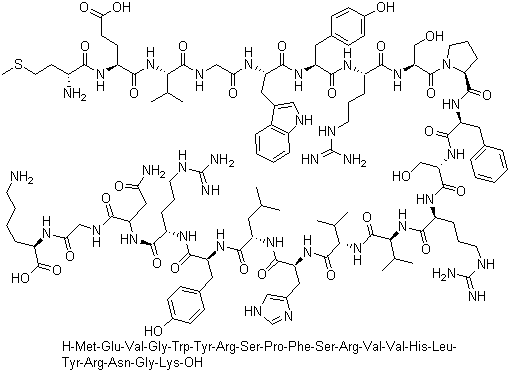 |
| Molecular Formula | C118H177N35O29S |
| Molecular Weight | 2581.95 |
| Protein Sequence | MEVGWYRSPFSRVVHLYRNGK |
| CAS Registry Number | 149635-73-4 |
| SMILES | CC(C)CC(C(=O)NC(CC1=CC=C(C=C1)O)C(=O)NC(CCCNC(=N)N)C(=O)NC(CC(=O)N)C(=O)NCC(=O)NC(CCCCN)C(=O)O)NC(=O)C(CC2=CNC=N2)NC(=O)C(C(C)C)NC(=O)C(C(C)C)NC(=O)C(CCCNC(=N)N)NC(=O)C(CO)NC(=O)C(CC3=CC=CC=C3)NC(=O)C4CCCN4C(=O)C(CO)NC(=O)C(CCCNC(=N)N)NC(=O)C(CC5=CC=C(C=C5)O)NC(=O)C(CC6=CNC7=CC=CC=C76)NC(=O)CNC(=O)C(C(C)C)NC(=O)C(CCC(=O)O)NC(=O)C(CCSC)N |
| Density | 1.5±0.1 g/cm3 Calc.* |
|---|---|
| Solubility | water: Soluble 0.50 mg/mL (Expl.) |
| Index of refraction | 1.678 (Calc.)* |
| * | Calculated using Advanced Chemistry Development (ACD/Labs) Software. |
| Hazard Symbols |  GHS07 Warning Details |
|---|---|
| Risk Statements | H302-H315-H319-H335 Details |
| Safety Statements | P261-P305+P351+P338 Details |
| SDS | Available |
 chemBlink Chemical Story
|
The numbers in MOG (35–55) identify a stretch of a protein, not the molecular mass or a range of concentrations. Counting both ends gives twenty-one residues. The CAS entry here refers to the mouse and rat fragment of myelin oligodendrocyte glycoprotein. It does not denote the entire protein, its attached carbohydrates, or an arbitrary fragment from another species. This distinction matters because immune recognition depends on context. A protein has a three-dimensional surface; a short fragment lacks most of the structural constraints that shape that surface. For T-cell recognition, cells can break proteins into peptides, and some of the resulting fragments can be displayed by major histocompatibility complex molecules. A T-cell receptor recognizes the combination of the presented peptide and its presenting molecule. A sequence occurring in a protein does not establish that the sequence is naturally displayed in every setting. A study of the 35–55 region in mice distinguished determinants that could be recognized after natural processing from cryptic determinants in the same region. A cryptic determinant can become apparent when a fragment is provided for study even if presentation following processing of the intact protein is weak or absent in the tested setting. The result illustrates why a defined fragment can reveal recognition that is hard to see when an investigator looks only at the whole protein. The difference also limits what can be concluded about disease. Researchers use the fragment to examine aspects of myelin-directed immunity in experimental systems. Recognition in those systems does not prove that the same peptide drives a person's disease or that it can serve as a diagnostic test. Species, the presenting molecule, and the distinction between antibodies recognizing an intact protein and T cells recognizing presented fragments all matter. This entry is therefore about a precisely identified research peptide and the questions it permits, rather than a synonym for the whole myelin protein. References: 1. Bachem. Mouse/rat MOG (35–55), product 4028291 and CAS identity. https://shop.bachem.com/product/4028291/ 2. Study of naturally processed and cryptic epitopes in MOG (35–55). https://pubmed.ncbi.nlm.nih.gov/17157925/ |
| Market Analysis Reports |