
Online Database of Chemicals from Around the World
| Hangzhou Verychem Science And Technology Co., Ltd. | China | |||
|---|---|---|---|---|
 | www.verychem.com | |||
 | +86 (571) 8816-2785 +86 13606544505 | |||
 | +86 (571) 8816-2787 | |||
 | lucy@verychem.com | |||
| Chemical manufacturer since 2004 | ||||
| chemBlink Massive supplier since 2021 | ||||
| Amadis Chemical Co., Ltd. | China | |||
|---|---|---|---|---|
| www.amadischem.com | |||
| +86 (571) 8992-5085 | |||
| +86 (571) 8992-5065 | |||
| sales@amadischem.com | |||
| Chemical manufacturer since 2010 | ||||
| chemBlink Standard supplier since 2015 | ||||
| Classification | Organic raw materials >> Carboxylic compounds and derivatives |
|---|---|
| Name | 2-Methyl-L-proline hydrochloride |
| Synonyms | (2S)-2-methylpyrrolidine-2-carboxylic acid;hydrochloride |
| Molecular Structure | 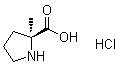 |
| Molecular Formula | C6H11NO2.HCl |
| Molecular Weight | 165.62 |
| Protein Sequence | X |
| CAS Registry Number | 1508261-86-6 |
| EC Number | 820-170-7 |
| SMILES | C[C@]1(CCCN1)C(=O)O.Cl |
| Hazard Symbols |  GHS07 Warning Details GHS07 Warning Details | ||||||||||||||||
|---|---|---|---|---|---|---|---|---|---|---|---|---|---|---|---|---|---|
| Risk Statements | H302-H312-H315-H319-H332-H335 Details | ||||||||||||||||
| Safety Statements | P261-P264-P264+P265-P270-P271-P280-P301+P317-P302+P352-P304+P340-P305+P351+P338-P317-P319-P321-P330-P332+P317-P337+P317-P362+P364-P403+P233-P405-P501 Details | ||||||||||||||||
| Hazard Classification | |||||||||||||||||
| |||||||||||||||||
| SDS | Available | ||||||||||||||||
 chemBlink Chemical Story
|
2-Methyl-L-proline hydrochloride is an amino acid derivative with a structural modification on the L-proline backbone. It was first synthesized in the mid-20th century during studies focused on developing proline analogues for research in peptide chemistry and drug design. The compound’s unique methyl group at the 2-position contributes to its altered conformational properties compared to L-proline, making it valuable in the study of peptide structure and function. Additionally, its salt form as hydrochloride enhances solubility, facilitating its use in biochemical research and pharmaceutical applications. One of the primary applications of 2-methyl-L-proline hydrochloride is in the synthesis of peptides and peptidomimetics, which are compounds designed to mimic the structure and function of peptides. The incorporation of 2-methyl-L-proline into peptide sequences can modify the peptide’s secondary structure due to the steric influence of the methyl group, providing researchers with a tool to investigate peptide folding and stability. This application is especially useful in designing peptides for drug discovery, where structural stability and resistance to enzymatic degradation are critical properties. By substituting L-proline with 2-methyl-L-proline, researchers can better understand how proline’s unique conformational effects influence peptide behavior, opening new possibilities in designing therapeutic peptides. In addition to its use in structural studies, 2-methyl-L-proline hydrochloride has shown potential in the development of bioactive compounds. The modified proline analog can act as a molecular scaffold in drug design, particularly in the development of enzyme inhibitors. Researchers have found that 2-methyl-L-proline derivatives can effectively inhibit certain enzymes by stabilizing conformations that resemble transition states, making the compound valuable in the development of inhibitors for enzymes involved in diseases such as cancer and viral infections. Its structural uniqueness contributes to the binding specificity required for such applications. The compound is also utilized in the study of metabolic pathways involving proline derivatives. By using 2-methyl-L-proline in biochemical assays, researchers can examine enzyme-substrate interactions that are crucial to understanding amino acid metabolism and proline’s role in cellular processes. Such studies are particularly relevant in examining metabolic disorders linked to amino acid metabolism, further underlining the compound’s utility in research. References 2023. Synthesis and clinical application of new drugs approved by FDA in 2022. Molecular Biomedicine, 4, 1. DOI: 10.1186/s43556-023-00138-y |
| Market Analysis Reports |