
Online Database of Chemicals from Around the World
| Shandong Wanda Organosilicon New Materials Co., Ltd. | China | |||
|---|---|---|---|---|
 | www.wandachem.com | |||
 | +86 (21) 5417-7116 +86 13916272156 | |||
 | +86 (21) 54302881 ex 804 | |||
 | sales@wandachem.com | |||
 | QQ Chat | |||
| Chemical manufacturer since 1986 | ||||
| chemBlink Standard supplier since 2008 | ||||
| Wilshire Technologies, Inc. | USA | |||
|---|---|---|---|---|
| www.wilshiretechnologies.com | |||
| +1 (609) 683-1117 | |||
| +1 (732) 274-0049 | |||
| Wilshire-info@evonik.com | |||
| Chemical manufacturer since 1997 | ||||
| chemBlink Standard supplier since 2010 | ||||
| BOC Sciences | USA | |||
|---|---|---|---|---|
| www.bocsci.com | |||
| +1 (631) 485-4226 | |||
| +1 (631) 614-7828 | |||
| info@bocsci.com | |||
| Chemical manufacturer | ||||
| chemBlink Standard supplier since 2010 | ||||
| Nanjing SiSiB Silicones Co., Ltd. | China | |||
|---|---|---|---|---|
| www.sisib.com | |||
| +86 (25) 5859-9930 5859-9931 5859-9932 +86 13913891929 | |||
| +86 (25) 5859-9935 | |||
| sales@sisib.com | |||
| QQ Chat | |||
| Chemical manufacturer since 1989 | ||||
| chemBlink Standard supplier since 2014 | ||||
| Wuhan Carnoss Technology Co., Ltd. | China | |||
|---|---|---|---|---|
| www.carnoss.com | |||
| +86 18064039730 | |||
| +86 (27) 8349-6462 | |||
| frank@carnosschem.com | |||
 | WeChat: kanuosi_wxid | |||
| Chemical manufacturer since 2012 | ||||
| chemBlink Standard supplier since 2018 | ||||
| Achemica | Switzerland | |||
|---|---|---|---|---|
| www.achemica.com | |||
| +41 (24) 466-2929 | |||
| +41 (24) 466-2800 | |||
| contact@achemica.com | |||
| Chemical manufacturer since 2010 | ||||
| Classification | Chemical reagent >> Organic reagent >> Silane |
|---|---|
| Name | Tris(tert-butyldioxy)vinylsilane |
| Synonyms | Vinyltris(tert-butyldioxy)silane |
| Molecular Structure | 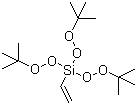 |
| Molecular Formula | C14H30O6Si |
| Molecular Weight | 322.47 |
| CAS Registry Number | 15188-09-7 |
| EC Number | 239-238-7 |
| SMILES | CC(C)(C)OO[Si](C=C)(OOC(C)(C)C)OOC(C)(C)C |
| Density | 1.0±0.1 g/cm3 Calc.* |
|---|---|
| Boiling point | 272.6±23.0 °C 760 mmHg (Calc.)* |
| Flash point | 103.6±23.0 °C (Calc.)* |
| Index of refraction | 1.435 (Calc.)* |
| * | Calculated using Advanced Chemistry Development (ACD/Labs) Software. |
 chemBlink Chemical Story
|
Vinyltris(tert-butylperoxy)silane is unusual because instability is built into the molecule on purpose. Its structure combines a vinyl-substituted silicon center with three tert-butylperoxy groups. The O-O bonds in organic peroxides are much weaker than typical C-C or C-O bonds, so heat can cleave them homolytically to generate radicals. In polymer processing, that controlled radical generation can be useful - but it also creates the safety requirements that define the material. Organic peroxides have long been used as radical initiators and crosslinking agents. When an O-O bond splits, each oxygen retains one electron and forms radical species that can abstract hydrogen atoms, add to carbon-carbon double bonds, or initiate chain reactions. In polyethylene and other polymers, peroxide-derived radicals can create carbon-centered radicals on neighboring chains; recombination then forms new C-C links and converts a melt-processable polymer into a more highly crosslinked network. The silicon and vinyl functionality adds another layer. Vinylsilanes can participate in polymer or surface chemistry, while silicon-containing groups can influence compatibility with inorganic fillers, moisture-curing pathways, or interfacial behavior. Patent literature includes vinyltris(tert-butylperoxy)silane among multifunctional peroxide/silane materials for polymer modification. However, high-quality open academic literature specific to CAS 15188-09-7 is limited, so it is important not to attribute every general silane or peroxide application to this exact compound without supporting evidence. Its chemistry is best understood as 'programmed instability.' Most materials are designed to resist bond cleavage during storage and use. A peroxide is different: the weak bond is intentionally retained until a chosen thermal or processing condition triggers radical formation. The challenge is to separate safe storage from useful activation. Temperature control, contamination avoidance, compatible packaging, and adherence to supplier safety data are therefore intrinsic parts of using organic peroxide materials, not administrative details added after the chemistry. The molecule also illustrates why multifunctional reagents can be attractive in polymer engineering. A single material can potentially introduce radicals for crosslinking while also carrying a silicon-centered group that influences later network or interfacial chemistry. Whether both functions are exploited in a particular formulation depends on polymer type, temperature, coagents, fillers, and process design. Vinyltris(tert-butylperoxy)silane is memorable because it reverses the usual intuition about chemical stability. Here, a relatively weak bond is not a defect; it is the source of function. The same O-O bond that makes organic peroxides hazardous when mishandled is what allows them to become useful radical generators under controlled conditions. References: 1. PubChem. Vinyltris(tert-butylperoxy)silane, CAS 15188-09-7, molecular formula C14H30O6Si. 2. Patent literature including US8021449B2 and related polymer-modification disclosures listing vinyltris(tert-butylperoxy)silane. 3. Moad G., Solomon D.H. The Chemistry of Radical Polymerization. DOI: 10.1016/B978-008044288-4/50001-0. 4. Organic peroxide safety and decomposition guidance from recognized chemical safety and supplier technical literature. |
| Market Analysis Reports |