
Online Database of Chemicals from Around the World
| wuhan chemi Pharmacy Chemical Technology Co., Ltd. | China | |||
|---|---|---|---|---|
 | www.chemipharm.com.cn | |||
 | +86 13971619949 | |||
 | gmn424@chemipharm.com.cn | |||
 | QQ Chat | |||
 | WeChat: 13971619949 | |||
| Chemical manufacturer since 2014 | ||||
| chemBlink Standard supplier since 2026 | ||||
| Classification | Organic raw materials >> Hydrocarbon compounds and their derivatives >> Hydrocarbon halide |
|---|---|
| Name | Pentaerythrityl tetraiodide |
| Synonyms | 1,3-diiodo-2,2-bis(iodomethyl)propane |
| Molecular Structure | 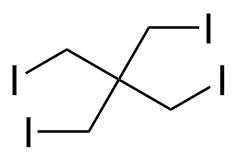 |
| Molecular Formula | C5H8I4 |
| Molecular Weight | 575.73 |
| CAS Registry Number | 1522-88-9 |
| EC Number | 683-649-8 |
| SMILES | C(C(CI)(CI)CI)I |
| Density | 3.1±0.1 g/cm3 Calc.* |
|---|---|
| Melting point | 227 °C (Expl.) |
| Boiling point | 497.4±13.0 °C 760 mmHg (Calc.)* |
| Flash point | 281.8±15.3 °C (Calc.)* |
| Index of refraction | 1.765 (Calc.)* |
| * | Calculated using Advanced Chemistry Development (ACD/Labs) Software. |
| Hazard Symbols |  GHS07 Warning Details GHS07 Warning Details | ||||||||||||||||
|---|---|---|---|---|---|---|---|---|---|---|---|---|---|---|---|---|---|
| Risk Statements | H315-H319-H335 Details | ||||||||||||||||
| Safety Statements | P261-P264-P264+P265-P271-P280-P302+P352-P304+P340-P305+P351+P338-P319-P321-P332+P317-P337+P317-P362+P364-P403+P233-P405-P501 Details | ||||||||||||||||
| Hazard Classification | |||||||||||||||||
| |||||||||||||||||
| SDS | Available | ||||||||||||||||
 chemBlink Chemical Story
|
Pentaerythrityl tetraiodide is an organoiodine compound derived from pentaerythritol, a tetrafunctional polyol containing four primary hydroxyl groups. In this compound, the hydroxyl groups are fully substituted by iodine atoms, producing a highly iodinated aliphatic structure. Compounds of this type belong to the broader class of organic iodine derivatives that have been studied in synthetic organic chemistry for their ability to serve as iodine-transfer reagents and reactive intermediates in halogen substitution reactions. The development of pentaerythrityl tetraiodide is associated with systematic investigations in halogenation chemistry, particularly the transformation of polyhydroxylated organic molecules into corresponding halide derivatives. Pentaerythritol itself has long been an important industrial polyol used as a building block in resins, explosives-related chemistry, and polymeric materials. As synthetic methods for converting alcohol groups into halides became more established in organic chemistry, fully substituted halogenated derivatives such as tetraiodides were prepared and studied to understand their reactivity and potential applications. The preparation of pentaerythrityl tetraiodide is generally based on substitution reactions in which hydroxyl groups are replaced by iodine using iodinating reagents. In such transformations, the alcohol functionality is activated and subsequently displaced to form carbon–iodine bonds. The resulting compound contains four iodomethyl-type substituents attached to a central quaternary carbon atom. The carbon–iodine bond is relatively weak compared with carbon–chlorine or carbon–bromine bonds, which contributes to the chemical reactivity of the compound. In the context of discovery and characterization, organoiodine compounds such as pentaerythrityl tetraiodide were investigated as part of broader efforts to understand the properties of alkyl iodides and polyfunctional halogenated molecules. Analytical techniques including elemental analysis and spectroscopic methods were used to confirm substitution patterns and assess structural features. These studies contributed to the general knowledge of how multiple halogen substituents influence the stability and reactivity of saturated carbon frameworks. One of the primary documented areas of application for pentaerythrityl tetraiodide is in synthetic organic chemistry as an iodinating agent or iodine-containing intermediate. Organic iodides are widely recognized as useful precursors in substitution reactions because the iodide leaving group facilitates nucleophilic displacement. In this context, polyiodinated compounds can serve as multifunctional intermediates capable of undergoing further transformation to introduce a variety of functional groups. The compound has also been studied in relation to iodine transfer chemistry. Organoiodine reagents can act as sources of electrophilic or nucleophilic iodine depending on reaction conditions. This property has made iodine-containing compounds valuable in the synthesis of more complex organic molecules, including those requiring selective carbon–iodine bond formation. Pentaerythrityl tetraiodide, with its multiple iodine substituents, represents an extreme case of a highly iodinated organic framework that can participate in such transformations. Another area of relevance is the general chemistry of polyhalogenated organic compounds. The presence of multiple iodine atoms significantly influences the physical and chemical properties of the molecule, including density, polarizability, and bond reactivity. Studies of such compounds have contributed to a better understanding of carbon–halogen bond behavior, particularly in systems where multiple halogen substituents are present on a single carbon framework. In addition to its role as a synthetic intermediate, pentaerythrityl tetraiodide has been considered within research on highly halogenated organic materials. Organoiodine compounds are of interest because of their high atomic weight and distinctive reactivity patterns. While many applications of halogenated compounds involve chlorinated or brominated systems, iodinated analogs provide complementary reactivity that is useful in specialized synthetic transformations. The significance of pentaerythrityl tetraiodide therefore lies primarily in its role as a polyiodinated derivative of a well-known polyol and as a representative compound in organoiodine chemistry. Its preparation and study have contributed to the broader understanding of halogen substitution reactions, carbon–iodine bond properties, and the behavior of highly substituted aliphatic iodides. Through its use in synthetic methodology and chemical reactivity studies, the compound occupies a niche position within the field of halogenated organic chemistry. |
| Market Analysis Reports |