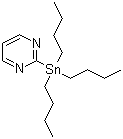
2-(Tributylstannanyl)pyrimidine is an organotin compound where a tributylstannyl group is attached to the 2-position of a pyrimidine ring. Its molecular formula is C13H24N2Sn. This compound belongs to a class of stannylated heterocycles that are highly useful as intermediates in organic synthesis, especially in transition metal-catalyzed cross-coupling reactions.
The development of 2-(tributylstannanyl)pyrimidine is closely linked to the emergence of organotin chemistry in the 20th century. Early research into organotin compounds demonstrated their utility as stable, versatile reagents capable of participating in various bond-forming processes. The synthesis of 2-(tributylstannanyl)pyrimidine generally involves the lithiation of pyrimidine at the 2-position using a strong base such as butyllithium, followed by reaction with tributyltin chloride. This methodology allows for high regioselectivity, installing the stannyl group precisely at the desired location on the aromatic heterocycle.
One of the primary applications of 2-(tributylstannanyl)pyrimidine is its role in Stille coupling reactions. In the Stille reaction, organostannanes like this compound react with organic halides in the presence of a palladium catalyst to form new carbon-carbon bonds. Because the pyrimidine ring is an important structural motif in many biologically active compounds, the ability to modify it selectively via Stille coupling using 2-(tributylstannanyl)pyrimidine is of significant value in pharmaceutical research and development. This compound enables the introduction of a variety of substituents at the 2-position of the pyrimidine ring, which can dramatically influence biological activity.
In medicinal chemistry, derivatives of pyrimidine are found in numerous therapeutic agents, including antiviral, anticancer, and anti-inflammatory drugs. The use of 2-(tributylstannanyl)pyrimidine as a synthetic intermediate facilitates the generation of libraries of pyrimidine analogs for biological screening. Moreover, the compound’s compatibility with various functional groups allows for its incorporation into complex molecular architectures without the need for extensive protection and deprotection steps, streamlining synthetic routes.
Beyond pharmaceuticals, 2-(tributylstannanyl)pyrimidine has applications in materials science. Pyrimidine-containing polymers and small molecules have been explored for use in organic electronics, such as organic light-emitting diodes (OLEDs) and organic solar cells. In these applications, the electronic properties of the pyrimidine unit can be finely tuned by introducing different substituents via cross-coupling reactions involving 2-(tributylstannanyl)pyrimidine.
Handling and storage of 2-(tributylstannanyl)pyrimidine require care due to the general toxicity associated with organotin compounds. Organotin reagents can pose risks to human health and the environment, necessitating the use of appropriate protective equipment and waste management practices. In laboratory settings, reactions involving 2-(tributylstannanyl)pyrimidine are typically conducted under an inert atmosphere such as nitrogen or argon to prevent oxidation and degradation.
The chemical stability of 2-(tributylstannanyl)pyrimidine under inert conditions and its reactivity under catalytic activation make it a particularly attractive building block in modern organic synthesis. Its discovery and utilization represent an important advancement in the toolkit available to synthetic chemists for the construction of complex, functionalized molecules.
|






 GHS06;GHS07;GHS08;GHS09 Danger Details
 chemBlink Chemical Story