
Online Database of Chemicals from Around the World
| Chizhou Dongsheng Pharmaceutical Co., Ltd. | China | |||
|---|---|---|---|---|
 | www.dspharmchem.com | |||
 | +86 (576) 8429-2571 | |||
 | +86 (576) 8429-2560 | |||
 | ksz@dspharmchem.com | |||
| Chemical manufacturer since 1995 | ||||
| chemBlink Premium supplier since 2011 | ||||
| Classification | Biochemical >> Inhibitor >> Neuronal signaling >> Histamine receptor inhibitor |
|---|---|
| Name | Fexofenadine hydrochloride |
| Synonyms | 2-[4-[1-Hydroxy-4-[4-(hydroxy-diphenyl-methyl)-1-piperidyl]-butyl]phenyl]-2-methyl-propanoic acid hydrochloride; Allegra |
| Molecular Structure | 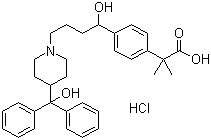 |
| Molecular Formula | C32H39NO4.HCl |
| Molecular Weight | 538.13 |
| CAS Registry Number | 153439-40-8 (138452-21-8) |
| EC Number | 604-906-2 |
| SMILES | CC(C)(C1=CC=C(C=C1)C(CCCN2CCC(CC2)C(C3=CC=CC=C3)(C4=CC=CC=C4)O)O)C(=O)O.Cl |
| Solubility | 50 mM (DMSO) |
|---|---|
| Hazard Symbols |   GHS07;GHS08 Danger Details GHS07;GHS08 Danger Details | ||||||||||||||||||||||||
|---|---|---|---|---|---|---|---|---|---|---|---|---|---|---|---|---|---|---|---|---|---|---|---|---|---|
| Risk Statements | H302-H312-H315-H317-H319-H335-H360-H361d Details | ||||||||||||||||||||||||
| Safety Statements | P203-P261-P264-P264+P265-P270-P271-P272-P280-P301+P317-P302+P352-P304+P340-P305+P351+P338-P317-P318-P319-P321-P330-P332+P317-P333+P317-P337+P317-P362+P364-P403+P233-P405-P501 Details | ||||||||||||||||||||||||
| Hazard Classification | |||||||||||||||||||||||||
| |||||||||||||||||||||||||
| SDS | Available | ||||||||||||||||||||||||
 chemBlink Chemical Story
|
Fexofenadine hydrochloride is a second-generation antihistamine commonly used to alleviate symptoms associated with allergic rhinitis, such as sneezing, runny nose, and itchy eyes. It also treats chronic idiopathic urticaria, a skin condition characterized by hives and itching. Fexofenadine hydrochloride is a derivative of terfenadine, an older antihistamine, but with significant improvements in safety and effectiveness. It was discovered as part of an effort to create antihistamines that do not cause sedation, a common side effect in first-generation compounds. Fexofenadine was developed by modifying the structure of terfenadine, primarily to eliminate the risk of cardiac arrhythmias, which was a serious side effect associated with terfenadine. Researchers identified that fexofenadine, a carboxylated form of the parent compound, retained the desired antihistamine effects without being metabolized into potentially harmful byproducts. This led to its approval by regulatory agencies and its commercialization as a safer alternative. The mechanism of action of fexofenadine hydrochloride involves blocking the H1 receptors for histamine in the body. Histamine is released during allergic reactions, causing inflammation and symptoms such as itching and swelling. By selectively inhibiting H1 receptors, fexofenadine prevents histamine from binding to these receptors, thereby reducing allergic symptoms. One of the key advantages of fexofenadine is its minimal penetration into the central nervous system, which reduces the risk of drowsiness, a frequent side effect seen in older antihistamines. Fexofenadine hydrochloride is widely used in both prescription and over-the-counter formulations for allergy management. Its efficacy in treating allergic rhinitis and chronic urticaria makes it one of the most commonly recommended non-sedating antihistamines. Fexofenadine’s rapid onset of action, usually within one hour of oral administration, and its relatively long half-life allow for once or twice daily dosing, enhancing patient compliance. The compound is also well-tolerated across different populations, including children and the elderly. Fexofenadine has minimal drug interactions and can be co-administered with various medications without significant risk of adverse effects. It is excreted primarily unchanged in the feces and urine, minimizing the strain on the liver, which makes it suitable for individuals with hepatic impairments. Ongoing research is investigating additional applications of fexofenadine hydrochloride, particularly in managing other allergic and inflammatory conditions. Some studies have suggested its potential in addressing symptoms related to asthma, although more research is needed. Additionally, the non-sedative nature of fexofenadine makes it a candidate for combination therapies where sedative side effects must be avoided. Fexofenadine hydrochloride remains a cornerstone in allergy treatment due to its balance of efficacy, safety, and convenience. It has become an essential tool for managing allergic conditions in a wide array of patient populations. References 2024. Eco-friendly extraction of anthocyanins compounds from red radicchio by-products with natural deep eutectic solvents. European Food Research and Technology, 250. DOI: 10.1007/s00217-024-04622-9 1998. Fexofenadine's effects, alone and with alcohol, on actual driving and psychomotor performance☆☆☆★★★. The Journal of allergy and clinical immunology, 101. DOI: 10.1016/s0091-6749(98)70240-4 2003. Fexofenadine is efficacious and safe in children (aged 6-11 years) with seasonal allergic rhinitis. The Journal of allergy and clinical immunology, 111. DOI: 10.1067/mai.2003.1384 |
| Market Analysis Reports |