
Online Database of Chemicals from Around the World
| Wuhan Kemi-works Chemical Co., Ltd. | China | |||
|---|---|---|---|---|
 | www.kemiworks.net | |||
 | +86 (27) 8573-6489 | |||
 | +86 (27) 8573-6485 | |||
 | info@kemiworks.net sales@kemiworks.com | |||
| Chemical manufacturer | ||||
| chemBlink Premium supplier since 2011 | ||||
| Classification | Chemical reagent >> Organic reagent >> Fatty acid |
|---|---|
| Name | 1,2,4,5-Cyclohexanetetracarboxylic acid |
| Synonyms | cyclohexane-1,2,4,5-tetracarboxylic acid |
| Molecular Structure | 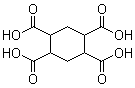 |
| Molecular Formula | C10H12O8 |
| Molecular Weight | 260.20 |
| CAS Registry Number | 15383-49-0 |
| EC Number | 625-764-8 |
| SMILES | C1C(C(CC(C1C(=O)O)C(=O)O)C(=O)O)C(=O)O |
| Density | 1.7±0.1 g/cm3, Calc.* |
|---|---|
| Melting Point | 271 °C (Expl.) |
| Index of Refraction | 1.585, Calc.* |
| Boiling Point | 549.1±50.0 °C (760 mmHg), Calc.* |
| Flash Point | 300.0±26.6 °C, Calc.* |
| * | Calculated using Advanced Chemistry Development (ACD/Labs) Software. |
| Hazard Symbols |   GHS05;GHS07 Danger Details GHS05;GHS07 Danger Details | ||||||||||||||||||||
|---|---|---|---|---|---|---|---|---|---|---|---|---|---|---|---|---|---|---|---|---|---|
| Risk Statements | H315-H318-H335 Details | ||||||||||||||||||||
| Safety Statements | P261-P264-P264+P265-P271-P273-P280-P302+P352-P304+P340-P305+P354+P338-P317-P319-P321-P332+P317-P362+P364-P391-P403+P233-P405-P501 Details | ||||||||||||||||||||
| Hazard Classification | |||||||||||||||||||||
| |||||||||||||||||||||
| SDS | Available | ||||||||||||||||||||
 chemBlink Chemical Story
|
1,2,4,5-Cyclohexanetetracarboxylic acid is an organic compound with the chemical formula C8H8O8. This compound belongs to the class of cyclic polycarboxylic acids and is characterized by its four carboxyl groups (COOH) attached to a cyclohexane ring. The structure of 1,2,4,5-cyclohexanetetracarboxylic acid is notable for the spatial arrangement of its carboxyl groups, which can influence its chemical reactivity and potential applications. The discovery of 1,2,4,5-cyclohexanetetracarboxylic acid can be traced back to research on polyfunctional organic acids and their interactions with various substrates. The compound was first synthesized as part of efforts to develop new types of polycarboxylic acids that could serve as intermediates in the synthesis of complex organic molecules. Early studies focused on the synthesis of various cyclohexane derivatives and their potential to form stable complexes with metal ions, as well as their use in organic synthesis. The synthesis of 1,2,4,5-cyclohexanetetracarboxylic acid typically involves the oxidation of a suitable precursor, often using strong oxidizing agents. The reaction proceeds through the introduction of carboxyl groups at specific positions on the cyclohexane ring, resulting in the formation of the tetracarboxylic acid. The synthesis can be carried out under controlled conditions to achieve high yields and purity of the compound. The structural properties of the compound make it suitable for a range of applications, including coordination chemistry and materials science. One of the key applications of 1,2,4,5-cyclohexanetetracarboxylic acid is in the field of metal-organic frameworks (MOFs) and coordination compounds. The multiple carboxyl groups in its structure allow it to bind with metal ions, forming stable complexes that can be used in a variety of chemical processes. These complexes can serve as catalysts in organic reactions or as materials for gas storage and separation. The ability of 1,2,4,5-cyclohexanetetracarboxylic acid to form chelate complexes with metals such as copper, zinc, and iron has led to its exploration in areas such as catalysis, environmental remediation, and energy storage. In addition to its role in coordination chemistry, 1,2,4,5-cyclohexanetetracarboxylic acid has also been studied for its potential use in the synthesis of functionalized polymers. The presence of multiple carboxyl groups in the molecule makes it a valuable building block for the preparation of polyfunctional materials with a wide range of properties. These materials can be used in applications such as coatings, adhesives, and composites, where the ability to control the chemical structure and reactivity of the polymer is important. The compound's unique structure also allows it to participate in polymerization reactions, leading to the formation of cross-linked networks with enhanced mechanical and thermal properties. Another important application of 1,2,4,5-cyclohexanetetracarboxylic acid is in the development of molecular sensors and devices. The compound's ability to interact with metal ions and other species makes it useful in the design of sensors that can detect changes in the chemical environment. These sensors can be employed in environmental monitoring, where the detection of pollutants or toxic substances is crucial. The compound's structural flexibility and its ability to form stable complexes with a variety of ions also make it a potential candidate for use in the design of molecular electronic devices. Despite its versatility, the use of 1,2,4,5-cyclohexanetetracarboxylic acid is not without challenges. The synthesis of the compound can be complex, and its reactivity must be carefully controlled to ensure the desired outcomes in chemical reactions. Additionally, the stability of the metal complexes formed with the compound can be affected by factors such as temperature, pH, and the presence of other ligands. As research continues, efforts are being made to optimize the synthesis of 1,2,4,5-cyclohexanetetracarboxylic acid and to explore new applications in materials science, catalysis, and environmental chemistry. In conclusion, 1,2,4,5-cyclohexanetetracarboxylic acid is a compound with a wide range of potential applications due to its unique structure and ability to form stable complexes with metal ions. Its uses in coordination chemistry, polymer synthesis, and molecular sensing are just a few examples of the versatility of this compound. As research in these areas continues to progress, 1,2,4,5-cyclohexanetetracarboxylic acid may play an increasingly important role in the development of new materials and technologies. References 2024. Preparation of Super Slippery Surface of Polyimide Composite Microspheres. Polymer Science, Series B, 66. DOI: 10.1134/s1560090424601146 2023. Chemically imidized semi-alicyclic polyimides: the effect of catalyst type and imidization temperature. Journal of Materials Science, 58. DOI: 10.1007/s10853-023-08936-z 2009. Conformation Preference of a Flexible Cyclohexanetetracarboxylate Ligand in Three New Metal-Organic Frameworks: Structures, Magnetic and Luminescent Properties. Inorganic Chemistry, 48. DOI: 10.1021/ic900390y |
| Market Analysis Reports |