
Online Database of Chemicals from Around the World
| Beijing Eagle Sky Pharmatech Co., Ltd. | China | |||
|---|---|---|---|---|
 | www.eagleskypharmatech.com | |||
 | +86 (10) 5979-9429 8875-5821 | |||
 | +86 (10) 5804-3698 | |||
 | sophia_818@126.com contact@eagleskypharmatech.com | |||
 | QQ Chat | |||
| Chemical manufacturer since 2009 | ||||
| chemBlink Premium supplier since 2010 | ||||
| Classification | Organic raw materials >> Amino compound >> Amide compound |
|---|---|
| Name | N-(2-Aminoethyl)-4-morpholinecarboxamide ethanedioate |
| Molecular Structure | 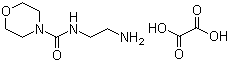 |
| Molecular Formula | C7H15N3O2.C2H2O4 |
| Molecular Weight | 263.25 |
| CAS Registry Number | 154467-16-0 |
| EC Number | 689-774-4 |
| SMILES | C1COCCN1C(=O)NCCN.C(=O)(C(=O)O)O |
| Hazard Symbols |  GHS07 Warning Details GHS07 Warning Details |
|---|---|
| Risk Statements | H302-H315-H319-H335 Details |
| Safety Statements | P261-P305+P351+P338 Details |
| SDS | Available |
 chemBlink Chemical Story
|
N-(2-Aminoethyl)-4-morpholinecarboxamide ethanedioate is a chemical compound of interest in the fields of medicinal chemistry and pharmaceutical research. This compound contains a morpholine ring, an amide group, and an aminoethyl side chain, all of which contribute to its unique chemical properties. These structural features make it a valuable candidate for various biological applications, particularly in drug design and synthesis. The compound was discovered through a series of synthetic efforts aimed at creating molecules with specific pharmacological activities. The morpholine ring, a versatile structure in medicinal chemistry, is often used to enhance the solubility and bioavailability of drugs. The aminoethyl group can participate in hydrogen bonding and electrostatic interactions, which may help the compound bind to biological targets. The ethanedioate (oxalate) salt form is commonly used to enhance the stability and solubility of the compound, facilitating its handling and potential therapeutic uses. N-(2-Aminoethyl)-4-morpholinecarboxamide ethanedioate has been explored for its potential role in the treatment of various diseases, particularly those involving the central nervous system (CNS). The morpholine-based structure is often associated with compounds that exhibit neuroactive properties, such as inhibition of enzymes involved in neurotransmitter metabolism or modulation of receptors in the brain. These properties suggest that the compound could have potential applications in treating conditions like Alzheimer's disease, Parkinson's disease, or other neurological disorders. In addition to CNS disorders, the compound's structural characteristics make it a promising candidate in the development of anticancer therapies. The ability of the amide group to form stable interactions with cellular targets, combined with the solubility-enhancing features of the ethanedioate salt, allows for optimized drug delivery to tumors. This dual focus on neuroactivity and anticancer potential opens up a wide range of applications for N-(2-aminoethyl)-4-morpholinecarboxamide ethanedioate in both academic and pharmaceutical research. Future research is required to fully elucidate the mechanism of action of this compound and its pharmacokinetic properties, including absorption, distribution, metabolism, and excretion (ADME) profiles. However, initial findings suggest that this compound could form the basis for the development of novel therapeutic agents targeting neurological and oncological diseases. |
| Market Analysis Reports |