
Online Database of Chemicals from Around the World
| Shanghai RC Chemicals Co., Ltd. | China | |||
|---|---|---|---|---|
 | www.rcc.net.cn | |||
 | +86 (21) 5032-2175 5866-1250 ex 603 | |||
 | +86 (21) 5032-2176 / 5866-1251 | |||
 | sales@rcc.net.cn chad@rcc.net.cn | |||
| Chemical manufacturer since 2006 | ||||
| chemBlink Standard supplier since 2007 | ||||
| SLN Pharmachem | India | |||
|---|---|---|---|---|
| www.slnpharmachem.com | |||
| +91 (22) 2870-1926 6524-0421 2854-9125 | |||
| +91 (22) 2854-9125 | |||
| ho@slnpharmachem.com office@slnpharmachem.co.in | |||
| Chemical manufacturer since 1997 | ||||
| chemBlink Standard supplier since 2008 | ||||
| Simagchem Corporation | China | |||
|---|---|---|---|---|
| www.simagchem.com | |||
| +86 13806087780 | |||
| +86 (592) 268-0237 | |||
| sale@simagchem.com | |||
| Chemical manufacturer since 2002 | ||||
| chemBlink Standard supplier since 2008 | ||||
| Zhejiang Qiming Pharmaceutical Co., Ltd. | China | |||
|---|---|---|---|---|
| www.qimingpharm.com | |||
| +86 (571) 8716-3895 8716-3893 | |||
| +86 (571) 8716-3816 | |||
| sales@qimingpharm.com | |||
 | QQ Chat | |||
| Chemical manufacturer | ||||
| chemBlink Standard supplier since 2009 | ||||
| Nivon Specialties | India | |||
|---|---|---|---|---|
| www.navoneindia.com | |||
| +91 9323789882 | |||
| nivonpharma@yahoo.com | |||
| Chemical manufacturer since 1999 | ||||
| chemBlink Standard supplier since 2025 | ||||
| Toronto Research Chemicals Inc. | Canada | |||
|---|---|---|---|---|
| www.trc-canada.com | |||
| +1 (416) 665-9696 | |||
| +1 (416) 665-4439 | |||
| info@trc-canada.com | |||
| Chemical manufacturer since 1982 | ||||
| Classification | Organic raw materials >> Carboxylic compounds and derivatives >> Carboxylic esters and their derivatives |
|---|---|
| Name | Methyl 2-(4-(4-chlorobutanoyl)phenyl)-2-methylpropanoate |
| Synonyms | 2-[4-(4-Chlorobutyryl)phenyl]-2-methylpropionic acid methyl ester |
| Molecular Structure | 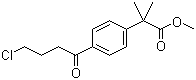 |
| Molecular Formula | C15H19ClO3 |
| Molecular Weight | 282.76 |
| CAS Registry Number | 154477-54-0 |
| SMILES | CC(C)(C1=CC=C(C=C1)C(=O)CCCCl)C(=O)OC |
| Density | 1.1±0.1 g/cm3 Calc.* |
|---|---|
| Boiling point | 396.5±32.0 °C 760 mmHg (Calc.)* |
| Flash point | 149.6±24.1 °C (Calc.)* |
| Index of refraction | 1.508 (Calc.)* |
| * | Calculated using Advanced Chemistry Development (ACD/Labs) Software. |
| Hazard Symbols |  GHS07 Warning Details GHS07 Warning Details |
|---|---|
| Risk Statements | H302-H315-H319-H335 Details |
| Safety Statements | P261-P305+P351+P338 Details |
| SDS | Available |
 chemBlink Chemical Story
|
Methyl 2-(4-(4-chlorobutanoyl)phenyl)-2-methylpropanoate is a synthetic organic compound characterized by a substituted aromatic ring bearing a 4-chlorobutanoyl side chain and a tert-butyl ester group. Its molecular formula is C14H19ClO3, and it belongs to a class of compounds used primarily as intermediates in the synthesis of pharmaceutical and agrochemical products. The structure consists of a para-substituted benzene ring attached to a 4-chlorobutanoyl group (–CO–(CH2)3Cl) and a 2-methylpropanoate ester moiety, where the ester is methylated. This compound has not been identified as a naturally occurring substance; it is prepared via conventional methods of esterification and Friedel–Crafts acylation reactions. In typical synthetic procedures, the acylation of a para-substituted aromatic ring with a 4-chlorobutanoyl chloride is followed by coupling with 2-methylpropanoic acid derivatives under controlled conditions. The methyl ester is often introduced at the final step to enhance the compound’s solubility and stability for subsequent transformations. The presence of the chlorobutanoyl group makes this compound reactive toward nucleophilic substitution, allowing for the introduction of various functional groups in downstream synthesis. This reactivity is useful for developing structural analogs in medicinal chemistry, especially in the synthesis of non-steroidal anti-inflammatory drugs (NSAIDs), receptor ligands, or small-molecule inhibitors targeting enzyme systems or signaling pathways. While specific therapeutic applications of methyl 2-(4-(4-chlorobutanoyl)phenyl)-2-methylpropanoate are not reported in public pharmacological databases, similar structural motifs have been used in the development of drug candidates affecting inflammatory responses and neurological activity. The combination of lipophilic (aryl) and electrophilic (chlorobutanoyl) regions in the molecule suggests potential activity in modulating biological membranes or enzyme binding pockets, depending on further structural modifications. As an intermediate, this compound may also find use in agricultural chemistry for the synthesis of bioactive compounds such as herbicides, fungicides, or insecticides. Functionalized aromatic ketones and esters are common frameworks in crop protection chemicals, where bioactivity is fine-tuned through substitution patterns and chain lengths. Toxicological and environmental data specific to this compound are limited, as it is typically handled within controlled laboratory or industrial environments. Based on its structure, precautions are advised due to the presence of the chlorinated aliphatic side chain, which can be reactive or irritating upon contact. General good practices such as use of gloves, fume hoods, and containment procedures are recommended during synthesis and handling. In summary, methyl 2-(4-(4-chlorobutanoyl)phenyl)-2-methylpropanoate is a synthetic ester used as a chemical intermediate in the development of bioactive molecules. Its functional groups provide reactivity suitable for pharmaceutical and agrochemical synthesis, although it is not known to have direct biological or therapeutic application without further modification. |
| Market Analysis Reports |