
Online Database of Chemicals from Around the World
| Beijing Hope International Pharmaceutical Technology Development Co., Ltd. | China | |||
|---|---|---|---|---|
 | www.hopelife.cn | |||
 | +86 (10) 6788-6402 | |||
 | +86 (10) 6788-7110 ex 8016 | |||
 | market@hopelife.cn andychina0528@hotmail.com | |||
| Chemical manufacturer | ||||
| chemBlink Standard supplier since 2007 | ||||
| Xiamen Kaijia Imp & Exp Co., Ltd. | China | |||
|---|---|---|---|---|
| www.kaijiachem.com | |||
| +86 (592) 510-1177 | |||
| +86 (592) 565-3685 | |||
| jojo@kaijiachem.com kaijiachem@163.com | |||
| Chemical distributor since 2006 | ||||
| chemBlink Standard supplier since 2008 | ||||
| Chengdu D-innovation Pharmaceutical Co., Ltd. | China | |||
|---|---|---|---|---|
| www.d-innovation.com | |||
| +86 (28) 8518-5760 (28) 8518-5486 | |||
| +86 (28) 8515-6444 | |||
| lillian@d-innovation.com sales@d-innovation.com | |||
 | Skype Chat | |||
| Chemical manufacturer | ||||
| chemBlink Standard supplier since 2009 | ||||
| Hefei TNJ Chemical Industry Co., Ltd. | China | |||
|---|---|---|---|---|
| www.tnjchem.com | |||
| +86 (551) 6541-8684 | |||
| +86 (551) 6541-8697 | |||
| sales@tnjchem.com | |||
| Chemical manufacturer since 2001 | ||||
| chemBlink Standard supplier since 2010 | ||||
| Hangzhou Leap Chem Co., Ltd. | China | |||
|---|---|---|---|---|
| www.leapchem.com | |||
| +86 (571) 8771-1850 | |||
| market19@leapchem.com | |||
 | QQ Chat | |||
| Chemical manufacturer since 2006 | ||||
| chemBlink Standard supplier since 2015 | ||||
| Amadis Chemical Co., Ltd. | China | |||
|---|---|---|---|---|
| www.amadischem.com | |||
| +86 (571) 8992-5085 | |||
| +86 (571) 8992-5065 | |||
| sales@amadischem.com | |||
| Chemical manufacturer since 2010 | ||||
| chemBlink Standard supplier since 2015 | ||||
| Cangzhou Enke Pharma-tech Co., Ltd. | China | |||
|---|---|---|---|---|
| www.enkepharma.com | |||
| +86 (317) 529-6180 510-6597 +86 15533709196 | |||
| +86 (317) 510-6596 | |||
| sale@enkepharma.com enkepharma@126.com | |||
| QQ Chat | |||
| Skype Chat | |||
 | WeChat: ymzhao | |||
| Chemical manufacturer since 2011 | ||||
| chemBlink Standard supplier since 2016 | ||||
| Shanghai Yingrui Biopharm Co., Ltd. | China | |||
|---|---|---|---|---|
| www.shyrchem.com | |||
| +86 (21) 3358-5366 3466-6753 +86 13311639313 | |||
| +86 (21) 3497-9012 | |||
| sales02@shyrchem.com | |||
| QQ Chat | |||
| Skype Chat | |||
| Chemical manufacturer since 2009 | ||||
| chemBlink Standard supplier since 2017 | ||||
| Changzhou Jiuwu Chemical Co., Ltd. | China | |||
|---|---|---|---|---|
| www.jiuwuchem.com | |||
| +86 (519) 8512-1086 +86 13775162768 | |||
| +86 (519) 8512-5369 | |||
| info@jiuwuchem.cn | |||
| QQ Chat | |||
| Chemical manufacturer since 2009 | ||||
| chemBlink Standard supplier since 2023 | ||||
| Classification | Organic raw materials >> Organic phosphine compound |
|---|---|
| Name | Minodronic acid |
| Synonyms | P,P'-(1-Hydroxy-2-imidazo[1,2-a]pyridin-3-ylethylidene)bisphosphonic acid hydrate |
| Molecular Structure | 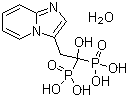 |
| Molecular Formula | C9H12N2O7P2.H2O |
| Molecular Weight | 340.17 |
| CAS Registry Number | 155648-60-5 |
| EC Number | 696-656-6 |
| SMILES | C1=CC2=NC=C(N2C=C1)CC(O)(P(=O)(O)O)P(=O)(O)O.O |
| Hazard Symbols |   GHS06;GHS08 Danger Details GHS06;GHS08 Danger Details | ||||||||||||
|---|---|---|---|---|---|---|---|---|---|---|---|---|---|
| Risk Statements | H301-H361 Details | ||||||||||||
| Safety Statements | P203-P264-P270-P280-P301+P316-P318-P321-P330-P405-P501 Details | ||||||||||||
| Hazard Classification | |||||||||||||
| |||||||||||||
| SDS | Available | ||||||||||||
 chemBlink Chemical Story
|
Minodronic acid is a synthetic bisphosphonate compound that plays a significant role in the treatment of bone-related disorders. It is a member of the bisphosphonate class of drugs, which are primarily used to treat conditions that involve excessive bone resorption, such as osteoporosis, Paget’s disease of bone, and metastatic bone disease. Minodronic acid was developed as a more potent alternative to other bisphosphonates, offering enhanced activity in inhibiting osteoclast-mediated bone resorption. The discovery of minodronic acid is part of the ongoing efforts to improve the efficacy and safety profiles of bisphosphonates, which have been in clinical use since the 1970s. Bisphosphonates work by inhibiting the activity of osteoclasts, the cells responsible for breaking down bone tissue, thereby reducing the rate of bone loss. Minodronic acid, with its unique chemical structure, was designed to possess stronger binding affinity to bone mineral than other bisphosphonates, leading to longer-lasting effects and improved therapeutic outcomes. Minodronic acid is used to treat conditions such as osteoporosis, where bone density decreases, and the risk of fractures increases, particularly in postmenopausal women and elderly patients. It is also used to manage Paget’s disease, a condition characterized by abnormal bone remodeling, and to prevent bone complications in patients with metastatic cancer involving the bones. The drug works by binding to hydroxyapatite in bone, where it inhibits osteoclast activity, reducing bone resorption and helping to maintain or increase bone mass. In addition, minodronic acid is useful in conditions involving hypercalcemia of malignancy, where excessive calcium is released from bones due to cancerous growth. In clinical settings, minodronic acid is administered as an intravenous infusion, typically in a hospital or outpatient clinic, depending on the condition being treated. The drug is usually administered in a cyclical regimen, with treatment intervals depending on the severity of the condition and patient response. Its effectiveness has been shown in clinical trials, where it has been found to significantly increase bone mineral density and reduce the risk of fractures in patients with osteoporosis. Minodronic acid has also been explored for its potential in other applications beyond osteoporosis and cancer-related bone diseases. Research into its impact on the prevention of bone fractures following orthopedic surgery or in individuals with severe bone loss continues. Furthermore, there are ongoing studies aimed at understanding the broader anti-inflammatory effects of bisphosphonates like minodronic acid, as they may play a role in managing other inflammatory diseases. Despite its efficacy, the use of minodronic acid and other bisphosphonates is not without side effects. Common adverse effects include gastrointestinal issues, such as nausea and abdominal pain, as well as potential musculoskeletal pain. Long-term use of bisphosphonates, including minodronic acid, may also be associated with rare but serious side effects like osteonecrosis of the jaw (ONJ) and atypical femoral fractures. Consequently, patients receiving bisphosphonates require careful monitoring, and treatment regimens are often tailored to minimize risks. In conclusion, minodronic acid is an important advancement in the treatment of bone diseases, providing an effective option for reducing bone loss and the risk of fractures in patients with conditions like osteoporosis and metastatic bone disease. Its development and continued research highlight the ongoing progress in improving therapies for bone health and related disorders. References 1998. Responses of Trabecular and Cortical Bone Turnover and Bone Mass and Strength to Bisphosphonate YH529 in Ovariohysterectomized Beagles with Calcium Restriction. Journal of Bone and Mineral Research: The Official Journal of the American Society for Bone and Mineral Research, 13, 6. DOI: 10.1359/jbmr.1998.13.6.1011 2024. Efficacy and safety of minodronate in the treatment of postmenopausal osteoporosis with low back pain: a single-centre, randomized and open-label controlled trial. Trials. URL: https://www.ncbi.nlm.nih.gov/pmc/articles/PMC11321119 2024. Development of Minodronic Acid-Loaded Dissolving Microneedles for Enhanced Osteoporosis Therapy: Influence of Drug Loading on the Bioavailability of Minodronic Acid. AAPS PharmSciTech. URL: https://pubmed.ncbi.nlm.nih.gov/39443354 |
| Market Analysis Reports |