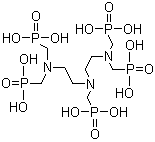
Diethylenetriaminepenta(methylene-phosphonic acid) (DTPMP) is a phosphonic acid derivative with the molecular formula C₉H₂₈N₃O₁₅P₅. It is a water-soluble compound known for its strong chelating properties and stability in various chemical environments. DTPMP has been widely studied and applied in industrial processes due to its ability to inhibit scale formation and metal ion precipitation.
The development of phosphonic acids, including DTPMP, dates back to the mid-20th century, when researchers explored their potential as water treatment agents. The compound was specifically synthesized to enhance scale inhibition in industrial water systems. Since its discovery, DTPMP has been extensively used in applications requiring effective metal sequestration and stability under extreme pH and temperature conditions.
DTPMP is primarily utilized in water treatment processes, where it functions as a scale and corrosion inhibitor in cooling water systems, desalination plants, and boiler water treatment. Its ability to bind with metal ions such as calcium, magnesium, and iron prevents the formation of insoluble precipitates, thereby reducing scaling in pipelines, heat exchangers, and other equipment. This property makes DTPMP a valuable additive in industrial and municipal water treatment programs.
In addition to its role in water treatment, DTPMP is used in the oil and gas industry to control scale formation in drilling operations and enhanced oil recovery processes. The presence of high concentrations of dissolved minerals in oilfield brines often leads to the deposition of scale, which can obstruct pipelines and production equipment. By inhibiting these deposits, DTPMP helps maintain efficient fluid flow and prolongs the operational lifespan of equipment.
DTPMP is also employed as a dispersing agent in detergents and cleaning formulations. It enhances the performance of cleaning products by preventing the precipitation of metal ions that could otherwise interfere with detergent activity. This application is particularly beneficial in household and industrial cleaning products used in hard water conditions.
Another established application of DTPMP is in the textile and pulp and paper industries. It is used to prevent scale buildup during bleaching and dyeing processes, ensuring better process efficiency and product quality. In the pulp and paper industry, DTPMP helps to minimize scaling in paper manufacturing equipment, reducing maintenance costs and improving production consistency.
DTPMP is known for its high thermal stability and resistance to degradation, which makes it suitable for long-term applications in challenging chemical environments. However, its environmental impact is carefully monitored, as phosphonic acids can contribute to eutrophication in water bodies if not properly managed. Regulatory guidelines often dictate its use and disposal to mitigate potential ecological effects.
Safety considerations in handling DTPMP include avoiding direct skin and eye contact, as it can be irritating. Appropriate personal protective equipment, including gloves and eye protection, is recommended when working with concentrated solutions. In industrial applications, proper dosing and monitoring ensure optimal performance while minimizing potential environmental risks.
The development and application of DTPMP have contributed significantly to advancements in industrial water treatment, oilfield operations, detergent formulations, and various manufacturing processes. Its effectiveness as a scale inhibitor and chelating agent has been well-documented in the literature, reinforcing its role as a critical component in chemical treatment programs.
References
2024. Anti-scaling and anti-corrosive study on waterborne composite coatings based on siloxane-g-polybutadiene incorporated with PTFE and nano-SiO2-EDTA. Journal of Coatings Technology and Research, 21(6).
DOI: 10.1007/s11998-024-01011-5
2020. Batch Studies of Phosphonate and Phosphate Adsorption on Granular Ferric Hydroxide (GFH) with Membrane Concentrate and Its Synthetic Replicas. Molecules, 25(21).
DOI: 10.3390/molecules25215202
2019. State of the art of synthetic threshold scale inhibitors for mineral scaling in the petroleum industry: a review. Petroleum Science, 16(1).
DOI: 10.1007/s12182-019-0299-5
|





 GHS05;GHS07 Danger Details
 chemBlink Chemical Story