Online Database of Chemicals from Around the World

alpha-Chloralose
[CAS# 15879-93-3]

List of Suppliers
Discovery Fine Chemicals Ltd. UK Inquire
www.discofinechem.com
+44 (1202) 874-517
+44 (845) 094-4385
pjc@discofinechem.com
Chemical manufacturer
chemBlink Standard supplier since 2009
Sarex Overseas Div of Saraf Chemicals Pvt. Ltd. India Inquire
www.sarex.com
+91 (22) 4218-4218
+91 (22) 4218-4350
fchem@sarex.com
Chemical manufacturer since 1965
chemBlink Standard supplier since 2010
BOC Sciences USA Inquire
www.bocsci.com
+1 (631) 485-4226
+1 (631) 614-7828
info@bocsci.com
Chemical manufacturer
chemBlink Standard supplier since 2010
Biosynth AG. Switzerland Inquire
www.biosynth.com
+41 (71) 858-2020
+41 (71) 858-2030
welcome@biosynth.ch
Chemical manufacturer
chemBlink Standard supplier since 2014
Labseeker Inc USA Inquire
www.labseeker.com
+1 (858) 750-1632
+1 (858) 412-1220
marketing@labseeker.com
Chemical manufacturer since 2002
chemBlink Standard supplier since 2015
Hangzhou Leap Chem Co., Ltd. China Inquire
www.leapchem.com
+86 (571) 8771-1850
market19@leapchem.com
QQ Chat
Chemical manufacturer since 2006
chemBlink Standard supplier since 2015
Creative Proteomics USA Inquire
www.creative-proteomics.com
+1 (631) 593-0501
+1 (631) 614-7828
contact@creative-proteomics.com
Chemical manufacturer since 2008
chemBlink Standard supplier since 2015
Anqing Puhua Trading Co., Ltd. China Inquire
www.aqpuhua.com
+86 (556) 522-0409
aqpuhua@163.com
Chemical manufacturer since 2002
chemBlink Standard supplier since 2019
Hebei Guanlang Biotechnology Co., LTD China Inquire
www.guanlang-group.com
+86 19930503252
mia@crovellbio.com
Chemical distributor since 2005
chemBlink Standard supplier since 2021
Shandong Zhishang Chemical Co., Ltd. China Inquire
www.zhishangchemical.com
+86 17653113209
13065062079
sales001@sdzschem.com
sales002@sdzschem.com
QQ Chat
Chemical manufacturer since 2016
chemBlink Standard supplier since 2022
Shandong Look Chemical Co., Ltd. China Inquire
www.sdlookchem.com
+86 17653113219
sales01@sdlookchem.com
QQ Chat
Chemical distributor since 2016
chemBlink Standard supplier since 2022
Autech Industry Co., Limited China Inquire
www.autechindustry.com
+86 (151) 6531-0911
sales@autechindustry.com
Chemical manufacturer since 2010
chemBlink Standard supplier since 2024
Chem Service, Inc. USA Inquire
www.chemservice.com
+1 (610) 692-3026
+1 (610) 692-8729
info@chemservice.com
Chemical manufacturer since 1962
Chemos GmbH & Co. KG Germany Inquire
www.chemos.de
+49 871-966346-0
+49 871-966346-13
chemos@chemos.de
Chemical distributor
Crescent Chemical Co. Inc. USA Inquire
www.crescentchemical.com
+1 (631) 348-0333
+1 (631) 348-0913
crescent@creschem.com
Chemical distributor
Changzhou Suntton Co., Ltd. USA Inquire
www.suntton.com
+1 (914) 965-2077
+86 (519) 8513-6089
+1 (914) 375-2093 / +86 (519) 8513-6133
luke.verdet@suntton.com
lily.chen@suntton.com
Chemical manufacturer

Identification
ClassificationAPI >> Anesthetic agents >> General anesthetics
Namealpha-Chloralose
Synonyms1,2-O-(2,2,2-Trichloroethylidene)-alpha-D-glucofuranose
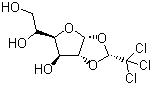
Molecular StructureCAS # 15879-93-3, alpha-Chloralose
Molecular FormulaC8H11Cl3O6
Molecular Weight309.53
CAS Registry Number15879-93-3
EC Number240-016-7
SMILESC([C@H]([C@@H]1[C@@H]([C@@H]2[C@H](O1)O[C@@H](O2)C(Cl)(Cl)Cl)O)O)O
Properties
Solubility0.44 g/100 mL (water, 15 °C), 46 mg/mL (DMSO) (Expl.)
Density1.8±0.1 g/cm3, Calc.*
Melting point178-182 °C (Expl.)
alpha18 ° (c=2, 95% C2H5OH)
Index of Refraction1.587, Calc.*
Boiling Point504.4±45.0 °C (760 mmHg), Calc.*
Flash Point258.9±28.7 °C, Calc.*
*Calculated using Advanced Chemistry Development (ACD/Labs) Software.
Safety Data
Hazard Symbolssymbol symbol symbol   GHS06;GHS07;GHS09 Danger  Details
Risk StatementsH301-H302-H312-H332-H336-H400-H410  Details
Safety StatementsP261-P264-P270-P271-P273-P280-P301+P316-P301+P317-P302+P352-P304+P340-P317-P319-P321-P330-P362+P364-P391-P403+P233-P405-P501  Details
Hazard Classification
up    Details
HazardClassCategory CodeHazard Statement
Acute toxicityAcute Tox.4H302
Acute toxicityAcute Tox.4H332
Acute toxicityAcute Tox.4H312
Specific target organ toxicity - single exposureSTOT SE3H336
Acute hazardous to the aquatic environmentAquatic Acute1H400
Chronic hazardous to the aquatic environmentAquatic Chronic1H410
Acute toxicityAcute Tox.3H301
SDSAvailable
up Discovery and Applications
Alpha-chloralose is a chemical compound that has gained recognition for its use as a rodenticide, anesthetic, and in certain laboratory research settings. It is a chlorinated derivative of glucose, consisting of a glucose molecule with a chlorine atom substituted at the alpha position of the glucose ring. This substance is known for its ability to act as a central nervous system depressant, and it is primarily used in the control of rodent populations due to its high toxicity to mammals.

The discovery of alpha-chloralose dates back to the early 20th century. It was first synthesized in 1928 by chemists who were investigating the effects of various chlorinated sugar derivatives on biological systems. Researchers soon realized that alpha-chloralose had potent anesthetic and sedative properties, leading to its further development and use in both medical and agricultural applications. Its rodenticide properties were particularly valuable, as it provided an effective and relatively humane method of controlling rodent populations without causing excessive harm to non-target animals when used correctly.

As a rodenticide, alpha-chloralose is commonly used in pest control, particularly in areas where rodent infestations are problematic. Its mechanism of action involves inhibiting the central nervous system, leading to paralysis and death in rodents. It works by disrupting the function of neurotransmitters in the brain, causing the rodent to become immobilized and eventually succumb to respiratory failure. Alpha-chloralose has been found to be more selective for rodents compared to other mammals, making it an effective tool in controlling pests while minimizing the impact on non-target species. However, it is still considered a highly toxic substance and must be used with care, especially in agricultural and urban settings.

In addition to its use as a rodenticide, alpha-chloralose is employed in medical and research settings as a general anesthetic. It has been used in certain surgical procedures, especially in veterinary medicine, to induce sedation and anesthesia in small animals. Its ability to induce a deep, reversible sedation has made it useful in studies involving small mammal models, particularly in the fields of pharmacology and toxicology. Alpha-chloralose is sometimes used in behavioral research, as it can immobilize subjects for various experiments without the need for more invasive methods of anesthesia.

One of the challenges associated with alpha-chloralose is its narrow therapeutic window. While it is effective as a rodenticide and anesthetic, its margin of safety between therapeutic and toxic doses is relatively small. This means that accidental poisoning of non-target species or humans can occur if the substance is not handled carefully. To mitigate these risks, precautions are necessary when using alpha-chloralose in both laboratory and field settings, including careful dosage monitoring and protective measures.

In agriculture, alpha-chloralose has also been used as a tool in managing wildlife that may damage crops. By targeting pest species such as rats and mice, it helps protect the agricultural industry, particularly in regions where rodents are known to cause significant economic losses. However, its use is regulated due to concerns about environmental contamination and the potential for secondary poisoning of animals that consume the poisoned rodents.

Alpha-chloralose remains a useful but carefully regulated compound in pest control and research. Ongoing research into its efficacy, safety, and alternative methods of application continues to be important to ensure its responsible use. As new techniques and formulations are developed, alpha-chloralose may continue to serve as a valuable tool in both pest management and scientific investigation.

References

1970. [Human intoxication by chloralose. Clinical study and electroencephalography]. Acta neurologica Belgica, 70(3), 377-392.
URL: https://pubmed.ncbi.nlm.nih.gov/4990666

1979. N-Allyl-derivative of clonidine, a substance with specific bradycardic action at a cardiac site. Naunyn-Schmiedeberg's Archives of Pharmacology, 306(3), 225-232.
DOI: https://pubmed.ncbi.nlm.nih.gov/471078

2024. Blood Flow Changes in the Rabbit Cranial and Caudal Venae Cavae during Postural Loads after Propranolol, Bisoprolol and Methyldopa Pretreatment. Journal of Evolutionary Biochemistry and Physiology, 60(3), 1056-1068.
DOI: 10.1134/s0022093024030050
Market Analysis Reports
List of Reports Available for alpha-Chloralose
Related Products
Chlomethoxyfen  Chlophedianol  Chlophedianol h...  Chloproxyfen  Chloracyzine  2-Chloradamanta...  Chlorahololide ...  Chloral  Chloralbofungin  Chloral hydrate  Chloramben  Chlorambucil  Chlorambucil-Te...  Chlorambucyl-Pr...  Chloramine  Chloramine-T  Chloramine B  Chloramine-B hy...  Chloramine-T tr...  Chloramphenicol...