
Online Database of Chemicals from Around the World
| BOC Sciences | USA | |||
|---|---|---|---|---|
 | www.bocsci.com | |||
 | +1 (631) 485-4226 | |||
 | +1 (631) 614-7828 | |||
 | info@bocsci.com | |||
| Chemical manufacturer | ||||
| chemBlink Standard supplier since 2010 | ||||
| Sichuan Taienkang Pharmaceutical Co., Ltd. | China | |||
|---|---|---|---|---|
| www.taienkangpharma.com | |||
| +86 15102825326 | |||
| sales@taienkangpharma.com | |||
 | QQ Chat | |||
 | Skype Chat | |||
| Chemical manufacturer since 2020 | ||||
| chemBlink Standard supplier since 2024 | ||||
| Pure Research Chemicals | China | |||
|---|---|---|---|---|
| www.purerechem.com | |||
| +86 (551) 6288-8437 +86 18096409024 | |||
| info@purerechem.com | |||
| QQ Chat | |||
| Skype Chat | |||
 | WeChat: 18856022585 | |||
| Chemical manufacturer since 2018 | ||||
| Classification | API >> Inhibitor drug |
|---|---|
| Name | Deucravacitinib |
| Synonyms | 6-(cyclopropanecarbonylamino)-4-[2-methoxy-3-(1-methyl-1,2,4-triazol-3-yl)anilino]-N-(trideuteriomethyl)pyridazine-3-carboxamide |
| Molecular Structure | 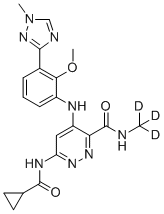 |
| Molecular Formula | C20D3H19N8O3 |
| Molecular Weight | 425.46 |
| CAS Registry Number | 1609392-27-9 |
| EC Number | 870-304-3 |
| SMILES | [2H]C([2H])([2H])NC(=O)C1=NN=C(C=C1NC2=CC=CC(=C2OC)C3=NN(C=N3)C)NC(=O)C4CC4 |
| Density | 1.5±0.1 g/cm3, Calc.* |
|---|---|
| Index of Refraction | 1.727, Calc.* |
| * | Calculated using Advanced Chemistry Development (ACD/Labs) Software. |
| Hazard Symbols |  GHS08 Danger Details GHS08 Danger Details | ||||||||||||
|---|---|---|---|---|---|---|---|---|---|---|---|---|---|
| Risk Statements | H361-H361f-H372 Details | ||||||||||||
| Safety Statements | P203-P260-P264-P270-P280-P318-P319-P405-P501 Details | ||||||||||||
| Hazard Classification | |||||||||||||
| |||||||||||||
| SDS | Available | ||||||||||||
 chemBlink Chemical Story
|
Deucravacitinib is a novel small molecule drug that has been developed as a selective inhibitor of the tyrosine kinase 2 (TYK2) enzyme. TYK2 is a member of the Janus kinase (JAK) family, and it plays a critical role in the signaling pathways of various cytokines involved in immune responses. The discovery and development of Deucravacitinib were motivated by the need for more targeted therapies for autoimmune diseases, particularly those where the immune system mistakenly attacks the body's tissues, such as psoriasis and lupus. By selectively inhibiting TYK2, Deucravacitinib offers the potential for effective disease management with a reduced side effect profile compared to broader JAK inhibitors. The initial discovery of Deucravacitinib was driven by research into selective kinase inhibition. While earlier therapies targeting JAK enzymes have shown efficacy in treating autoimmune diseases, they can also interfere with multiple signaling pathways, leading to side effects such as increased risk of infections and cancer. Deucravacitinib was designed with greater specificity for TYK2, which is involved in the signaling of key cytokines such as interleukin-12, interleukin-23, and interferons, all of which are implicated in autoimmune diseases. By selectively inhibiting TYK2, Deucravacitinib aims to modulate immune activity in a more precise way, providing a targeted approach to treatment. In clinical studies, Deucravacitinib has shown promise for the treatment of psoriasis, a chronic autoimmune disease that causes inflammation and skin lesions. In Phase 3 clinical trials, Deucravacitinib demonstrated significant efficacy in improving skin symptoms and reducing inflammation compared to placebo and existing treatments. The drug works by inhibiting TYK2, which in turn blocks the downstream signaling of cytokines involved in the inflammatory process. This results in a reduction of the overactive immune response that characterizes conditions like psoriasis. Additionally, Deucravacitinib has shown potential in other autoimmune diseases, including lupus, where TYK2 also plays a crucial role in disease pathogenesis. One of the key advantages of Deucravacitinib over other JAK inhibitors is its selective targeting of TYK2. This selectivity leads to a more favorable safety profile, with fewer off-target effects and a reduced risk of side effects commonly associated with broader JAK inhibition, such as gastrointestinal issues, liver abnormalities, and increased susceptibility to infections. Clinical trials have shown that Deucravacitinib is well tolerated, with side effects typically being mild to moderate in nature. This makes it an attractive treatment option for patients who may not tolerate other immunomodulatory drugs. Deucravacitinib's selectivity also allows for more precise modulation of the immune system, offering the potential for greater therapeutic benefits with a lower risk of adverse effects. Its oral formulation and convenient dosing regimen make it a promising option for long-term management of autoimmune diseases. As research continues, Deucravacitinib may also be explored in combination with other therapies for a broader range of autoimmune conditions, including rheumatoid arthritis and inflammatory bowel disease. Overall, Deucravacitinib represents a significant advancement in the treatment of autoimmune diseases, offering a more targeted approach to immune modulation. Its clinical efficacy, safety profile, and potential for use in a variety of autoimmune disorders make it an important addition to the therapeutic landscape for patients suffering from chronic immune-mediated diseases. References 2018. Phase 2 Trial of Selective Tyrosine Kinase 2 Inhibition in Psoriasis. The New England Journal of Medicine, 379, 1313-1321. DOI: 10.1056/nejmoa1806382 2024. Tyrosine kinase 2 inhibitors in autoimmune diseases. Autoimmunity Reviews, 23, 103649. DOI: 10.1016/j.autrev.2024.103649 2020. Discovery of BMS-986202: A Clinical Tyk2 Inhibitor that Binds to Tyk2 JH2. Journal of Medicinal Chemistry, 63, 15111-15128. DOI: 10.1021/acs.jmedchem.0c01698 |
| Market Analysis Reports |