
Online Database of Chemicals from Around the World
| Chizhou Dongsheng Pharmaceutical Co., Ltd. | China | |||
|---|---|---|---|---|
 | www.dspharmchem.com | |||
 | +86 (576) 8429-2571 | |||
 | +86 (576) 8429-2560 | |||
 | ksz@dspharmchem.com | |||
| Chemical manufacturer since 1995 | ||||
| chemBlink Premium supplier since 2011 | ||||
| Classification | Pharmaceutical intermediate >> Heterocyclic compound intermediate |
|---|---|
| Name | (5R)-3-(3-Fluoro-4-(4-morpholinyl)phenyl)-5-hydroxymethyl-2-oxazolidione |
| Synonyms | PNU-100440 |
| Molecular Structure | 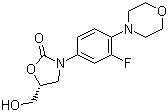 |
| Molecular Formula | C14H17FN2O4 |
| Molecular Weight | 296.29 |
| CAS Registry Number | 168828-82-8 |
| EC Number | 688-342-2 |
| SMILES | C1COCCN1C2=C(C=C(C=C2)N3C[C@@H](OC3=O)CO)F |
| Hazard Symbols |   GHS07;GHS08 Warning Details GHS07;GHS08 Warning Details | ||||||||||||||||||||
|---|---|---|---|---|---|---|---|---|---|---|---|---|---|---|---|---|---|---|---|---|---|
| Risk Statements | H302-H312-H332-H373 Details | ||||||||||||||||||||
| Safety Statements | P260-P261-P264-P270-P271-P280-P301+P317-P302+P352-P304+P340-P317-P319-P321-P330-P362+P364-P501 Details | ||||||||||||||||||||
| Hazard Classification | |||||||||||||||||||||
| |||||||||||||||||||||
| SDS | Available | ||||||||||||||||||||
 chemBlink Chemical Story
|
(5R)-3-(3-Fluoro-4-(4-morpholinyl)phenyl)-5-hydroxymethyl-2-oxazolidinone is a synthetic compound belonging to the class of oxazolidinones, a group of heterocyclic organic compounds known for their antimicrobial properties. Oxazolidinones have gained attention in medicinal chemistry, particularly for their use in developing antibiotics to treat resistant bacterial infections. The discovery of this compound is part of broader research efforts aimed at addressing the global challenge of antibiotic resistance, which has driven scientists to explore new molecular scaffolds and modifications to improve therapeutic efficacy. The chemical structure of this compound is notable for the presence of key functional groups that contribute to its biological activity. The oxazolidinone ring is central to the molecule's antimicrobial properties, as this scaffold is known to inhibit bacterial protein synthesis by binding to the ribosomal subunit. The stereochemistry at the 5-position (denoted by the "5R" configuration) is important for its biological activity, as the specific spatial arrangement of atoms can influence the compound's interaction with its target. The hydroxymethyl group at this position adds hydrophilic character to the molecule, potentially improving solubility and pharmacokinetics. The phenyl ring, substituted with a fluorine atom at the 3-position and a morpholine group at the 4-position, is a critical part of the structure. Fluorine substitution is frequently employed in drug design to enhance metabolic stability and binding affinity, while the morpholine group contributes to the compound's solubility and may influence its ability to cross biological membranes. These modifications are designed to optimize the molecule's pharmacological profile, making it a promising candidate for further development in antimicrobial therapies. Applications of (5R)-3-(3-Fluoro-4-(4-morpholinyl)phenyl)-5-hydroxymethyl-2-oxazolidinone are primarily focused on its potential as an antibiotic. Similar oxazolidinone derivatives, such as linezolid, have been successfully used in clinical settings to treat infections caused by Gram-positive bacteria, including methicillin-resistant Staphylococcus aureus (MRSA) and vancomycin-resistant Enterococci (VRE). This compound's structure suggests that it could have similar activity, with the fluorine and morpholine substitutions potentially offering improved pharmacokinetic properties and broader spectrum of activity. Beyond its antimicrobial applications, the compound may serve as a useful scaffold in medicinal chemistry for developing other bioactive molecules. The oxazolidinone ring is a versatile structure that can be modified to target various biological processes, making it a valuable tool for drug discovery efforts beyond antibiotics. Researchers may explore its potential in other therapeutic areas, such as oncology or immunology, by modifying its functional groups to interact with different biological targets. The discovery of (5R)-3-(3-Fluoro-4-(4-morpholinyl)phenyl)-5-hydroxymethyl-2-oxazolidinone highlights the importance of chemical modifications in enhancing the efficacy and safety of drug candidates. By incorporating functional groups like fluorine and morpholine, scientists can improve the pharmacological properties of molecules, making them more effective in treating diseases and addressing the growing threat of drug-resistant infections. References 2010. Syntheses and antibacterial activity studies of new oxazolidinones from nitroso Diels-Alder chemistry. Bioorganic & Medicinal Chemistry Letters. DOI: https://www.ncbi.nlm.nih.gov/pmc/articles/PMC2818252 2003. Linezolid. Pharmaceutical Substances. URL: https://pharmaceutical-substances.thieme.com/ps/search-results?docUri=KD-12-0041 |
| Market Analysis Reports |