
Online Database of Chemicals from Around the World
| Beijing Eagle Sky Pharmatech Co., Ltd. | China | |||
|---|---|---|---|---|
 | www.eagleskypharmatech.com | |||
 | +86 (10) 5979-9429 8875-5821 | |||
 | +86 (10) 5804-3698 | |||
 | sophia_818@126.com contact@eagleskypharmatech.com | |||
 | QQ Chat | |||
| Chemical manufacturer since 2009 | ||||
| chemBlink Standard supplier since 2010 | ||||
| BOC Sciences | USA | |||
|---|---|---|---|---|
| www.bocsci.com | |||
| +1 (631) 485-4226 | |||
| +1 (631) 614-7828 | |||
| info@bocsci.com | |||
| Chemical manufacturer | ||||
| chemBlink Standard supplier since 2010 | ||||
| Caerulum Pharma Discovery Co., Ltd. | China | |||
|---|---|---|---|---|
| www.caerulumpharm.com | |||
| +86 (21) 6455-6180 +86 189149758185 | |||
| +86 (21) 6455-6180 | |||
| sales-cpd@caerulumpharma.com | |||
| QQ Chat | |||
 | Skype Chat | |||
| Chemical manufacturer since 2012 | ||||
| chemBlink Standard supplier since 2019 | ||||
| Neostar United (Changzhou) Industrial Co., Ltd. | China | |||
|---|---|---|---|---|
| www.neostarunited.com | |||
| +86 (519) 8555-7386 +86 18015025600 | |||
| +86 (519) 8555-7389 | |||
| marketing1@neostarunited.com | |||
| Chemical distributor since 2014 | ||||
| chemBlink Standard supplier since 2020 | ||||
| Classification | Biochemical >> Inhibitor >> Angiogenesis >> FGFR inhibitor |
|---|---|
| Name | Roblitinib |
| Synonyms | N-[5-Cyano-4-[(2-methoxyethyl)amino]-2-pyridinyl]-7-formyl-3,4-dihydro-6-[(4-methyl-2-oxo-1-piperazinyl)methyl]-1,8-naphthyridine-1(2H)-carboxamide |
| Molecular Structure | 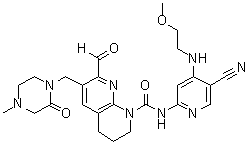 |
| Molecular Formula | C25H30N8O4 |
| Molecular Weight | 506.56 |
| CAS Registry Number | 1708971-55-4 |
| SMILES | CN1CCN(C(=O)C1)CC2=C(N=C3C(=C2)CCCN3C(=O)NC4=NC=C(C(=C4)NCCOC)C#N)C=O |
| Solubility | Practically insoluble (0.061 g/L) (25 °C), Calc.* |
|---|---|
| Density | 1.39±0.1 g/cm3 (20 °C 760 Torr), Calc.* |
| Index of Refraction | 1.654, Calc.* |
| Boiling Point | 852.1±65.0 °C (760 mmHg), Calc.* |
| Flash Point | 469.1±34.3 °C, Calc.* |
| * | Calculated using Advanced Chemistry Development (ACD/Labs) Software. |
| Hazard Symbols |  GHS07 Warning Details GHS07 Warning Details |
|---|---|
| Risk Statements | H302-H315-H319-H335 Details |
| Safety Statements | P261-P305+P351+P338 Details |
| SDS | Available |
 chemBlink Chemical Story
|
Roblitinib is a chemical compound that has garnered attention for its potential therapeutic applications, particularly in the treatment of various cancers. It belongs to the class of tyrosine kinase inhibitors (TKIs), a group of compounds designed to block the activity of specific enzymes known as tyrosine kinases, which are involved in the regulation of cell functions. Tyrosine kinases play a significant role in processes such as cell division, growth, and survival. Abnormalities in these enzymes are often associated with the development of cancer, making them valuable targets for anticancer drug development. The discovery of Roblitinib came from the need to develop more effective and selective agents for cancer therapy, especially in cases where traditional treatments such as chemotherapy are less effective or cause significant side effects. Roblitinib is specifically known to inhibit the activity of certain tyrosine kinases, including those involved in the epidermal growth factor receptor (EGFR) pathway, which is frequently implicated in various types of cancer, including non-small cell lung cancer (NSCLC) and other solid tumors. By blocking the signaling pathways that drive tumor growth, Roblitinib aims to halt or slow the progression of these cancers. One of the key advantages of Roblitinib is its selectivity. Unlike traditional chemotherapy, which affects rapidly dividing cells in general, Roblitinib targets specific molecules involved in cancer cell signaling. This targeted action reduces the damage to healthy cells and minimizes the side effects commonly associated with chemotherapy, such as hair loss, nausea, and immunosuppression. Roblitinib has been the subject of clinical studies to evaluate its efficacy and safety in various cancer types. Clinical trials have shown promise in its use as a treatment for cancers that exhibit mutations or overexpression of the EGFR. These trials suggest that Roblitinib may provide significant therapeutic benefits for patients with advanced cancers, especially those that are resistant to other forms of treatment. Additionally, ongoing research is exploring the potential of Roblitinib in combination with other anticancer agents to enhance its effectiveness and broaden its application. Apart from its anticancer properties, Roblitinib is also being investigated for its possible applications in other diseases where tyrosine kinase signaling plays a role, including autoimmune disorders and fibrotic conditions. The compound's ability to modulate kinase activity could provide new treatment options in these areas as well. In conclusion, Roblitinib represents a promising approach in the targeted treatment of cancer. Its selective inhibition of tyrosine kinases involved in cancer cell growth has the potential to improve patient outcomes, especially in cancers resistant to conventional therapies. Ongoing clinical trials and research are expected to expand its therapeutic applications and further validate its role in modern cancer treatment strategies. References 2019. FGF401, A First-In-Class Highly Selective and Potent FGFR4 Inhibitor for the Treatment of FGF19-Driven Hepatocellular Cancer. Molecular Cancer Therapeutics, 18(12). DOI: 10.1158/1535-7163.mct-18-1291 2024. FGFR-targeted therapeutics: clinical activity, mechanisms of resistance and new directions. Nature reviews. Clinical oncology, 21(4). URL: https://pubmed.ncbi.nlm.nih.gov/38424198 2021. Synthesis of Roblitinib. Synfacts, 17(03). DOI: 10.1055/s-0040-1719320. |
| Market Analysis Reports |