
Online Database of Chemicals from Around the World
| Wuhan Kemi-works Chemical Co., Ltd. | China | |||
|---|---|---|---|---|
 | www.kemiworks.net | |||
 | +86 (27) 8573-6489 | |||
 | +86 (27) 8573-6485 | |||
 | info@kemiworks.net sales@kemiworks.com | |||
| Chemical manufacturer | ||||
| chemBlink Premium supplier since 2011 | ||||
| Classification | Catalysts and additives >> Antioxidant |
|---|---|
| Name | 1,3,5-Trimethyl-2,4,6-tris(3,5-di-tert-butyl-4-hydroxybenzyl)benzene |
| Synonyms | 2,4,6-Tris(3',5'-di-tert-butyl-4'-hydroxybenzyl)mesitylene; Antioxidant 330; Evernox 1330 |
| Molecular Structure | 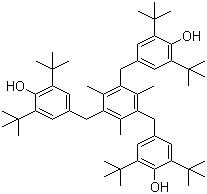 |
| Molecular Formula | C54H78O3 |
| Molecular Weight | 775.21 |
| CAS Registry Number | 1709-70-2 |
| EC Number | 216-971-0 |
| SMILES | CC1=C(C(=C(C(=C1CC2=CC(=C(C(=C2)C(C)(C)C)O)C(C)(C)C)C)CC3=CC(=C(C(=C3)C(C)(C)C)O)C(C)(C)C)C)CC4=CC(=C(C(=C4)C(C)(C)C)O)C(C)(C)C |
| Density | 1.0±0.1 g/cm3, Calc.* |
|---|---|
| Melting point | 248-250 °C |
| Index of Refraction | 1.547, Calc.* |
| Boiling Point | 730.0±55.0 °C (760 mmHg), Calc.* |
| Flash Point | 240.0±26.1 °C, Calc.* |
| * | Calculated using Advanced Chemistry Development (ACD/Labs) Software. |
| Hazard Symbols |  GHS07 Warning Details GHS07 Warning Details | ||||||||||||||||||||||||||||||||
|---|---|---|---|---|---|---|---|---|---|---|---|---|---|---|---|---|---|---|---|---|---|---|---|---|---|---|---|---|---|---|---|---|---|
| Risk Statements | H302-H413 Details | ||||||||||||||||||||||||||||||||
| Safety Statements | P264-P270-P273-P301+P317-P330-P501 Details | ||||||||||||||||||||||||||||||||
| Hazard Classification | |||||||||||||||||||||||||||||||||
| |||||||||||||||||||||||||||||||||
| SDS | Available | ||||||||||||||||||||||||||||||||
 chemBlink Chemical Story
|
1,3,5-Trimethyl-2,4,6-tris(3,5-di-tert-butyl-4-hydroxybenzyl)benzene, commonly referred to as a high-performance antioxidant, is a complex organic compound notable for its robust protective properties against oxidative degradation in various materials. Its molecular structure consists of a benzene ring substituted with three trimethyl groups and three bulky 3,5-di-tert-butyl-4-hydroxybenzyl groups, which significantly enhance its stability and efficiency. The synthesis and application of this compound have gained prominence since its introduction in the late 20th century, aligning with the increasing demand for effective stabilizers in industrial applications. The discovery of this antioxidant can be traced back to the extensive research into phenolic compounds and their effectiveness in preventing the oxidative degradation of polymers, lubricants, and other materials. Scientists aimed to develop a compound that could provide superior thermal stability and resistance to oxidation, leading to longer service life and better performance in various applications. The synthesis of 1,3,5-trimethyl-2,4,6-tris(3,5-di-tert-butyl-4-hydroxybenzyl)benzene typically involves multiple steps, including the alkylation of phenolic compounds and subsequent coupling reactions to achieve the desired substituents on the benzene ring. One of the primary applications of this compound is in the plastics and rubber industries, where it acts as a stabilizer to enhance the thermal and oxidative stability of polymeric materials. As polymers are often exposed to heat, light, and oxygen during processing and end-use, the incorporation of antioxidants like 1,3,5-trimethyl-2,4,6-tris(3,5-di-tert-butyl-4-hydroxybenzyl)benzene is crucial in preventing degradation. This antioxidant effectively scavenge free radicals and inhibits oxidative reactions, thereby prolonging the lifespan and maintaining the mechanical properties of plastic and rubber products. Additionally, this compound finds significant use in the formulation of lubricants and greases. The performance of lubricants can deteriorate due to oxidative processes that lead to the formation of sludge and deposits. The inclusion of 1,3,5-trimethyl-2,4,6-tris(3,5-di-tert-butyl-4-hydroxybenzyl)benzene in lubricant formulations enhances their oxidative stability, ensuring smoother operation and reducing wear and tear in machinery and automotive applications. This is particularly important in high-performance engines, where extreme conditions can accelerate degradation. In the food packaging industry, this antioxidant is utilized to improve the stability of polymer films used in packaging materials. Food products are susceptible to oxidation, which can lead to rancidity and spoilage. By incorporating 1,3,5-trimethyl-2,4,6-tris(3,5-di-tert-butyl-4-hydroxybenzyl)benzene into packaging films, manufacturers can extend the shelf life of food products while maintaining quality and safety. The compound’s effectiveness in scavenging free radicals makes it an excellent choice for protecting sensitive food products from oxidative damage. The growing focus on sustainability and environmental safety has also prompted research into the biodegradability and safety profile of this compound. While effective as an antioxidant, understanding its environmental impact is crucial for its continued use in various applications. Regulatory bodies are increasingly requiring comprehensive safety assessments for additives and stabilizers used in consumer products. In conclusion, 1,3,5-trimethyl-2,4,6-tris(3,5-di-tert-butyl-4-hydroxybenzyl)benzene is a vital antioxidant with significant applications across multiple industries, including plastics, lubricants, and food packaging. Its discovery marked a crucial advancement in material science, addressing the need for effective stabilization against oxidative degradation. As research continues to uncover new applications and assess environmental impacts, this compound is poised to remain a key player in enhancing the durability and performance of various products. References 1965. THE FATE OF 2,4,6-TRI-(3′,5′-DI-TERT.-BUTYL-4′-HYDROXYBENZYL)MESITYLENE (IONOX 330) IN THE DOG AND RAT. The Biochemical journal, 95(1). DOI: 10.1042/bj0950098 2021. Tuning the Johari-Goldstein β-Relaxation and Its Separation from α-Relaxation of Poly(n-alkyl methacrylate)s by Small Molecule-bridged Hydrogen Bonds. Chinese Journal of Polymer Science, 39(10). DOI: 10.1007/s10118-021-2595-y 2017. Synthesis of a novel efficient antioxidant for use in lubes and biodiesel. Petroleum Chemistry, 57(1). DOI: 10.1134/s096554411701011x |
| Market Analysis Reports |