
Online Database of Chemicals from Around the World
| wuhan chemi Pharmacy Chemical Technology Co., Ltd. | China | |||
|---|---|---|---|---|
 | www.chemipharm.com.cn | |||
 | +86 13971619949 | |||
 | gmn424@chemipharm.com.cn | |||
 | QQ Chat | |||
 | WeChat: 13971619949 | |||
| Chemical manufacturer since 2014 | ||||
| chemBlink Standard supplier since 2026 | ||||
| Classification | Pharmaceutical intermediate >> Heterocyclic compound intermediate >> Pyridine compound |
|---|---|
| Name | Tris(2,2 inverted exclamation marka-bipyridine)copper(2+) |
| Synonyms | copper tris(2-pyridin-2-ylpyridine) |
| Molecular Structure | 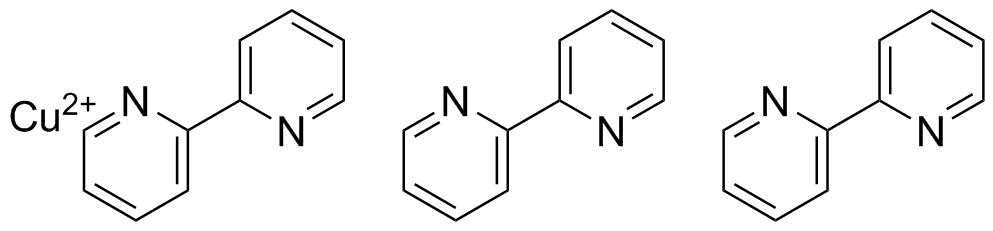 |
| Molecular Formula | C30H24CuN6+2 |
| Molecular Weight | 532.10 |
| CAS Registry Number | 17168-72-8 |
| SMILES | C1=CC=NC(=C1)C2=CC=CC=N2.C1=CC=NC(=C1)C2=CC=CC=N2.C1=CC=NC(=C1)C2=CC=CC=N2.[Cu+2] |
| Hazard Symbols |  GHS07 Warning Details GHS07 Warning Details |
|---|---|
| Risk Statements | H302-H315-H319-H335 Details |
| Safety Statements | P280-P305+P351+P338 Details |
| SDS | Available |
 chemBlink Chemical Story
|
Tris(2,2′-bipyridine)copper(II) is a coordination complex consisting of a copper(II) center bound to three bidentate 2,2′-bipyridine ligands. The compound belongs to the class of transition metal polypyridyl complexes, which have been extensively studied in coordination chemistry due to their well-defined structures, strong metal–ligand interactions, and characteristic electronic properties. Complexes of copper with bipyridine ligands have played an important role in the development of ligand field theory and in the broader understanding of transition metal coordination behavior. The historical development of copper–bipyridine chemistry is closely linked to the growth of coordination chemistry in the late nineteenth and twentieth centuries. The recognition that nitrogen-donor ligands such as bipyridine could form stable chelate complexes with transition metals significantly advanced the understanding of metal–ligand bonding. 2,2′-Bipyridine is a rigid, aromatic ligand containing two pyridine rings joined by a carbon–carbon bond, allowing it to bind metal ions through both nitrogen atoms and form stable five-membered chelate rings. In tris(2,2′-bipyridine)copper(II), three bipyridine ligands coordinate to a central copper ion, forming an octahedral coordination environment. However, copper(II), with a d9 electronic configuration, often exhibits Jahn–Teller distortion, which leads to elongation or compression of the coordination geometry. As a result, the actual structure of the complex may deviate from an ideal octahedron, reflecting the electronic asymmetry of the metal center. The copper(II) oxidation state is relatively less commonly stabilized in tris(bipyridine) complexes compared with copper(I), because the d9 electronic configuration can lead to structural distortion and reduced thermodynamic stability. Nevertheless, copper(II)–bipyridine complexes are well documented and have been used in studies of redox chemistry and ligand field effects. The presence of three strong chelating ligands helps stabilize the copper(II) ion in solution and in solid-state coordination compounds. One of the most important aspects of tris(2,2′-bipyridine)copper(II) chemistry is its redox behavior. Copper complexes can undergo reversible or quasi-reversible interconversion between copper(II) and copper(I) oxidation states. The bipyridine ligands play a key role in stabilizing both oxidation states by providing strong σ-donation and π-accepting characteristics. This redox activity has made copper–bipyridine systems useful in studies of electron transfer processes and coordination redox chemistry. Copper–polypyridyl complexes, including tris(2,2′-bipyridine)copper(II), have also been investigated in photochemical and electrochemical contexts. Although copper(I) complexes are more commonly associated with metal-to-ligand charge transfer (MLCT) excited states, copper(II) complexes contribute to understanding excited-state deactivation pathways and redox-induced structural changes. These studies have helped clarify how ligand environment influences electronic transitions and photophysical properties. In addition to fundamental studies, copper–bipyridine complexes have been explored in catalytic and synthetic applications. Copper salts in combination with bipyridine ligands are widely used in catalytic reactions such as oxidative coupling, atom transfer processes, and carbon–heteroatom bond formation. While the active catalytic species may vary in oxidation state and coordination environment, tris(2,2′-bipyridine)copper(II) represents an important structural motif in understanding how ligand coordination affects catalytic behavior. The compound has also been studied using a range of spectroscopic and structural techniques. UV–visible spectroscopy is particularly informative due to characteristic d–d transitions and charge transfer bands associated with copper(II) centers. Electron paramagnetic resonance spectroscopy is also commonly used, as copper(II) is paramagnetic and provides detailed information about the electronic environment. X-ray crystallography has been used to determine coordination geometry and confirm ligand binding modes. Overall, tris(2,2′-bipyridine)copper(II) is a representative transition metal coordination complex that illustrates key principles of ligand field theory, coordination geometry, and redox chemistry. Its significance lies in its role as a model system for studying copper coordination behavior, electron transfer processes, and the influence of polypyridyl ligands on the structure and properties of metal complexes. |
| Market Analysis Reports |