
Online Database of Chemicals from Around the World
| Wuhan Kemi-works Chemical Co., Ltd. | China | |||
|---|---|---|---|---|
 | www.kemiworks.net | |||
 | +86 (27) 8573-6489 | |||
 | +86 (27) 8573-6485 | |||
 | info@kemiworks.net sales@kemiworks.com | |||
| Chemical manufacturer | ||||
| chemBlink Premium supplier since 2011 | ||||
| Classification | Pharmaceutical intermediate >> Heterocyclic compound intermediate >> Pyridine compound >> Pyridine derivative |
|---|---|
| Name | 4,4'-Dimethoxy-2,2'-bipyridine |
| Synonyms | 4-methoxy-2-(4-methoxypyridin-2-yl)pyridine |
| Molecular Structure | 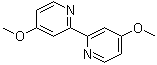 |
| Molecular Formula | C12H12N2O2 |
| Molecular Weight | 216.24 |
| CAS Registry Number | 17217-57-1 |
| EC Number | 628-568-0 |
| SMILES | COC1=CC(=NC=C1)C2=NC=CC(=C2)OC |
| Solubility | Slightly soluble (8.9 g/L) (25 °C), Calc.* |
|---|---|
| Density | 1.143±0.06 g/cm3 (20 °C 760 Torr), Calc.* |
| Melting point | 170-171 °C (ethanol )** |
| Index of Refraction | 1.551, Calc.* |
| Boiling point | 347.6±37.0 °C (760 Torr), Calc.* |
| Flash point | 127.0±16.8 °C, Calc.* |
| * | Calculated using Advanced Chemistry Development (ACD/Labs) Software V11.02 (©1994-2013 ACD/Labs) |
| ** | ten Brink, Gerd-Jan |
| Hazard Symbols |  GHS07 Warning Details GHS07 Warning Details | ||||||||||||||||||||
|---|---|---|---|---|---|---|---|---|---|---|---|---|---|---|---|---|---|---|---|---|---|
| Risk Statements | H315-H319-H335 Details | ||||||||||||||||||||
| Safety Statements | P261-P305+P351+P338 Details | ||||||||||||||||||||
| Hazard Classification | |||||||||||||||||||||
| |||||||||||||||||||||
| SDS | Available | ||||||||||||||||||||
 chemBlink Chemical Story
|
4,4'-Dimethoxy-2,2'-bipyridine is a bidentate ligand widely used in coordination chemistry due to its ability to chelate metal centers. The compound consists of two pyridine rings connected by a single bond, with methoxy groups attached to the 4-positions of the pyridine rings. Its molecular formula is C12H12N2O2, and it has a distinctive structure that enables it to form stable complexes with transition metals. The discovery and subsequent exploration of 4,4'-dimethoxy-2,2'-bipyridine can be traced to research into bipyridine derivatives and their ability to coordinate with metal ions, which have been known for their usefulness in catalysis and material science. The synthesis of 4,4'-dimethoxy-2,2'-bipyridine typically involves the methylation of 2,2'-bipyridine with methoxy reagents, such as methyl iodide, in the presence of a base. This method efficiently introduces the methoxy groups into the desired positions of the pyridine rings. The resulting compound has enhanced electron-donating properties compared to unsubstituted bipyridine, making it more reactive in certain applications, especially in the context of metal coordination. In terms of applications, 4,4'-dimethoxy-2,2'-bipyridine is particularly valuable in the field of coordination chemistry. It is frequently used as a ligand in the preparation of metal complexes, especially those of transition metals such as iron, copper, and palladium. These metal-ligand complexes have found use in catalysis, particularly in reactions such as cross-coupling reactions and oxidation processes. The presence of methoxy groups enhances the ligand's solubility in organic solvents, which is beneficial for its use in various catalytic systems. In addition to its catalytic applications, 4,4'-dimethoxy-2,2'-bipyridine has been studied for its potential use in material science, particularly in the development of organic light-emitting diodes (OLEDs) and other electronic devices. The electron-donating methoxy groups can influence the electronic properties of the material, making it suitable for such applications. Furthermore, the ligand’s ability to form stable metal complexes is of interest in the development of molecular sensors and other technologies that rely on metal-ligand interactions. The compound has also been explored for its potential use in biological applications. Due to its chelating properties, it may serve as a framework for designing metal-based drugs or diagnostic agents. Ongoing research continues to explore the versatility of 4,4'-dimethoxy-2,2'-bipyridine in these diverse fields, making it a valuable compound for further study. In summary, 4,4'-dimethoxy-2,2'-bipyridine is a versatile ligand with a variety of applications in catalysis, material science, and potential biomedical fields. Its ability to chelate metal centers, along with its ease of synthesis, makes it a useful compound for ongoing research and technological development. References 2010. Electronic Modification of the [RuII(tpy)(bpy)(OH2)]2+ Scaffold: Effects on Catalytic Water Oxidation. Journal of the American Chemical Society, 132(43). DOI: 10.1021/ja106108y 2022. Recent Progress on Transition-Metal-Mediated Reductive C(sp3)-O Bond Radical Addition and Coupling Reactions. Synthesis, 54(12). DOI: 10.1055/a-1848-3005 2006. Synthesis, Crystal Structure, and Luminescent Properties of Novel Eu3+ Heterocyclic β-Diketonate Complexes with Bidentate Nitrogen Donors. Inorganic Chemistry, 45(23). DOI: 10.1021/ic061425a. |
| Market Analysis Reports |