
Online Database of Chemicals from Around the World
| Simagchem Corporation | China | |||
|---|---|---|---|---|
 | www.simagchem.com | |||
 | +86 13806087780 | |||
 | +86 (592) 268-0237 | |||
 | sale@simagchem.com | |||
| Chemical manufacturer since 2002 | ||||
| chemBlink Standard supplier since 2008 | ||||
| Jiangyan Yangtze River Chemical Co., Ltd. | China | |||
|---|---|---|---|---|
| www.yzjchem.com | |||
| +86 (523) 8864-7977 | |||
| +86 (523) 8864-2070 | |||
| sales@yzjchem.com | |||
| Chemical manufacturer since 1992 | ||||
| chemBlink Standard supplier since 2009 | ||||
| Wuhan Kemi-works Chemical Co., Ltd. | China | |||
|---|---|---|---|---|
| www.kemiworks.net | |||
| +86 (27) 8573-6489 | |||
| +86 (27) 8573-6485 | |||
| info@kemiworks.net sales@kemiworks.com | |||
| Chemical manufacturer | ||||
| chemBlink Standard supplier since 2011 | ||||
| Hangzhou Leap Chem Co., Ltd. | China | |||
|---|---|---|---|---|
| www.leapchem.com | |||
| +86 (571) 8771-1850 | |||
| market19@leapchem.com | |||
 | QQ Chat | |||
| Chemical manufacturer since 2006 | ||||
| chemBlink Standard supplier since 2015 | ||||
| Beijing TND Science and Technology Co., Ltd. | China | |||
|---|---|---|---|---|
| www.tndtech.com.cn | |||
| +86 (10) 8075-1706 +86 13521671946 | |||
| +86 (10) 8075-1706 | |||
| sales@tndtech.com.cn | |||
| Chemical distributor since 2010 | ||||
| chemBlink Standard supplier since 2018 | ||||
| Alchemie Shanghai Co., Ltd. | China | |||
|---|---|---|---|---|
| www.alcshanghai.com | |||
| +86 (021) 5072-0087 | |||
| assistant2@alchemie-shanghai.com | |||
| Chemical distributor since 2018 | ||||
| chemBlink Standard supplier since 2025 | ||||
| Shanghai Worldyang Chemical Co., Ltd. | China | |||
|---|---|---|---|---|
| www.worldyachem.com | |||
| +86 13651600618 +86 (21) 5679-5779 | |||
| +86 (21) 5679-5266 | |||
| sales7777@worldyachem.com | |||
| QQ Chat | |||
 | WeChat: 13651600618 | |||
 | WhatsApp:+86 13651600618 | |||
| Chemical manufacturer since 2012 | ||||
| AccuStandard Inc. | USA | |||
|---|---|---|---|---|
| www.accustandard.com | |||
| +1 (203) 786-5290 | |||
| +1 (203) 786-5287 | |||
| orders@accustandard.com | |||
| Chemical manufacturer since 1986 | ||||
| Classification | Chemical pesticide >> Fungicide >> Other fungicides |
|---|---|
| Name | Pyraclostrobine |
| Synonyms | Methyl N-[2-[[1-(4-chlorophenyl)pyrazol-3-yl]oxymethyl]phenyl]-N-methoxycarbamate |
| Molecular Structure | 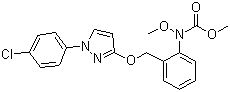 |
| Molecular Formula | C19H18ClN3O4 |
| Molecular Weight | 387.82 |
| CAS Registry Number | 175013-18-0 |
| EC Number | 605-747-1 |
| SMILES | COC(=O)N(C1=CC=CC=C1COC2=NN(C=C2)C3=CC=C(C=C3)Cl)OC |
| Density | 1.3±0.1 g/cm3 Calc.* |
|---|---|
| Boiling point | 501.1±60.0 °C 760 mmHg (Calc.)* |
| Flash point | 256.8±32.9 °C (Calc.)* |
| Index of refraction | 1.592 (Calc.)* |
| * | Calculated using Advanced Chemistry Development (ACD/Labs) Software. |
| Hazard Symbols |    GHS06;GHS08;GHS09 Danger Details GHS06;GHS08;GHS09 Danger Details | ||||||||||||||||||||||||
|---|---|---|---|---|---|---|---|---|---|---|---|---|---|---|---|---|---|---|---|---|---|---|---|---|---|
| Risk Statements | H302-H315:-H331:-H335:-H361d:-H373:-H400:-H410: Details | ||||||||||||||||||||||||
| Safety Statements | P203-P260-P261-P264-P270-P271-P273-P280-P301+P317-P302+P352-P304+P340-P316-P318-P319-P321-P330-P332+P317-P362+P364-P391-P403+P233-P405-P501 Details | ||||||||||||||||||||||||
| Hazard Classification | |||||||||||||||||||||||||
| |||||||||||||||||||||||||
| SDS | Available | ||||||||||||||||||||||||
 chemBlink Chemical Story
|
Pyraclostrobine is a broad-spectrum fungicide belonging to the strobilurin class, developed for the control of various fungal pathogens affecting crops. It is derived from natural antifungal compounds originally isolated from the wood-decay fungus *Strobilurus tenacellus*. The molecular formula of pyraclostrobine is C19H18ClN3O4, and its chemical structure includes a methoxyacrylate moiety, which is essential for its biological activity, as well as a chlorinated phenyl ring and a pyrimidinyl ether group. Pyraclostrobine functions by inhibiting mitochondrial respiration in fungi. It specifically targets the cytochrome bc1 complex (Complex III) in the electron transport chain, binding to the Qo site and blocking electron transfer. This disruption halts ATP synthesis, leading to energy depletion and ultimately fungal cell death. Because of this mode of action, pyraclostrobine is classified as a QoI (quinone outside inhibitor) fungicide. The compound was developed in the late 1990s as part of efforts to introduce more effective and selective fungicides with systemic and translaminar properties. Pyraclostrobine is rapidly absorbed by plant tissues and can move within the leaf, providing both curative and protective activity against a wide range of fungal diseases such as powdery mildew, rusts, leaf spots, and blights. It is used in crops such as cereals, soybeans, fruits, vegetables, and ornamental plants. Pyraclostrobine is frequently formulated alone or in combination with fungicides from other chemical classes, such as triazoles or succinate dehydrogenase inhibitors (SDHIs), to broaden the spectrum of activity and mitigate the risk of resistance development. QoI fungicides are susceptible to resistance due to mutations in the fungal cytochrome b gene, which necessitates careful management through rotation and mixture strategies. Beyond its fungicidal action, pyraclostrobine has been reported to have physiological benefits in plants, a phenomenon sometimes referred to as “plant health effects.” These may include delayed senescence, improved stress tolerance, and enhanced photosynthetic efficiency, although such effects vary by crop and environmental condition and are not the primary basis for its registration or usage. The environmental profile of pyraclostrobine indicates moderate persistence in soil and low mobility, with primary degradation occurring via microbial activity and photolysis. It is moderately toxic to aquatic organisms and should be applied with caution near water bodies. In mammals, it exhibits low acute toxicity, and its use is generally considered safe when applied according to label directions. In summary, pyraclostrobine is a synthetic strobilurin fungicide that inhibits mitochondrial respiration in fungal pathogens. It is widely used in modern agriculture for its protective and curative effects against a broad range of fungal diseases and is often integrated into resistance management and crop protection programs. References 2024. Pyraclostrobin induces developmental toxicity and cardiotoxicity through oxidative stress and inflammation in zebrafish embryos. Environmental Pollution, 355. DOI: 10.1016/j.envpol.2024.124490 2024. Friends or foes: co-application of Trichoderma- and Bacillus-based products with chemicals to manage soybean foliar diseases. BioControl, 69(6). DOI: 10.1007/s10526-024-10298-7 2024. Nurse honey bees filter fungicide residues to maintain larval health. Current Biology, 34(21). DOI: 10.1016/j.cub.2024.10.008 |
| Market Analysis Reports |