
Online Database of Chemicals from Around the World
| wuhan chemi Pharmacy Chemical Technology Co., Ltd. | China | |||
|---|---|---|---|---|
 | www.chemipharm.com.cn | |||
 | +86 13971619949 | |||
 | gmn424@chemipharm.com.cn | |||
 | QQ Chat | |||
 | WeChat: 13971619949 | |||
| Chemical manufacturer since 2014 | ||||
| chemBlink Standard supplier since 2026 | ||||
| Classification | Pharmaceutical intermediate >> Heterocyclic compound intermediate >> Pyrimidine compound |
|---|---|
| Name | 2,4,6-Trichloro-5-isopropylpyrimidine |
| Molecular Structure | 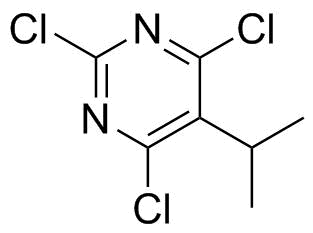 |
| Molecular Formula | C7H7Cl3N2 |
| Molecular Weight | 225.50 |
| CAS Registry Number | 1780-42-3 |
| SMILES | CC(C)C1=C(N=C(N=C1Cl)Cl)Cl |
| Density | 1.4±0.1 g/cm3 Calc.* |
|---|---|
| Boiling point | 243.8±35.0 °C 760 mmHg (Calc.)* |
| Flash point | 124.8±11.5 °C (Calc.)* |
| Index of refraction | 1.547 (Calc.)* |
| * | Calculated using Advanced Chemistry Development (ACD/Labs) Software. |
| Hazard Symbols |  GHS07 Warning Details GHS07 Warning Details |
|---|---|
| Risk Statements | H302-H315-H319-H335 Details |
| Safety Statements | P261-P305+P351+P338 Details |
| SDS | Available |
 chemBlink Chemical Story
|
2,4,6-Trichloro-5-isopropylpyrimidine is a halogenated pyrimidine derivative in which a pyrimidine ring is substituted with three chlorine atoms at the 2-, 4-, and 6-positions and an isopropyl group at the 5-position. Pyrimidine is a six-membered aromatic heterocycle containing two nitrogen atoms at positions 1 and 3, and derivatives of this scaffold are widely used in organic synthesis, agrochemical development, and medicinal chemistry because of their strong electrophilic reactivity and versatile substitution patterns. The chemistry of chlorinated pyrimidines developed significantly during the twentieth century as heterocyclic chemistry expanded into industrial applications. Halogenated azines such as chloropyrimidines were recognized as highly useful intermediates because the electron-deficient nature of the pyrimidine ring makes them especially reactive toward nucleophilic aromatic substitution. The presence of multiple chlorine substituents further enhances this reactivity by stabilizing the intermediate anionic σ-complex formed during substitution reactions. In 2,4,6-trichloro-5-isopropylpyrimidine, the three chlorine atoms occupy positions that are activated toward nucleophilic displacement due to the electron-withdrawing effect of the ring nitrogen atoms. The pyrimidine system is inherently electron-poor compared with benzene, and the presence of chlorine substituents increases its susceptibility to substitution by nucleophiles such as amines, alkoxides, thiols, and other nucleophilic reagents. This reactivity makes trichloropyrimidine derivatives valuable intermediates for stepwise functionalization of heterocyclic systems. The isopropyl substituent at the 5-position introduces steric and electronic modification to the pyrimidine ring. While it does not directly participate in nucleophilic substitution reactions, it can influence the overall reactivity and selectivity of the molecule by affecting steric accessibility and altering the local electronic environment of the ring. Substituents at the 5-position of pyrimidines are commonly used in synthetic chemistry to tune physical properties and direct reactivity patterns in subsequent transformations. One of the primary documented applications of compounds in this class is in the synthesis of more complex pyrimidine derivatives through sequential nucleophilic substitution reactions. The chlorine atoms in 2,4,6-trichloro-5-isopropylpyrimidine can be selectively replaced under controlled conditions, allowing chemists to construct highly functionalized pyrimidine scaffolds. This stepwise substitution strategy is widely used in heterocyclic chemistry to build libraries of structurally diverse compounds. Such halogenated pyrimidines are also important intermediates in agrochemical research. Pyrimidine-based structures are common in herbicides, fungicides, and other crop protection agents. The high reactivity of trichloropyrimidine derivatives makes them suitable starting materials for introducing biologically relevant substituents that modify activity, selectivity, and environmental behavior. The ability to systematically replace chlorine atoms with different nucleophiles supports the development of structure–activity relationships in agrochemical discovery programs. In medicinal chemistry, chloropyrimidines serve as versatile building blocks for the synthesis of pharmacologically active heterocycles. The pyrimidine ring is a core structural element in many bioactive compounds, including nucleic acid bases and various enzyme inhibitors. Highly substituted pyrimidines such as 2,4,6-trichloro-5-isopropylpyrimidine provide a reactive platform for constructing analogs with tailored properties through substitution reactions and further functional group modifications. From a physicochemical perspective, halogenated pyrimidines typically exhibit moderate polarity and relatively high chemical reactivity. The electron-deficient aromatic system is stabilized by resonance involving the ring nitrogen atoms, but remains sufficiently activated to undergo substitution. The presence of multiple chlorine atoms increases molecular weight and lipophilicity, while also contributing to characteristic reactivity patterns in nucleophilic aromatic substitution. Overall, 2,4,6-trichloro-5-isopropylpyrimidine is a highly functionalized heteroaromatic compound whose significance lies in its role as a reactive intermediate in heterocyclic synthesis. Its combination of an electron-deficient pyrimidine core, multiple leaving-group chlorines, and a modulating isopropyl substituent makes it a valuable building block for the preparation of more complex pyrimidine derivatives used in agrochemical, pharmaceutical, and synthetic organic chemistry applications. References 2014. Methods of Synthesis of 6-Substituted Uracil Derivatives – the Structural Base of Antiviral Agents (Review). Chemistry of Heterocyclic Compounds. DOI: 10.1007/s10593-014-1394-6 |
| Market Analysis Reports |