
Online Database of Chemicals from Around the World
| Shanghai Amsheng Chemical Co., Ltd. | China | |||
|---|---|---|---|---|
 | www.amsheng.com | |||
 | +86 (21) 6267-3642 | |||
 | +86 (21) 6218-0706 | |||
 | info@amsheng.com | |||
| Chemical manufacturer | ||||
| chemBlink Standard supplier since 2007 | ||||
| Simagchem Corporation | China | |||
|---|---|---|---|---|
| www.simagchem.com | |||
| +86 13806087780 | |||
| +86 (592) 268-0237 | |||
| sale@simagchem.com | |||
| Chemical manufacturer since 2002 | ||||
| chemBlink Standard supplier since 2008 | ||||
| Hangzhou Chemtech Inductry Co., Ltd. | China | |||
|---|---|---|---|---|
| www.zjchemtech.com | |||
| +86 (571) 5671-5668 | |||
| +86 (571) 85423167 | |||
| info@zjchemtech.com | |||
| Chemical manufacturer since 2013 | ||||
| chemBlink Standard supplier since 2014 | ||||
| Hangzhou Leap Chem Co., Ltd. | China | |||
|---|---|---|---|---|
| www.leapchem.com | |||
| +86 (571) 8771-1850 | |||
| market19@leapchem.com | |||
 | QQ Chat | |||
| Chemical manufacturer since 2006 | ||||
| chemBlink Standard supplier since 2015 | ||||
| Wako Pure Chemical Industries, Ltd. | Japan | |||
|---|---|---|---|---|
| www.wako-chem.co.jp | |||
| +81 (6) 6203-3741 | |||
| +81 (6) 6201-5964 | |||
| wkhk.info@fujifilm.com | |||
| Chemical manufacturer since 1922 | ||||
| CABB AG | Switzerland | |||
|---|---|---|---|---|
| www.cabb-chemicals.com | |||
| +41 (61) 825-3111 | |||
| +41 (61) 825-3636 | |||
| contact@cabb-chemicals.com | |||
| Chemical manufacturer | ||||
| Classification | Chemical pesticide >> Herbicide >> Herbicide intermediate |
|---|---|
| Name | 2,6-Dichloroquinoxaline |
| Molecular Structure | 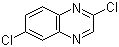 |
| Molecular Formula | C8H4Cl2N2 |
| Molecular Weight | 199.04 |
| CAS Registry Number | 18671-97-1 |
| EC Number | 606-094-5 |
| SMILES | C1=CC2=NC(=CN=C2C=C1Cl)Cl |
| Density | 1.5±0.1 g/cm3, Calc.* |
|---|---|
| Melting point | 153-157 °C |
| Index of Refraction | 1.671, Calc.* |
| Boiling Point | 278.7±35.0 °C (760 mmHg), Calc.* |
| Flash Point | 149.1±11.5 °C, Calc.* |
| * | Calculated using Advanced Chemistry Development (ACD/Labs) Software. |
| Hazard Symbols |    GHS07;GHS05;GHS09 Danger Details GHS07;GHS05;GHS09 Danger Details | ||||||||||||||||||||||||||||||||
|---|---|---|---|---|---|---|---|---|---|---|---|---|---|---|---|---|---|---|---|---|---|---|---|---|---|---|---|---|---|---|---|---|---|
| Risk Statements | H302-H315-H317-H318-H319-H335-H411 Details | ||||||||||||||||||||||||||||||||
| Safety Statements | P261-P264-P264+P265-P270-P272-P280-P301+P317-P302+P352-P305+P351+P338-P321-P330-P332+P317-P333+P317-P337+P317-P362+P364-P501 Details | ||||||||||||||||||||||||||||||||
| Hazard Classification | |||||||||||||||||||||||||||||||||
| |||||||||||||||||||||||||||||||||
| SDS | Available | ||||||||||||||||||||||||||||||||
 chemBlink Chemical Story
|
2,6-Dichloroquinoxaline is a chlorinated derivative of quinoxaline, a bicyclic compound composed of two fused aromatic rings containing nitrogen atoms. The compound has attracted attention for its potential applications in medicinal chemistry and materials science. The discovery of 2,6-dichloroquinoxaline dates back to the mid-20th century when researchers began exploring the structure-activity relationships of various quinoxaline derivatives. Its unique chemical structure, characterized by the presence of two chlorine atoms at the 2 and 6 positions of the quinoxaline ring, contributes to its distinctive properties and biological activities. The synthesis of 2,6-dichloroquinoxaline is typically achieved through the chlorination of quinoxaline or its derivatives using chlorine gas or other chlorinating agents. This process allows for the selective introduction of chlorine atoms at the desired positions on the quinoxaline ring, resulting in the formation of 2,6-dichloroquinoxaline. The ability to modify the quinoxaline structure through halogenation enhances its reactivity and opens up new avenues for further chemical transformations. One of the notable applications of 2,6-dichloroquinoxaline is in the field of pharmacology, where it has been investigated for its potential as an antitumor agent. Research has indicated that quinoxaline derivatives, including 2,6-dichloroquinoxaline, can exhibit cytotoxic effects against various cancer cell lines. These compounds are believed to interfere with essential cellular processes, such as DNA replication and cell division, leading to the inhibition of tumor growth. Additionally, studies have suggested that 2,6-dichloroquinoxaline may possess antimicrobial properties, further expanding its potential therapeutic applications. Moreover, 2,6-dichloroquinoxaline has been explored for its role in developing agrochemicals, particularly as a potential herbicide. The compound's structural features may enhance its ability to target specific biochemical pathways in plants, leading to effective weed management. Research into the herbicidal activity of 2,6-dichloroquinoxaline has shown promise, indicating its potential as a selective herbicide with reduced environmental impact compared to traditional chemical herbicides. In addition to its applications in medicine and agriculture, 2,6-dichloroquinoxaline has also been utilized in materials science. Its unique chemical structure allows it to act as a building block in the synthesis of novel polymers and organic materials. The incorporation of 2,6-dichloroquinoxaline into polymer matrices can impart specific properties, such as increased thermal stability and enhanced electrical conductivity. This makes it a valuable compound for developing advanced materials for use in electronic and optoelectronic devices. Furthermore, the study of 2,6-dichloroquinoxaline has led to insights into the mechanisms of action of various quinoxaline derivatives. Researchers have been investigating the structure-activity relationships of these compounds to identify key functional groups that contribute to their biological activity. This knowledge aids in the design and optimization of new quinoxaline-based drugs with improved efficacy and reduced side effects. In conclusion, 2,6-dichloroquinoxaline is a significant compound with a rich history of discovery and diverse applications across multiple fields. Its potential as an antitumor agent, herbicide, and building block for advanced materials underscores its importance in research and development. Ongoing investigations into its properties and mechanisms of action will likely unveil further applications and enhance our understanding of quinoxaline derivatives in medicinal and material sciences. References 2022. Cross-Coupling Reactions of Polyhalogenated Heterocycles. Synlett. DOI: 10.1055/s-0040-1719906 2021. Nucleophilic Substitution in 6-Chloro-2-(2-cyanophenoxy)quinoxalines and Antibacterial Activity of Phenoxychloroquinoxaline Derivatives. Russian Journal of Organic Chemistry. DOI: 10.1134/s1070428021040217 2020. Concise Synthesis of Furo[2,3-b]indolines via [3,3]-Sigmatropic Rearrangement of N-Alkenyloxyindoles. Synlett. DOI: 10.1055/s-0040-1707250 |
| Market Analysis Reports |