
Online Database of Chemicals from Around the World
| Wuhan Kemi-works Chemical Co., Ltd. | China | |||
|---|---|---|---|---|
 | www.kemiworks.net | |||
 | +86 (27) 8573-6489 | |||
 | +86 (27) 8573-6485 | |||
 | info@kemiworks.net sales@kemiworks.com | |||
| Chemical manufacturer | ||||
| chemBlink Premium supplier since 2011 | ||||
| Classification | Chemical reagent >> Organic reagent >> Siloxane |
|---|---|
| Name | Heptamethyl trisiloxane |
| Synonyms | Bis(trimethylsiloxy)methylsilane |
| Molecular Structure | 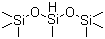 |
| Molecular Formula | C7H22O2Si3 |
| Molecular Weight | 222.51 |
| CAS Registry Number | 1873-88-7 |
| EC Number | 217-496-1 |
| SMILES | C[Si](O[Si](C)(C)C)O[Si](C)(C)C |
| Density | 0.819 g/mL (Expl.) |
|---|---|
| Refractive index | 1.382 (Expl.) |
| Boiling Point | 163.8±23.0 °C (760 mmHg), Calc.*, 142 °C (Expl.) |
| Flash Point | 52.8±22.6 °C, Calc.*, 27 °C (Expl.) |
| Hazard Symbols |   GHS02;GHS07 Warning Details GHS02;GHS07 Warning Details | ||||||||||||||||||||||||||||
|---|---|---|---|---|---|---|---|---|---|---|---|---|---|---|---|---|---|---|---|---|---|---|---|---|---|---|---|---|---|
| Risk Statements | H225-H226-H315-H319-H335 Details | ||||||||||||||||||||||||||||
| Safety Statements | P210-P233-P240-P241-P242-P243-P261-P264-P264+P265-P271-P280-P302+P352-P303+P361+P353-P304+P340-P305+P351+P338-P319-P321-P332+P317-P337+P317-P362+P364-P370+P378-P403+P233-P403+P235-P405-P501 Details | ||||||||||||||||||||||||||||
| Hazard Classification | |||||||||||||||||||||||||||||
| |||||||||||||||||||||||||||||
| Transport Information | UN 1993 | ||||||||||||||||||||||||||||
| SDS | Available | ||||||||||||||||||||||||||||
 chemBlink Chemical Story
|
Heptamethyl trisiloxane is an organosilicon compound known for its unique structure and properties. It is composed of three silicon atoms connected by oxygen atoms, with methyl groups attached to the silicon atoms. Specifically, the compound features the molecular formula Si3O7(CH3)7, indicating seven methyl groups surrounding the three silicon atoms. This structure makes it part of the broader class of siloxanes, which are renowned for their versatility and stability in various industrial applications. The discovery of heptamethyl trisiloxane can be traced back to the extensive research on siloxane chemistry in the mid-20th century. The development of this compound was part of ongoing efforts to improve the performance and functionality of silicon-based materials, which have long been valued for their thermal stability, low surface tension, and high chemical resistance. As researchers sought to expand the range of available siloxane compounds, heptamethyl trisiloxane emerged as an important variant with a particularly favorable set of physical properties, such as low viscosity and excellent surface-active characteristics. Synthesis of heptamethyl trisiloxane typically involves the reaction of silicon-containing reagents with methylating agents. The reaction conditions are carefully controlled to ensure that the desired structure is achieved, with the right number of methyl groups attached to the silicon atoms. This method allows for the production of the compound in large quantities, which can then be used in various applications. One of the most important applications of heptamethyl trisiloxane is in the cosmetics industry, where it is commonly used as an ingredient in hair care and skin care products. Due to its low viscosity and ability to form smooth, non-greasy films, heptamethyl trisiloxane is often incorporated into formulations designed to provide a silky, soft texture. It is frequently used in conditioners, moisturizers, and other cosmetic products where its ability to improve spreadability and provide a dry, smooth finish is highly valued. Furthermore, the compound’s stability and resistance to heat and moisture make it suitable for products that require long-lasting performance. Heptamethyl trisiloxane also finds application in the automotive and aerospace industries, where it is used as a lubricant and surface treatment agent. Its low surface tension allows it to penetrate into small spaces, reducing friction and providing lubrication for various moving parts. This property is particularly valuable in high-performance engines and precision machinery, where reliable lubrication is essential to ensure smooth operation and reduce wear and tear on components. Additionally, the compound is used in the formulation of high-performance coatings and sealants that require durability and resistance to extreme conditions. In the electronics industry, heptamethyl trisiloxane is employed as an intermediate in the production of specialty materials such as dielectric fluids and insulators. These materials are used to protect sensitive electronic components from moisture, dust, and other environmental contaminants while also providing electrical insulation. The compound’s low viscosity and high thermal stability make it an ideal choice for applications where both heat resistance and electrical insulating properties are required. Another significant use of heptamethyl trisiloxane is in the field of surface modification. Its ability to reduce surface tension makes it effective in creating hydrophobic surfaces. These surfaces are useful in a variety of applications, from water-repellent coatings for textiles and building materials to the creation of non-stick surfaces in cookware. Heptamethyl trisiloxane’s ability to serve as a lubricant, moisture-resistant agent, and surface modifier has led to its inclusion in a wide variety of products across industries. Its stable chemical structure, low surface tension, and ability to form smooth films have made it an invaluable compound in formulations that require enhanced performance under challenging conditions. As research into siloxane chemistry continues to expand, heptamethyl trisiloxane will likely remain an essential component in the development of new materials and technologies. References 2024. Anti-scaling and anti-corrosive study on waterborne composite coatings based on siloxane-g-polybutadiene incorporated with PTFE and nano-SiO2-EDTA. Journal of Coatings Technology and Research. DOI: 10.1007/s11998-024-01011-5 2012. Synthesis and Properties of a Hydrolysis Resistant Cationic Trisiloxane Surfactant. Journal of Surfactants and Detergents. DOI: 10.1007/s11743-012-1363-y 2015. Direct silylation reactions of inert C-H bonds via transition metal catalysis. Science China Chemistry. DOI: 10.1007/s11426-015-5375-0 |
| Market Analysis Reports |