
Online Database of Chemicals from Around the World
| Wuhan Kemi-works Chemical Co., Ltd. | China | |||
|---|---|---|---|---|
 | www.kemiworks.net | |||
 | +86 (27) 8573-6489 | |||
 | +86 (27) 8573-6485 | |||
 | info@kemiworks.net sales@kemiworks.com | |||
| Chemical manufacturer | ||||
| chemBlink Premium supplier since 2011 | ||||
| Classification | Organic raw materials >> Carboxylic compounds and derivatives >> Carboxylic esters and their derivatives |
|---|---|
| Name | Propylene glycol dibenzoate |
| Synonyms | 2-benzoyloxypropyl benzoate |
| Molecular Structure | 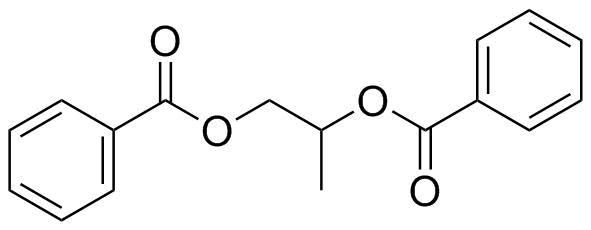 |
| Molecular Formula | C17H16O4 |
| Molecular Weight | 284.31 |
| CAS Registry Number | 19224-26-1 |
| EC Number | 242-894-7 |
| SMILES | CC(COC(=O)C1=CC=CC=C1)OC(=O)C2=CC=CC=C2 |
| Density | 1.2±0.1 g/cm3 Calc.* |
|---|---|
| Melting point | -3 °C (Expl.) |
| Boiling point | 385.5 °C 760 mmHg (Calc.)*, 423.4 °C (Expl.) |
| Flash point | 206.7±22.4 °C (Calc.)* |
| Index of refraction | 1.56 (Calc.)*, 1.542 - 1.547 (Expl.) |
| * | Calculated using Advanced Chemistry Development (ACD/Labs) Software. |
| Hazard Symbols |   GHS07;GHS09 Warning Details GHS07;GHS09 Warning Details | ||||||||||||||||||||||||||||
|---|---|---|---|---|---|---|---|---|---|---|---|---|---|---|---|---|---|---|---|---|---|---|---|---|---|---|---|---|---|
| Risk Statements | H302-H315-H319-H335 Details | ||||||||||||||||||||||||||||
| Safety Statements | P280-P305+P351+P338 Details | ||||||||||||||||||||||||||||
| Hazard Classification | |||||||||||||||||||||||||||||
| |||||||||||||||||||||||||||||
| SDS | Available | ||||||||||||||||||||||||||||
 chemBlink Chemical Story
|
Propylene glycol dibenzoate is an aromatic diester formed by the esterification of propylene glycol with two equivalents of benzoic acid. It belongs to the family of benzoate ester compounds that are widely used in industrial formulations as plasticizers, solvents, and performance additives in polymers, coatings, adhesives, and related materials systems. The compound is based on propylene glycol, a three-carbon diol containing two hydroxyl groups on adjacent or nearby carbon atoms depending on isomeric form. In propylene glycol dibenzoate, both hydroxyl groups are converted into ester linkages with benzoic acid, producing a molecule that contains two benzoate groups attached to a short aliphatic backbone. This structure combines aromatic rigidity with aliphatic flexibility, which is a key feature in its functional behavior. Benzoic acid, the aromatic component of the molecule, is one of the simplest aromatic carboxylic acids and has been widely used in chemical synthesis for centuries. Its carboxyl group readily participates in esterification reactions, forming stable ester bonds with alcohols under acid-catalyzed or dehydrative conditions. The resulting benzoate esters inherit the hydrophobic character of the benzene ring while gaining additional structural diversity depending on the alcohol used. In propylene glycol dibenzoate, the propylene glycol backbone provides flexibility and conformational mobility, while the two benzoate groups contribute hydrophobicity and aromatic interaction capability. This combination leads to a molecule that is relatively non-volatile and compatible with many organic polymer systems. The ester groups are polar enough to interact with polymer matrices, while the aromatic rings enhance miscibility with hydrophobic resins. The compound is primarily known for its role as a plasticizer. Plasticizers are additives incorporated into polymer materials to increase flexibility, reduce brittleness, and improve processing characteristics. They function by inserting themselves between polymer chains, reducing intermolecular forces and increasing chain mobility. Propylene glycol dibenzoate is particularly effective in systems such as polyvinyl chloride and other polar polymers where balanced compatibility is required. Compared with smaller, more volatile plasticizers, propylene glycol dibenzoate exhibits low volatility and relatively high molecular weight. These properties reduce migration and evaporation over time, contributing to improved long-term performance of formulated materials. Its viscosity and polarity can also be adjusted by blending with other benzoate esters or plasticizers to meet specific application requirements. From a chemical stability perspective, the ester bonds in propylene glycol dibenzoate are generally stable under neutral conditions. However, like most esters, they can undergo hydrolysis under strongly acidic or strongly basic environments, regenerating benzoic acid and propylene glycol. Under normal storage and application conditions, hydrolysis is limited, which supports its industrial utility. The physical properties of the compound are influenced by its dual aromatic structure and short glycol backbone. The benzoate groups increase molecular weight and hydrophobic interactions, while the propylene glycol segment prevents crystallization and promotes a liquid state over a wide temperature range. This balance contributes to favorable handling characteristics in industrial formulations. Propylene glycol dibenzoate is also used in applications beyond plasticization. It can function as a solvent for resins, dyes, and other organic compounds, and it is sometimes incorporated into coatings and adhesive systems to modify viscosity and drying behavior. Its compatibility with a wide range of organic materials makes it a versatile formulation ingredient. Overall, propylene glycol dibenzoate is a bifunctional aromatic ester derived from benzoic acid and propylene glycol. Its significance lies in its role as a low-volatility plasticizer and solvent with balanced structural features that provide compatibility, stability, and performance enhancement in polymer and industrial chemical applications. References 2016. Sunscreen Formulation: Optimising Aesthetic Elements for Twenty-First-Century Consumers. Principles and Practice of Photoprotection. DOI: 10.1007/978-3-319-29382-0_16 |
| Market Analysis Reports |