
Online Database of Chemicals from Around the World
| Jiangsu Juming Chemical Technology Co., Ltd. | China | |||
|---|---|---|---|---|
 | en.jmchemchina.com | |||
 | +86 17798763151 | |||
 | admin@jumingchem.com | |||
| Chemical manufacturer since 2017 | ||||
| chemBlink Standard supplier since 2026 | ||||
| Classification | Organic raw materials >> Organic fluorine compound |
|---|---|
| Name | Diphenyliodanium nonafluorobutane-1-sulfonate |
| Molecular Structure | 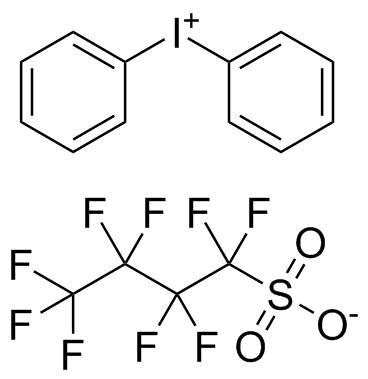 |
| Molecular Formula | C16H10F9IO3S |
| Molecular Weight | 580.20 |
| CAS Registry Number | 194999-82-1 |
| SMILES | C1=CC=C(C=C1)[I+]C2=CC=CC=C2.C(C(C(F)(F)S(=O)(=O)[O-])(F)F)(C(F)(F)F)(F)F |
| Melting point | 78 - 84 °C (Expl.) |
|---|---|
 chemBlink Chemical Story
|
Diphenyliodanium nonafluorobutane-1-sulfonate, CAS 194999-82-1, is a diaryliodonium salt documented in patent literature under the commercial designation DPI-109. Its importance comes from a remarkable transformation: a stable ionic solid can convert absorbed light into strong-acid chemistry. This makes it a member of the photoacid-generator family used in photolithography and other light-triggered polymer processes. The positively charged iodine center is bonded to two phenyl groups. Hypervalent iodine compounds of this type can undergo photochemical and electron-transfer pathways that fragment the diaryliodonium ion. In the presence of the fluorinated sulfonate counterion, the resulting sequence can generate a strong acid. The nonafluorobutanesulfonate anion is highly fluorinated; electron-withdrawing fluorine stabilizes the sulfonate conjugate base and is one reason such counterions are associated with strong acids. In a chemically amplified photoresist, this photochemistry is only the first stage. The acid produced in the exposed region catalyzes reactions in the polymer during post-exposure bake, commonly removing acid-labile protecting groups and changing the polymer's solubility in developer. Because the acid acts catalytically, one primary photochemical event can lead to many chemical conversions. That amplification greatly improves sensitivity compared with imaging schemes in which every structural change must correspond directly to a photon. Patent literature provides a particularly clear record for CAS 194999-82-1. DPI-109 appears among iodonium photoacid generators in inventions involving resist materials, solar-cell manufacturing and porous titanium-oxide processing. These documents do not mean that every use of the isolated compound has identical performance; they show that the salt has been selected as a practical source of photo-generated acid in several materials contexts. Diaryliodonium salts also have a broader role in photopolymerization, where photo-generated cationic species can initiate curing reactions of epoxides and related monomers. The exact reaction pathway depends on sensitizers, wavelength, matrix and other formulation variables. The central concept nevertheless remains the same: light changes the onium ion, and the ionic products switch on chemistry that was largely dormant before irradiation. CAS 194999-82-1 is therefore a good example of molecular signal conversion. The molecule is not simply a source of acidity sitting in a bottle. It is designed so that acidity can be generated in space and time by light. In microfabrication, that distinction is crucial: the chemistry must happen primarily where the optical image says it should happen. References: 1. TW200937123A, Resist material and laminate; DPI-109 identified as CAS 194999-82-1. 2. EP2927980A1, Method for manufacturing solar cell, and solar cell. 3. WO2014083884A1, Method for producing porous titanium oxide laminate. 4. Crivello JV. The discovery and development of onium salt cationic photoinitiators. J Polym Sci A Polym Chem. 1999;37:4241-4254. |
| Market Analysis Reports |