
Online Database of Chemicals from Around the World
| Sichuan Taienkang Pharmaceutical Co., Ltd. | China | |||
|---|---|---|---|---|
 | www.taienkangpharma.com | |||
 | +86 15102825326 | |||
 | sales@taienkangpharma.com | |||
 | QQ Chat | |||
 | Skype Chat | |||
| Chemical manufacturer since 2020 | ||||
| chemBlink Standard supplier since 2024 | ||||
| Classification | API >> Inhibitor drug |
|---|---|
| Name | Nirogacestat Hydrobromide |
| Synonyms | (2S)-2-[[(2S)-6,8-difluoro-1,2,3,4-tetrahydronaphthalen-2-yl]amino]-N-[1-[1-(2,2-dimethylpropylamino)-2-methylpropan-2-yl]imidazol-4-yl]pentanamide;dihydrobromide |
| Molecular Structure | 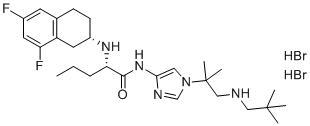 |
| Molecular Formula | C27H43Br2F2N5O |
| Molecular Weight | 651.47 |
| CAS Registry Number | 1962925-29-6 |
| EC Number | 110-175-6 |
| SMILES | CCC[C@@H](C(=O)NC1=CN(C=N1)C(C)(C)CNCC(C)(C)C)N[C@H]2CCC3=C(C2)C(=CC(=C3)F)F.Br.Br |
| Solubility | soluble 10 mM (water), 100 mM (DMSO) (Expl.) |
|---|---|
| Hazard Symbols |  GHS07 Warning Details GHS07 Warning Details |
|---|---|
| Risk Statements | H315-H319-H335 Details |
| Safety Statements | P261-P264-P264+P265-P271-P280-P302+P352-P304+P340-P305+P351+P338-P319-P321-P332+P317-P337+P317-P362+P364-P403+P233-P405-P501 Details |
| SDS | Available |
 chemBlink Chemical Story
|
Nirogacestat hydrobromide is a chemical compound that has garnered attention in the field of oncology due to its potential use as a therapeutic agent in cancer treatment. It is a selective gamma-secretase inhibitor, which means it blocks the activity of gamma-secretase, an enzyme that plays a pivotal role in the Notch signaling pathway. This pathway is involved in regulating cell differentiation, proliferation, and survival. Dysregulation of Notch signaling is associated with various types of cancers, including solid tumors and hematologic malignancies, making gamma-secretase inhibitors like Nirogacestat hydrobromide an attractive target for cancer therapy. The discovery of Nirogacestat hydrobromide was driven by the need to identify effective inhibitors of the Notch signaling pathway. Researchers recognized the therapeutic potential of targeting this pathway in cancers where aberrant Notch signaling contributes to tumor growth and resistance to treatment. Through the development of gamma-secretase inhibitors, such as Nirogacestat hydrobromide, scientists hoped to halt the progression of these cancers and improve treatment outcomes for patients. The synthesis of Nirogacestat hydrobromide involves advanced organic chemistry techniques, including the development of selective inhibitors that target gamma-secretase with high specificity. The compound's structure is carefully optimized to ensure potent inhibition of the enzyme while minimizing off-target effects. The hydrobromide salt form of Nirogacestat is typically used to enhance its solubility and stability, which is important for its pharmacological efficacy. In preclinical studies, Nirogacestat hydrobromide has demonstrated promising anticancer activity, particularly in the treatment of hematologic malignancies, such as T-cell acute lymphoblastic leukemia (T-ALL), and certain solid tumors. By inhibiting the Notch signaling pathway, the compound can reduce the growth and spread of cancer cells, making it a potential candidate for inclusion in cancer treatment regimens. In clinical trials, Nirogacestat hydrobromide has been evaluated in combination with other therapies, with the goal of enhancing the overall efficacy of cancer treatments and overcoming resistance mechanisms that may arise during treatment. Beyond its application in cancer, Nirogacestat hydrobromide may also have potential in treating other diseases associated with abnormal Notch signaling, such as Alzheimer's disease, where excessive activation of Notch signaling can contribute to neurodegeneration. Further research into the compound's broader therapeutic potential is ongoing. References 2024. Examining nirogacestat for adults with progressing desmoid tumors who require systemic treatment. Expert Opinion on Pharmacotherapy, 25(15). DOI: 10.1080/14656566.2024.2418416 2024. Gamma-Secretase Inhibitors Downregulate the Profibrotic NOTCH Signaling Pathway in Recessive Dystrophic Epidermolysis Bullosa. The Journal of investigative dermatology, 144(7). DOI: 10.1016/j.jid.2023.10.045 2023. Nirogacestat effective in desmoid tumours. Nature reviews. Clinical oncology, 20(4). DOI: 10.1038/s41571-023-00758-x |
| Market Analysis Reports |