
Online Database of Chemicals from Around the World
| BOC Sciences | USA | |||
|---|---|---|---|---|
 | www.bocsci.com | |||
 | +1 (631) 485-4226 | |||
 | +1 (631) 614-7828 | |||
 | info@bocsci.com | |||
| Chemical manufacturer | ||||
| chemBlink Standard supplier since 2010 | ||||
| Targetmol Chemicals Inc. | USA | |||
|---|---|---|---|---|
| www.targetmol.com | |||
| +1 (781) 999-5354 | |||
| +1 (781) 281-9145 | |||
| sales@targetmol.com | |||
| Chemical manufacturer since 2013 | ||||
| chemBlink Standard supplier since 2025 | ||||
| Classification | Biochemical >> Antibody >> MAPK and PI3K/Akt pathway |
|---|---|
| Name | Inavolisib |
| Synonyms | (2S)-2-[[2-[(4S)-4-(difluoromethyl)-2-oxo-1,3-oxazolidin-3-yl]-5,6-dihydroimidazo[1,2-d][1,4]benzoxazepin-9-yl]amino]propanamide |
| Molecular Structure | 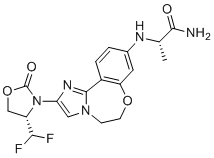 |
| Molecular Formula | C18H19F2N5O4 |
| Molecular Weight | 407.37 |
| CAS Registry Number | 2060571-02-8 |
| SMILES | C[C@@H](C(=O)N)NC1=CC2=C(C=C1)C3=NC(=CN3CCO2)N4[C@@H](COC4=O)C(F)F |
| Density | 1.6±0.1 g/cm3, Calc.* |
|---|---|
| Index of Refraction | 1.693, Calc.* |
| Boiling Point | 656.5±65.0 °C (760 mmHg), Calc.* |
| Flash Point | 350.8±34.3 °C, Calc.* |
| * | Calculated using Advanced Chemistry Development (ACD/Labs) Software. |
| Hazard Symbols |   GHS06;GHS08 Danger Details GHS06;GHS08 Danger Details |
|---|---|
| Risk Statements | H301-H361 Details |
| Safety Statements | P501-P270-P202-P201-P264-P280-P308+P313-P301+P310+P330-P405 Details |
| SDS | Available |
 chemBlink Chemical Story
|
Inavolisib is an experimental drug that belongs to a class of compounds known as PI3K inhibitors. It specifically targets the alpha isoform of the phosphoinositide 3-kinase (PI3Kα), which is a key component of the PI3K/Akt signaling pathway. This pathway is involved in regulating various cellular functions, including growth, survival, metabolism, and proliferation. The dysregulation of PI3K signaling, particularly through mutations in the PIK3CA gene that encodes the PI3Kα isoform, is commonly observed in a variety of cancers. These mutations are often linked to tumorigenesis, cancer progression, and resistance to chemotherapy. The discovery of inavolisib stems from efforts to develop selective inhibitors of PI3Kα, aiming to overcome the limitations of previous pan-PI3K inhibitors, which target all isoforms of PI3K. These pan-inhibitors often have a broader range of side effects because they inhibit multiple PI3K isoforms that are involved in normal cellular processes. Inavolisib was designed to provide more targeted inhibition of PI3Kα, potentially reducing off-target effects and enhancing its therapeutic efficacy in cancers with specific mutations in the PIK3CA gene. Inavolisib has shown promising preclinical activity in various cancer models, especially in cancers with PIK3CA mutations, such as breast cancer, endometrial cancer, and other solid tumors. In clinical trials, inavolisib has been investigated primarily in combination with other cancer therapies, including targeted agents and immunotherapies, to assess its potential in overcoming resistance mechanisms and improving patient outcomes. A key area of research for inavolisib is in hormone receptor-positive, HER2-negative breast cancer, a subtype of breast cancer where PIK3CA mutations are commonly found. In these cancers, the PI3K/Akt/mTOR pathway plays a crucial role in driving tumor growth. Inavolisib, when used in combination with endocrine therapy or other agents, has been evaluated for its ability to block the PI3K pathway, thereby potentially improving responses in patients who are resistant to standard treatments. Inavolisib is typically administered orally, which offers a convenient route of administration compared to intravenous chemotherapy. However, as with other experimental therapies, its safety profile and efficacy are still being evaluated in ongoing clinical trials. Early-phase clinical trials have focused on assessing the pharmacokinetics, pharmacodynamics, and dose-limiting toxicities of inavolisib, with a goal to define the optimal dosing regimen for future studies. Some common side effects observed in early trials include gastrointestinal symptoms, such as diarrhea and nausea, as well as effects related to immune system modulation. These side effects are being monitored closely to determine whether they can be managed effectively and whether they might limit the potential for long-term use in patients. Overall, inavolisib represents a promising new approach in the treatment of cancers driven by PIK3CA mutations. By selectively inhibiting PI3Kα, it aims to provide a more targeted therapeutic option for patients with these mutations, potentially improving outcomes and reducing side effects compared to broader PI3K inhibitors. However, further studies are required to confirm its clinical benefit and to determine the most effective combinations with other therapies for treating cancer. References 2021. RTK-Dependent Inducible Degradation of Mutant PI3Kα Drives GDC-0077 (Inavolisib) Efficacy. Cancer Discovery, 12(1). DOI: 10.1158/2159-8290.cd-21-0072 2022. Discovery of GDC-0077 (Inavolisib), a Highly Selective Inhibitor and Degrader of Mutant PI3Kα. Journal of Medicinal Chemistry, 65(23). DOI: 10.1021/acs.jmedchem.2c01422 2024. Inavolisib-Based Therapy in PIK3CA-Mutated Advanced Breast Cancer. The New England Journal of Medicine, 391(18). DOI: 10.1056/nejmoa2404625 |
| Market Analysis Reports |