Online Database of Chemicals from Around the World

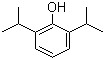
Propofol
[CAS# 2078-54-8]

List of Suppliers
Epochem Co., Ltd. China Inquire
www.epochem.com
+86 (21) 6760-1595
6760-1597
+86 (21) 6760-1605
seth_wang@epochem.com
QQ Chat
Chemical manufacturer since 2006
chemBlink Standard supplier since 2005
Nanjing Datang Chemical Co., Ltd. China Inquire
www.chem-expert.com
+86 (25) 8528-7198
+86 (25) 8528-7178
sales@chemdatang.com
market02@chemdatang.com
QQ Chat
Skype Chat
Chemical manufacturer since 1999
chemBlink Standard supplier since 2006
Azocolor Technology Ltd. China Inquire
www.azocolor.com
+86 (731) 8551-2161
sales@azocolor.com
Chemical manufacturer
chemBlink Standard supplier since 2007
Shandong Zhongke Taidou Chemical Co., Ltd. China Inquire
www.sdzktd.com
+86 (531) 8868-2301
+86 (531) 6232-5738
admin@sdzktd.com
sangyunfu@tom.com
Chemical manufacturer
chemBlink Standard supplier since 2008
Creative Peptides USA Inquire
www.creative-peptides.com
+1 (631) 624-4882
+1 (631) 614-7828
info@creative-peptides.com
Chemical manufacturer
chemBlink Standard supplier since 2010
Beckmann-Kenko GmbH Germany Inquire
www.beckmann-kenko.com
+49 (4241) 930-888
+49 (4241) 930-889
info@beckmann-kenko.com
Chemical distributor
chemBlink Standard supplier since 2011
Eastwardchem Co., Ltd. China Inquire
www.dtbiochem.com
+86 (731) 8849-8068
+86 (731) 8397-6627
unikem@126.com
Chemical manufacturer since 2015
chemBlink Standard supplier since 2015
Shanghai Valleyben Technology Co., Ltd. China Inquire
www.valleyben.com
+86 13917011423
valleyben@qq.com
Chemical distributor since 2019
chemBlink Standard supplier since 2019
Archimica Inc. USA Inquire
www.archimica.com
+1 (302) 994-3043
+1 (302) 994-3475
contact@archimica.com
Chemical manufacturer since 1946
Ascent Scientific UK Inquire
www.ascentscientific.com
+44 (117) 982-9988
+44 (2030) 700-369
customerservice@ascentscientific.co.uk
Chemical manufacturer
Chiron AS Norway Inquire
www.chiron.no
+47 (73) 874-490
+47 (73) 874-499
chiron@chiron.no
Chemical manufacturer
Anvia Chemicals, LLC USA Inquire
www.anviachem.com
+1 (414) 534-7845
+1 (414) 762-5539
sales@anviachem.com
Chemical manufacturer
Molekula Ltd UK Inquire
www.molekula.com
+44 (1747) 831-066
+44 (1747) 831-199
info@molekula.com
Chemical manufacturer
Euticals S.p.A. Italy Inquire
www.euticals.com
+39 (371) 490-2339
+39 (371) 417-635
contact@archimica.com
Chemical manufacturer since 1946

Identification
ClassificationAPI >> Anesthetic agents >> General anesthetics
NamePropofol
SynonymsDiprivan; 2,6-Diisopropylphenol
Molecular StructureCAS # 2078-54-8, Propofol
Molecular FormulaC12H18O
Molecular Weight178.27
CAS Registry Number2078-54-8
EC Number218-206-6
SMILESCC(C)C1=C(C(=CC=C1)C(C)C)O
Properties
Solubility100 mM (ethano)
Density0.962
Melting point18 °C
Boiling point256 °C (764 mmHg)
Refractive index1.513-1.515
Flash point45 °C
Safety Data
Hazard Symbolssymbol   GHS07 Warning  Details
Risk StatementsH302-H315-H319-H335  Details
Safety StatementsP261-P264-P264+P265-P270-P271-P280-P301+P317-P302+P352-P304+P340-P305+P351+P338-P319-P321-P330-P332+P317-P337+P317-P362+P364-P403+P233-P405-P501  Details
Hazard Classification
up    Details
HazardClassCategory CodeHazard Statement
Acute toxicityAcute Tox.4H302
Skin irritationSkin Irrit.2H315
Eye irritationEye Irrit.2H319
Specific target organ toxicity - single exposureSTOT SE3H335
Skin corrosionSkin Corr.1BH314
Acute hazardous to the aquatic environmentAquatic Acute1H400
Chronic hazardous to the aquatic environmentAquatic Chronic1H410
Acute toxicityAcute Tox.4H312
Chronic hazardous to the aquatic environmentAquatic Chronic2H411
Eye irritationEye Irrit.2AH319
Specific target organ toxicity - single exposureSTOT SE3H336
Reproductive toxicityRepr.1AH360
Transport InformationUN 2810
SDSAvailable
up Discovery and Applications
Propofol, chemically known as 2,6-diisopropylphenol, is a widely used intravenous anesthetic. Its rapid onset and short duration of action make it ideal for induction and maintenance of anesthesia and sedation. Propofol was discovered by John B. Glen of Imperial Chemical Industries (ICI) in the 1970s while searching for a new anesthetic. The researchers aimed to develop an anesthetic with good pharmacokinetics and safer than existing anesthetics. After extensive trials demonstrating its efficacy and safety, propofol was introduced into clinical practice in 1986. Propofol is a phenol derivative characterized by its lipid solubility, which facilitates rapid onset of action and clearance from the body.

Propofol is primarily used to induce and maintain general anesthesia. It has a rapid onset of action, usually within 30 seconds, and a short duration of action, allowing for precise control of the depth of anesthesia, which can be quickly adjusted during surgery, helping patients recover more smoothly. Propofol is rapidly cleared from the body, which minimizes postoperative drowsiness, making it suitable for outpatient surgery and allowing patients to be discharged the same day. This efficiency reduces hospital stays and increases patient throughput.

Propofol is commonly used for sedation in various diagnostic and therapeutic procedures, such as endoscopy and dental surgery. It is able to provide a calm, relaxed state without deep anesthesia, thereby improving patient comfort and compliance during minimally invasive procedures. In the intensive care unit (ICU), propofol is used for sedation of mechanically ventilated patients. Its favorable pharmacokinetic properties allow for continuous infusion, providing consistent sedation levels and making patient management easier.

Propofol has antiemetic properties that can reduce the incidence of PONV, a common postoperative complication. This property can improve patient comfort and satisfaction after surgery. Propofol has been used to treat severe pruritus caused by conditions such as cholestasis and uremia. Its efficacy in reducing pruritus may improve the quality of life of patients with these conditions.

The rapid onset and metabolism of propofol allows for rapid patient recovery, thereby reducing the need for prolonged observation and facilitating efficient patient turnover in the surgical setting. Unlike some other anesthetics, propofol does not accumulate in the body with repeated dosing or continuous infusion, making it suitable for long-term use in surgical and critical care settings.

Propofol is used to study the mechanisms of consciousness and anesthesia. Its well-defined effects on brain activity have provided valuable insights into the neural pathways involved in sleep, wakefulness, and sedation. The success of propofol has inspired the development of other intravenous anesthetics with improved safety and efficacy. As a benchmark in anesthesia research, propofol continues to influence the design of new sedatives.

References

1986. Sensitivity to propofol in the elderly. Anaesthesia, 41(5).
DOI: 10.1111/j.1365-2044.1986.tb13271.x

1991. Cardiodynamic effects of propofol in comparison with thiopental: assessment with a transesophageal echocardiographic approach. Anesthesia and Analgesia, 72(1).
DOI: 10.1213/00000539-199101000-00006

1986. EFFECTS OF PROPOFOL ON CARDIOVASCULAR DYNAMICS, MYOCARDIAL BLOOD FLOW AND MYOCARDIAL METABOLISM IN PATIENTS WITH CORONARY ARTERY DISEASE. British Journal of Anaesthesia, 58(9).
DOI: 10.1093/bja/58.9.969
Market Analysis Reports
List of Reports Available for Propofol
Related Products
Propiothetin  Propipocaine  Propisergide  Propisochlor  Propiverine  Propiverine hyd...  Propiverine N-O...  Propizepine  Propofol-d18  Propofol-d17  Propofol Glucur...  PROPOFOL-4-HYDR...  Propolis  Propotox M  Propoxate  Propoxur  Propoxur D3 (N-...  4-Propoxyacetan...  Propoxyacetic a...  1-Propoxyaceton...