
Online Database of Chemicals from Around the World
| Insight Finechem Co., Ltd. | China | |||
|---|---|---|---|---|
 | www.ifc.cn | |||
 | +86 (10) 8278-0291 | |||
 | +86 (10) 8278-0289 | |||
 | jane@ifc.cn | |||
| Chemical manufacturer | ||||
| chemBlink Standard supplier since 2006 | ||||
| Zhejiang Yangfan New Materials Co., Ltd. | China | |||
|---|---|---|---|---|
| www.shoufu.com | |||
| +86 (571) 8890-2510 8890-2504 8890-2511 | |||
| +86 (571) 8890-2500 | |||
| shoufu@shoufuchem.com | |||
| Chemical manufacturer since 2002 | ||||
| chemBlink Standard supplier since 2006 | ||||
| Simagchem Corporation | China | |||
|---|---|---|---|---|
| www.simagchem.com | |||
| +86 13806087780 | |||
| +86 (592) 268-0237 | |||
| sale@simagchem.com | |||
| Chemical manufacturer since 2002 | ||||
| chemBlink Standard supplier since 2008 | ||||
| Changzhou Chenqiang Chemical Co., Ltd. | China | |||
|---|---|---|---|---|
| www.cq-chem.com | |||
| +86 (519) 8890-2455 (510) 6689-6080 +86 18015336699 | |||
| +86 (519) 8890-4599 | |||
| info@cq-chem.com sales@wxichem.com | |||
 | QQ Chat | |||
| Chemical manufacturer since 1996 | ||||
| chemBlink Standard supplier since 2009 | ||||
| Changzhou Sunchem Pharmaceutical Chemical Material Co., Ltd. | China | |||
|---|---|---|---|---|
| www.sunkechem.com | |||
| +86 (519) 8519-5575 8519-5528 8519-5565 | |||
| +86 (519) 8519-5585 | |||
| info@sunkechem.com | |||
| QQ Chat | |||
| Chemical manufacturer since 2002 | ||||
| chemBlink Standard supplier since 2009 | ||||
| Hefei TNJ Chemical Industry Co., Ltd. | China | |||
|---|---|---|---|---|
| www.tnjchem.com | |||
| +86 (551) 6541-8684 | |||
| +86 (551) 6541-8697 | |||
| sales@tnjchem.com | |||
| Chemical manufacturer since 2001 | ||||
| chemBlink Standard supplier since 2010 | ||||
| BOC Sciences | USA | |||
|---|---|---|---|---|
| www.bocsci.com | |||
| +1 (631) 485-4226 | |||
| +1 (631) 614-7828 | |||
| info@bocsci.com | |||
| Chemical manufacturer | ||||
| chemBlink Standard supplier since 2010 | ||||
| Chembridge International Corp. Taipei / Dongguan / Nanjing | China | |||
|---|---|---|---|---|
| www.chembridge.com.tw | |||
| +886 (2) 2649-6320 +86 (769) 2250-4087 +86 (25) 8471-2192 | |||
| +886 (2) 2704-3915 / +86 (769) 2246-8225 / +86 (25) 8471-2052 | |||
| cnservice@chembridge.net | |||
| Chemical manufacturer | ||||
| chemBlink Standard supplier since 2011 | ||||
| Lift Chemical Technology Co., Ltd. | China | |||
|---|---|---|---|---|
| www.liftchem.com | |||
| +86 (22) 8834-5196 | |||
| sales@liftchem.com | |||
| Chemical distributor since 2023 | ||||
| chemBlink Standard supplier since 2023 | ||||
| Sinocure Chemical Group | China | |||
|---|---|---|---|---|
| www.sinocurechem.com | |||
| +86 15550440621 | |||
| info@sinocurechem.com | |||
| Chemical manufacturer since 2020 | ||||
| Frinton Laboratories, Inc. | USA | |||
|---|---|---|---|---|
| www.frinton.com | |||
| +1 (856) 722-7037 | |||
| +1 (856) 439-1977 | |||
| sales@frinton.com frinton@frinton.com | |||
| Chemical manufacturer since 1963 | ||||
| Changzhou Tronly Chemical Co., Ltd. | China | |||
|---|---|---|---|---|
| www.tronly.com | |||
| +86 (519) 8838-1281 ex 881, 883, 885 | |||
| +86 (519) 8877-1621 | |||
| sales@tronly.com | |||
| Chemical manufacturer since 2000 | ||||
| Classification | Chemical reagent >> Organic reagent >> Ester >> Acid ester compound |
|---|---|
| Name | 2-Ethylhexyl 4-dimethylaminobenzoate |
| Synonyms | Octyl dimethylaminobenzoate |
| Molecular Structure | 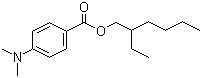 |
| Molecular Formula | C17H27NO2 |
| Molecular Weight | 277.40 |
| CAS Registry Number | 21245-02-3 |
| EC Number | 244-289-3 |
| SMILES | CCCCC(CC)COC(=O)C1=CC=C(C=C1)N(C)C |
| Density | 0.995 |
|---|---|
| Boiling point | 325 °C |
| Refractive index | 1.542 |
| Flash point | >110 °C |
| Hazard Symbols |   GHS07;GHS08 Danger Details GHS07;GHS08 Danger Details | ||||||||||||||||||||||||||||
|---|---|---|---|---|---|---|---|---|---|---|---|---|---|---|---|---|---|---|---|---|---|---|---|---|---|---|---|---|---|
| Risk Statements | H315-H319-H335-H360 Details | ||||||||||||||||||||||||||||
| Safety Statements | P203-P261-P264-P264+P265-P271-P280-P302+P352-P304+P340-P305+P351+P338-P318-P319-P321-P332+P317-P337+P317-P362+P364-P403+P233-P405-P501 Details | ||||||||||||||||||||||||||||
| Hazard Classification | |||||||||||||||||||||||||||||
| |||||||||||||||||||||||||||||
| SDS | Available | ||||||||||||||||||||||||||||
 chemBlink Chemical Story
|
2-Ethylhexyl 4-dimethylaminobenzoate, commonly known as octyl dimethyl PABA, is an organic compound that plays a significant role in the cosmetic and pharmaceutical industries, particularly in sunscreens and other skin-care products. This compound is a derivative of para-aminobenzoic acid (PABA), modified to enhance its solubility and photostability. It is primarily used as a UV filter, offering protection against ultraviolet B (UVB) radiation, which is responsible for sunburn and contributes to the development of skin cancer. The discovery of 2-ethylhexyl 4-dimethylaminobenzoate can be traced back to the mid-20th century, a period marked by growing awareness of the harmful effects of UV radiation. As the demand for effective sun protection increased, researchers focused on developing UV filters that could provide broad-spectrum protection while being safe for human use. PABA was one of the first compounds to be used in sunscreens, but its application was limited by its tendency to cause allergic reactions in some individuals and its instability under sunlight. To address these limitations, scientists modified the PABA molecule by attaching an ethylhexyl group and a dimethylamino group, resulting in 2-ethylhexyl 4-dimethylaminobenzoate. This modification improved the compound's lipophilicity, making it more suitable for use in oil-based formulations, and enhanced its photostability, reducing the likelihood of degradation upon exposure to sunlight. As a result, this compound became a popular ingredient in sunscreens, known for its ability to absorb UVB radiation effectively. The primary application of 2-ethylhexyl 4-dimethylaminobenzoate is in sunscreens, where it acts as a chemical UV filter. Its effectiveness in absorbing UVB rays helps to prevent sunburn and reduces the risk of long-term skin damage, including premature aging and skin cancer. Due to its compatibility with other sunscreen ingredients and its ability to blend well in various formulations, it is commonly used in combination with other UV filters to provide broad-spectrum protection. This synergy with other filters helps to enhance the overall efficacy of sunscreens, ensuring comprehensive protection against both UVA and UVB radiation. In addition to its use in sunscreens, 2-ethylhexyl 4-dimethylaminobenzoate is also incorporated into a range of other personal care products, such as moisturizers, lip balms, and makeup products that offer sun protection. Its ability to provide UV protection while being non-greasy and easily absorbed by the skin makes it a favored choice in cosmetic formulations. Furthermore, it is often used in products designed for sensitive skin, as it is less likely to cause irritation compared to other UV filters. Beyond cosmetics, this compound has found applications in the pharmaceutical industry, particularly in topical medications that require UV protection to maintain their stability and efficacy. For instance, some dermatological treatments that are sensitive to light degradation may include 2-ethylhexyl 4-dimethylaminobenzoate to shield the active ingredients from UV exposure. Despite its widespread use, 2-ethylhexyl 4-dimethylaminobenzoate is not without its challenges. Concerns have been raised regarding its potential to cause allergic reactions, although these are generally less frequent compared to its predecessor, PABA. Additionally, as with many chemical UV filters, there is ongoing research into its environmental impact, particularly its effects on marine ecosystems, where it may contribute to coral bleaching. As a result, some regions have begun to regulate or restrict the use of certain chemical sunscreens, prompting the development of alternative UV filters that are more environmentally friendly. In conclusion, 2-ethylhexyl 4-dimethylaminobenzoate represents a significant advancement in the field of sun protection, offering enhanced UVB absorption, improved stability, and compatibility with a variety of cosmetic formulations. Its discovery and subsequent application have had a profound impact on the development of sunscreens and other personal care products, contributing to better skin protection and overall health. However, ongoing research and regulation are essential to address the environmental concerns associated with its use, ensuring that sun protection can be achieved without compromising ecological sustainability. References 2021. Sunscreens and Photoaging: A Review of Current Literature. American Journal of Clinical Dermatology, 22(6). DOI: 10.1007/s40257-021-00632-5 2022. Review on photoprotection: a clinician’s guide to the ingredients, characteristics, adverse effects, and disease-specific benefits of chemical and physical sunscreen compounds. Archives of Dermatological Research. DOI: 10.1007/s00403-022-02483-4 2024. Sunscreens in the aquatic environment and potential solutions for mitigation of sunscreen pollution. Euro-Mediterranean Journal for Environmental Integration. DOI: 10.1007/s41207-024-00655-4 |
| Market Analysis Reports |