
Online Database of Chemicals from Around the World
| Hangzhou Verychem Science And Technology Co., Ltd. | China | |||
|---|---|---|---|---|
 | www.verychem.com | |||
 | +86 (571) 8816-2785 +86 13606544505 | |||
 | +86 (571) 8816-2787 | |||
 | lucy@verychem.com | |||
| Chemical manufacturer since 2004 | ||||
| chemBlink Massive supplier since 2021 | ||||
| Changzhou Litong Chem Co., Ltd. | China | |||
|---|---|---|---|---|
| www.litonchem.com | |||
| +86 (519) 8630-1238 | |||
| +86 (519) 8659-1192 | |||
| htszh2004@163.com | |||
| Chemical manufacturer since 2005 | ||||
| chemBlink Standard supplier since 2014 | ||||
| Hangzhou Leap Chem Co., Ltd. | China | |||
|---|---|---|---|---|
| www.leapchem.com | |||
| +86 (571) 8771-1850 | |||
| market19@leapchem.com | |||
 | QQ Chat | |||
| Chemical manufacturer since 2006 | ||||
| chemBlink Standard supplier since 2015 | ||||
| Amadis Chemical Co., Ltd. | China | |||
|---|---|---|---|---|
| www.amadischem.com | |||
| +86 (571) 8992-5085 | |||
| +86 (571) 8992-5065 | |||
| sales@amadischem.com | |||
| Chemical manufacturer since 2010 | ||||
| chemBlink Standard supplier since 2015 | ||||
| Classification | Biochemical >> Nucleoside drugs >> Nucleoside intermediate |
|---|---|
| Name | 5-Methylcytidine |
| Synonyms | 3: PN: US20060035254 PAGE: 63 claimed sequence; NSC 363933 |
| Molecular Structure | 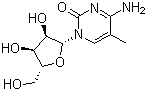 |
| Molecular Formula | C10H15N3O5 |
| Molecular Weight | 257.24 |
| Protein Sequence | N |
| CAS Registry Number | 2140-61-6 |
| EC Number | 218-390-8 |
| SMILES | CC1=CN(C(=O)N=C1N)[C@H]2[C@@H]([C@@H]([C@H](O2)CO)O)O |
| Density | 1.8±0.1 g/cm3, Calc.* |
|---|---|
| Melting point | 212-215 °C (Expl.) |
| Index of Refraction | 1.725, Calc.* |
| Boiling Point | 537.5±60.0 °C (760 mmHg), Calc.* |
| Flash Point | 278.9±32.9 °C, Calc.* |
| * | Calculated using Advanced Chemistry Development (ACD/Labs) Software. |
| Hazard Symbols |  GHS07 Warning Details GHS07 Warning Details |
|---|---|
| Risk Statements | H315-H319-H335 Details |
| Safety Statements | P261-P305+P351+P338 Details |
| SDS | Available |
 chemBlink Chemical Story
|
5-Methylcytidine is a modified nucleoside in which a methyl group is attached to the carbon-5 position of the pyrimidine ring of cytidine. It is a naturally occurring derivative of cytidine, one of the four nucleosides that make up RNA. This modification is part of the broader class of nucleoside modifications that play important roles in the regulation of gene expression and cellular functions. 5-Methylcytidine is involved in the process of RNA methylation, where it is found as a methylated form of cytidine in the RNA of various organisms. The methylation of cytidine residues within RNA molecules is a key regulatory mechanism in the expression of genes and affects the stability, splicing, translation, and turnover of RNA. The addition of a methyl group at the 5-position of the pyrimidine ring modifies the interactions between RNA and RNA-binding proteins, influencing the molecular processes of RNA metabolism. In biological systems, 5-methylcytidine is widely present in the RNA of all eukaryotic cells and has been implicated in various aspects of RNA processing, including RNA splicing and the regulation of gene expression. Methylation at the 5-position of cytidine residues can regulate RNA stability, translation efficiency, and the formation of higher-order RNA structures, all of which are important in cellular function and gene regulation. It also plays a role in the epigenetic regulation of gene expression through the methylation of DNA, where it influences the transcriptional activity of genes and is involved in processes such as X-chromosome inactivation and genomic imprinting. The compound's role in RNA modification is essential for various biological processes. It has been shown that the methylation of cytidine residues, such as in the case of 5-methylcytidine, affects the three-dimensional structure of RNA and its interaction with proteins. This interaction can alter the stability and function of RNA molecules and is crucial in regulating various aspects of cellular processes, including cell differentiation, proliferation, and apoptosis. In addition to its role in RNA biology, 5-methylcytidine has been implicated in a variety of disease processes, particularly those involving abnormal RNA metabolism and gene expression regulation. Research has shown that dysregulation of RNA methylation patterns, including those involving 5-methylcytidine, may contribute to the development of various cancers and neurological disorders. Changes in the methylation status of RNA and DNA are a hallmark of many diseases, including various types of cancer, where the methylation patterns of both DNA and RNA can influence tumorigenesis and cancer progression. Therapeutically, 5-methylcytidine has been investigated for its potential in modulating gene expression. Its role in RNA metabolism and gene regulation suggests that it could be used in therapeutic applications where the modulation of gene expression is beneficial. This includes research into targeted therapies for cancer, where the modulation of RNA methylation could influence the expression of tumor-suppressor genes or oncogenes. The compound is also of interest in the context of aging and age-related diseases. Since RNA methylation patterns change with age and are involved in the regulation of genes associated with aging and cellular senescence, understanding the role of 5-methylcytidine in these processes may provide insights into aging and related conditions. However, the specific therapeutic applications of 5-methylcytidine itself are still being explored in the field of epigenetics and gene therapy. Overall, 5-methylcytidine is a critical molecule in the regulation of RNA function and gene expression, and its role in biological processes makes it an important subject of research in fields such as cancer biology, neurobiology, and epigenetics. References 1960. The isolation of 5-methylcytidine from RNA. Biochimica et Biophysica Acta, 38(2). DOI: 10.1016/0006-3002(60)91219-1 2024. Stress-induced modification of Escherichia coli tRNA generates 5-methylcytidine in the variable loop. Proceedings of the National Academy of Sciences of the United States of America, 121(45). DOI: 10.1073/pnas.2317857121 2024. The extensive m5C epitranscriptome of Thermococcus kodakarensis is generated by a suite of RNA methyltransferases that support thermophily. Nature Communications, 15(1). DOI: 10.1038/s41467-024-51410-w |
| Market Analysis Reports |