
Online Database of Chemicals from Around the World
| Changzhou Ditong Chemical Co., Ltd. | China | |||
|---|---|---|---|---|
 | www.edengenechem.com | |||
 | +86 (519) 8829-8848 +86 18118010980 | |||
 | info@edengenechem.com sale@edengenechem.com | |||
 | QQ Chat | |||
 | WeChat: 18118010980 | |||
| Chemical manufacturer since 2006 | ||||
| chemBlink Premium supplier since 2026 | ||||
| Classification | Pharmaceutical intermediate >> OLED material intermediate |
|---|---|
| Name | 9-(1-Naphthyl)carbazole |
| Molecular Structure | 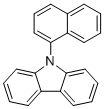 |
| Molecular Formula | C22H15N |
| Molecular Weight | 293.36 |
| CAS Registry Number | 22034-43-1 |
| EC Number | 808-157-4 |
| SMILES | C1=CC=C2C(=C1)C=CC=C2N3C4=CC=CC=C4C5=CC=CC=C53 |
| Solubility | 0.004968 mg/L (25 °C water) |
|---|---|
| Density | 1.2±0.1 g/cm3, Calc.* |
| Index of Refraction | 1.669, Calc.* |
| Melting point | 185.42 °C |
| Boiling Point | 503.7±23.0 °C (760 mmHg), Calc.*, 456.55 °C |
| Flash Point | 258.4±22.6 °C, Calc.* |
| * | Calculated using Advanced Chemistry Development (ACD/Labs) Software. |
| Hazard Symbols |  GHS07 Warning Details GHS07 Warning Details | ||||||||||||
|---|---|---|---|---|---|---|---|---|---|---|---|---|---|
| Risk Statements | H315-H319 Details | ||||||||||||
| Safety Statements | P264-P264+P265-P280-P302+P352-P305+P351+P338-P321-P332+P317-P337+P317-P362+P364 Details | ||||||||||||
| Hazard Classification | |||||||||||||
| |||||||||||||
| SDS | Available | ||||||||||||
 chemBlink Chemical Story
|
9-(1-Naphthyl)carbazole is an aromatic heterocyclic compound that belongs to the carbazole family, a class of tricyclic nitrogen-containing molecules characterized by a fused indole and benzene structure. In this derivative, the carbazole core is substituted at the 9-position with a naphthyl group oriented in the 1-position. This structural modification significantly alters the electronic and optical properties of the molecule, making it of particular interest in materials science and organic electronics. The discovery and synthesis of carbazole derivatives such as 9-(1-naphthyl)carbazole can be traced back to the growing interest in heteroaromatic compounds during the 20th century. Carbazole itself was first isolated from coal tar in the 19th century, and it became a valuable framework for synthetic modification due to its stability, planarity, and electronic properties. Substitution at the 9-position was pursued to extend the π-conjugation of the molecule and enhance its utility in optoelectronic applications. The introduction of a naphthyl moiety, with its large aromatic surface, provides increased conjugation and modifies both charge transport and photophysical behavior. The compound is typically synthesized using transition-metal-catalyzed cross-coupling reactions, with the Suzuki–Miyaura and Ullmann coupling methods being common strategies. These approaches enable the formation of the C–C bond between carbazole and the naphthyl unit with high efficiency. Alternative synthetic routes involve Friedel–Crafts-type reactions and modern palladium-catalyzed arylations, which allow for precise substitution control. Applications of 9-(1-naphthyl)carbazole are most prominent in the field of organic electronics. The extended π-conjugation system and strong photoluminescent properties make the compound suitable as a building block in organic light-emitting diodes (OLEDs), organic field-effect transistors (OFETs), and photovoltaic devices. In OLED technology, carbazole-based derivatives are often employed as hole-transport materials due to their high thermal stability and favorable highest occupied molecular orbital (HOMO) energy levels. The addition of the naphthyl group at the 9-position enhances intermolecular stacking and charge mobility, improving the efficiency of emissive layers in device architectures. In organic photovoltaics, 9-(1-naphthyl)carbazole serves as a donor material in bulk heterojunction solar cells, where its conjugated framework facilitates light absorption and charge transfer. It has also been investigated in the synthesis of dendritic and polymeric structures, where the carbazole-naphthyl motif functions as a chromophore or structural unit for photoconductive polymers. Beyond optoelectronic applications, derivatives of 9-(1-naphthyl)carbazole have been explored for their potential in supramolecular chemistry and sensing. The large aromatic surface area enables strong π–π interactions, which are useful in host–guest chemistry and the construction of supramolecular assemblies. Furthermore, its photophysical properties can be tuned by chemical modification, opening pathways to applications in fluorescence sensing. In summary, 9-(1-naphthyl)carbazole is a synthetically derived aromatic heterocycle that extends the electronic properties of the carbazole scaffold through conjugation with a naphthyl group. While its biological significance is limited, the compound has found broad utility in modern materials science, particularly in organic electronics, where its stability, optical characteristics, and charge-transport properties make it a valuable material for device engineering. It continues to play a role as a model compound for the design of next-generation functional organic materials. References 2025. Condition-controlled divergent trifluoroalkylation: a diversity-oriented synthesis strategy for efficient construction of CF3-decorated carbazole libraries. BMC Chemistry. DOI: 10.1186/s13065-025-01536-9 2022. Mild and metal-free Birch-type hydrogenation of (hetero)arenes with boron carbonitride in water. Nature Catalysis. DOI: 10.1038/s41929-022-00886-0 1974. Phosphorescence, Triplet States, and the Shpol’skii Effect. Guide to Fluorescence Literature. DOI: 10.1007/978-1-4684-6198-5_12 |
| Market Analysis Reports |