
Online Database of Chemicals from Around the World
| Guangzhou Wanqian Pharmaceutical Technology Co., Ltd. | China | |||
|---|---|---|---|---|
 | www.wqpharma.cn | |||
 | +86 13928768873 | |||
 | sales@wqpharma.cn | |||
 | QQ Chat | |||
 | WeChat: 13928768873 | |||
| Chemical distributor since 2013 | ||||
| chemBlink Standard supplier since 2026 | ||||
| Classification | Organic raw materials >> Amino compound >> Amide compound |
|---|---|
| Name | (S)-5-(2,2-Dimethyltetrahydro-2H-pyran-4-YL)-N-methyl-N-phenyl-1H-indole-2-carboxamide |
| Synonyms | 5-[(4S)-2,2-dimethyloxan-4-yl]-N-methyl-N-phenyl-1H-indole-2-carboxamide |
| Molecular Structure | 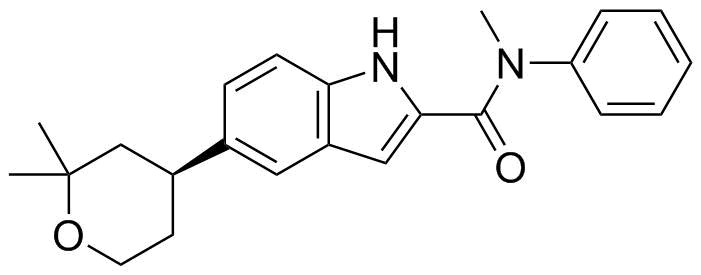 |
| Molecular Formula | C23H26N2O2 |
| Molecular Weight | 362.46 |
| CAS Registry Number | 2212021-79-7 |
| SMILES | CC1(C[C@H](CCO1)C2=CC3=C(C=C2)NC(=C3)C(=O)N(C)C4=CC=CC=C4)C |
| Hazard Symbols |  GHS07 Warning Details GHS07 Warning Details |
|---|---|
| Risk Statements | H302-H315-H319 Details |
| Safety Statements | P501-P270-P264-P280-P302+P352-P337+P313-P305+P351+P338-P362+P364-P332+P313-P301+P312+P330 Details |
| SDS | Available |
 chemBlink Chemical Story
|
(S)-5-(2,2-Dimethyltetrahydro-2H-pyran-4-yl)-N-methyl-N-phenyl-1H-indole-2-carboxamide is a highly substituted heterocyclic carboxamide containing an indole core, a cyclic ether substituent, and a tertiary aromatic amide. The molecule combines aromatic, heterocyclic, and conformationally constrained structural elements that contribute to its overall physicochemical and stereochemical properties. The central structural framework is an indole ring system. Indole consists of a bicyclic fused aromatic structure formed by fusion of a benzene ring with a pyrrole ring containing one nitrogen atom. The indole nucleus is an electron-rich heteroaromatic system because the lone pair of the pyrrolic nitrogen contributes to aromatic delocalization. Indole scaffolds are chemically important because they provide extensive π-electron character and can participate in hydrogen-bonding interactions through the NH group. At the 2-position of the indole ring, the molecule contains a carboxamide functionality. The amide nitrogen is substituted with both a methyl group and a phenyl group, making it a tertiary amide. Because the nitrogen is fully substituted, the amide lacks hydrogen-bond donor capability but retains a carbonyl oxygen that acts as a hydrogen-bond acceptor. The amide bond exhibits partial double-bond character through resonance between the nitrogen and carbonyl group, restricting rotation and contributing to structural rigidity. The N-phenyl substituent attached to the amide introduces an additional aromatic ring into the structure. The phenyl ring contributes hydrophobicity and can participate in π–π interactions. The N-methyl substituent slightly modifies the electronic properties and steric environment around the amide nitrogen. At the 5-position of the indole ring, the structure contains a substituted tetrahydropyran group, specifically a 2,2-dimethyltetrahydro-2H-pyran moiety attached through its 4-position. Tetrahydropyran is a six-membered saturated cyclic ether containing one oxygen atom within the ring. The oxygen atom introduces localized polarity and hydrogen-bond-accepting ability. The two methyl groups at the 2-position increase steric bulk and hydrophobic character while influencing preferred ring conformations. The descriptor (S) indicates the presence of a defined stereogenic center. Chirality is an important aspect of the molecular architecture because the spatial orientation of substituents affects three-dimensional shape and molecular recognition properties. The specified S configuration determines the arrangement of the tetrahydropyran substituent relative to the remainder of the molecule. From a conformational perspective, the tetrahydropyran ring generally adopts chair-like conformations that minimize steric interactions. The geminal dimethyl groups influence conformational preferences through steric effects. The indole and phenyl rings remain essentially planar aromatic systems, while the amide bond restricts rotational freedom between major portions of the molecule. From a physicochemical standpoint, the molecule contains both hydrophobic and polar regions. The indole and phenyl rings contribute extensive hydrophobic and aromatic character, while the amide carbonyl and ether oxygen contribute polarity and hydrogen-bond-accepting capability. This combination produces an amphiphilic profile with multiple potential intermolecular interaction sites. Chemically, the amide functionality is generally stable under neutral conditions but can undergo hydrolysis under strongly acidic or strongly basic environments. The cyclic ether is comparatively stable but can undergo cleavage under harsh acidic conditions. The indole ring can participate in electrophilic substitution reactions due to its electron-rich nature. Without verified literature specific to this exact compound, no claims can be made regarding biological activity or application. Based solely on established structural chemistry, (S)-5-(2,2-dimethyltetrahydro-2H-pyran-4-yl)-N-methyl-N-phenyl-1H-indole-2-carboxamide is best described as a chiral indole-derived tertiary carboxamide incorporating a substituted cyclic ether and multiple aromatic regions that collectively generate a conformationally structured, amphiphilic molecular framework. References 2024. Heterocyclic glp-1r agonists. US-2025304572-A1 Priority Date: 2024-03-29. URL: https://patents.google.com/patent/US2025304572A1 2023. A synthesis method of key intermediates of Orforglipron and its intermediates. CN-117777111-A Priority Date: 2023-12-26. URL: https://patents.google.com/patent/CN117777111A 2023. Glp-1 receptor targeting compounds and uses thereof. WO-2025119206-A1 Priority Date: 2023-12-05. URL: https://patents.google.com/patent/WO2025119206A1 |
| Market Analysis Reports |