
Online Database of Chemicals from Around the World
| Guangzhou Wanqian Pharmaceutical Technology Co., Ltd. | China | |||
|---|---|---|---|---|
 | www.wqpharma.cn | |||
 | +86 13928768873 | |||
 | sales@wqpharma.cn | |||
 | QQ Chat | |||
 | WeChat: 13928768873 | |||
| Chemical distributor since 2013 | ||||
| chemBlink Standard supplier since 2026 | ||||
| Classification | Organic raw materials >> Amino compound >> Amide compound |
|---|---|
| Name | 1-((1S,2S)-1-Cyano-2-methylcyclopropyl)-5-((4S)-2,2-dimethyloxan-4-yl)-N-methyl-N-phenylindole-2-carboxamide |
| Molecular Structure | 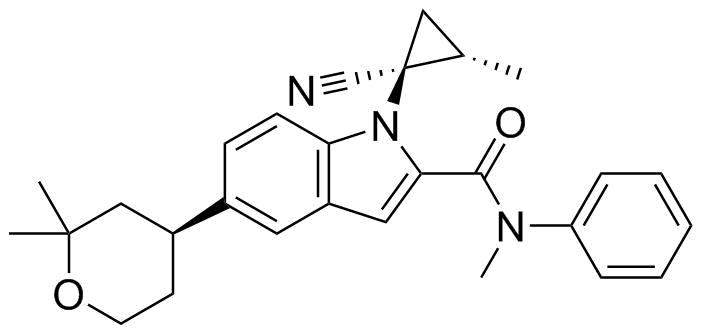 |
| Molecular Formula | C28H31N3O2 |
| Molecular Weight | 441.56 |
| CAS Registry Number | 2212021-81-1 |
| SMILES | C[C@H]1C[C@]1(C#N)N2C3=C(C=C(C=C3)[C@H]4CCOC(C4)(C)C)C=C2C(=O)N(C)C5=CC=CC=C5 |
| Hazard Symbols |  GHS07 Warning Details GHS07 Warning Details |
|---|---|
| Risk Statements | H302-H315-H319 Details |
| Safety Statements | P501-P270-P264-P280-P302+P352-P337+P313-P305+P351+P338-P362+P364-P332+P313-P301+P312+P330 Details |
| SDS | Available |
 chemBlink Chemical Story
|
1-((1S,2S)-1-Cyano-2-methylcyclopropyl)-5-((4S)-2,2-dimethyloxan-4-yl)-N-methyl-N-phenylindole-2-carboxamide is a structurally complex chiral indole-derived carboxamide containing several distinct functional domains, including an indole heteroaromatic core, a substituted cyclopropyl nitrile fragment, a cyclic ether moiety, and a tertiary aromatic amide. The molecule combines rigid and flexible structural elements and contains multiple stereogenic centers that define its three-dimensional organization. The central framework of the molecule is an indole ring system. Indole consists of a fused bicyclic aromatic structure formed by fusion of a benzene ring with a pyrrole ring containing one nitrogen atom. This aromatic scaffold possesses extensive π-electron delocalization and is an electron-rich heterocycle. In the present structure, the indole nitrogen is substituted and therefore does not retain the NH hydrogen typically associated with unsubstituted indoles. Attached to the indole nitrogen at the 1-position is a substituted cyclopropyl fragment described as a (1S,2S)-1-cyano-2-methylcyclopropyl group. Cyclopropane is a three-membered carbocyclic ring characterized by significant ring strain due to its compressed bond angles. This strain creates distinctive electronic and conformational properties. The ring carries both a nitrile substituent and a methyl group. The nitrile functionality (–C≡N) contains a strongly polarized carbon–nitrogen triple bond and acts primarily as a hydrogen-bond acceptor. Nitriles are generally stable functional groups under neutral conditions and are strongly electron-withdrawing. The specified (1S,2S) stereochemistry defines the relative three-dimensional orientation of the nitrile and methyl substituents on the cyclopropane ring. The presence of stereogenic centers influences molecular shape and restricts the spatial arrangement of neighboring groups. At the 2-position of the indole core is a carboxamide functionality. The amide nitrogen bears both methyl and phenyl substituents, making this a tertiary amide. Tertiary amides cannot donate hydrogen bonds because the nitrogen lacks a hydrogen atom, but the carbonyl oxygen remains a strong hydrogen-bond acceptor. Resonance between the nitrogen and carbonyl group gives the amide bond partial double-bond character, decreasing rotational freedom and introducing structural rigidity. The phenyl substituent attached to the amide nitrogen adds hydrophobic and aromatic character. Aromatic systems contribute π-surface area and can participate in π–π interactions and hydrophobic associations. The N-methyl group further modifies steric and electronic properties surrounding the amide region. At the 5-position of the indole system is a (4S)-2,2-dimethyloxan-4-yl substituent. Oxane, commonly known as tetrahydropyran, is a six-membered saturated cyclic ether containing one oxygen atom within the ring. The oxygen atom contributes localized polarity and hydrogen-bond-accepting capability. Two methyl groups at the 2-position increase steric bulk and hydrophobic character and influence preferred ring conformations. The (4S) designation specifies the stereochemistry at the substituted carbon of the oxane ring. From a physicochemical perspective, the molecule contains both hydrophobic and polar regions. The indole and phenyl rings provide extensive aromatic hydrophobic surface area, while the amide carbonyl, ether oxygen, and nitrile group contribute polarity and hydrogen-bond-accepting functionality. The result is an amphiphilic molecular profile. Chemically, the nitrile group and tertiary amide are generally stable under neutral conditions. The indole system can undergo electrophilic aromatic substitution reactions under suitable conditions, while the cyclic ether may be susceptible to cleavage only under strongly acidic environments. The strained cyclopropane ring can also influence reactivity compared with larger carbocyclic systems. Without verified literature specific to this exact compound, no claims can be made regarding biological activity or applications. Based solely on structural chemistry, the compound is best described as a stereochemically defined indole-derived tertiary carboxamide containing a strained cyclopropyl nitrile fragment, a substituted cyclic ether, and multiple aromatic domains that collectively create a rigid and conformationally complex molecular architecture. References 2025. Process to make GLP1 RA and intermediates therefor. US-12365682-B2 Grant Date: 2025-07-22. URL: https://patents.google.com/patent/US12365682B2 2024. Preparation method of GLP-1 receptor agonist Orforglipron. CN-119552158-A Priority Date: 2024-10-22. URL: https://patents.google.com/patent/CN119552158A |
| Market Analysis Reports |