
Online Database of Chemicals from Around the World
| Guangzhou Wanqian Pharmaceutical Technology Co., Ltd. | China | |||
|---|---|---|---|---|
 | www.wqpharma.cn | |||
 | +86 13928768873 | |||
 | sales@wqpharma.cn | |||
 | QQ Chat | |||
 | WeChat: 13928768873 | |||
| Chemical distributor since 2013 | ||||
| chemBlink Standard supplier since 2026 | ||||
| Classification | Organic raw materials >> Ketone compound |
|---|---|
| Name | (S)-1-(4-fluoro-1-methyl-1H-indazol-5-yl)-3-(2-(4-fluoro-3,5-dimethylphenyl)-4-methyl-4,5,6,7-tetrahydro-2H-pyrazolo(4,3-c)pyridin-3-yl)-1,3-dihydro-2H-imidazol-2-one |
| Synonyms | 1-[(4S)-2-(4-fluoro-3,5-dimethylphenyl)-4-methyl-4,5,6,7-tetrahydropyrazolo[4,3-c]pyridin-3-yl]-3-(4-fluoro-1-methylindazol-5-yl)imidazol-2-one |
| Molecular Structure | 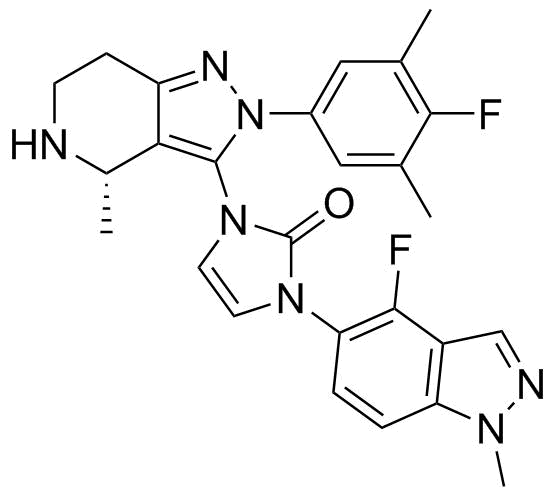 |
| Molecular Formula | C26H25F2N7O |
| Molecular Weight | 489.52 |
| CAS Registry Number | 2212022-56-3 |
| EC Number | 998-345-3 |
| SMILES | C[C@H]1C2=C(N(N=C2CCN1)C3=CC(=C(C(=C3)C)F)C)N4C=CN(C4=O)C5=C(C6=C(C=C5)N(N=C6)C)F |
| Density | 1.45±0.1g/mL (Expl.) |
|---|---|
| Hazard Symbols |  GHS07 Warning Details GHS07 Warning Details |
|---|---|
| Risk Statements | H302-H315-H319-H335 Details |
| Safety Statements | P261-P264-P270-P271-P280-P301+P312-P302+P352-P304+P340-P305+P351+P338-P330-P332+P313-P337+P313-P362-P403+P233-P405-P501 Details |
| SDS | Available |
 chemBlink Chemical Story
|
(S)-1-(4-fluoro-1-methyl-1H-indazol-5-yl)-3-(2-(4-fluoro-3,5-dimethylphenyl)-4-methyl-4,5,6,7-tetrahydro-2H-pyrazolo[4,3-c]pyridin-3-yl)-1,3-dihydro-2H-imidazol-2-one is a highly complex, stereochemically defined heterocyclic compound composed of multiple fused nitrogen-containing ring systems, fluorinated aromatic substituents, and a central imidazol-2-one core. The molecule is characterized by a rigid polycyclic architecture combined with several electronically diverse functional groups. The central structural motif is the 1,3-dihydro-2H-imidazol-2-one ring system. This is a five-membered heterocycle containing two nitrogen atoms and a carbonyl group at the 2-position. The imidazol-2-one core is highly polar due to the presence of the carbonyl functionality, which acts as a hydrogen-bond acceptor, and the adjacent nitrogen atoms, which influence electron distribution through resonance. The ring system exhibits partial double-bond character across the N–C–N framework, contributing to conformational rigidity. At the 1-position of the imidazol-2-one is a 4-fluoro-1-methyl-1H-indazol-5-yl substituent. Indazole is a bicyclic heteroaromatic system formed by fusion of a benzene ring and a pyrazole ring. The indazole framework contains two adjacent nitrogen atoms in the five-membered ring, creating a relatively electron-rich heteroaromatic system. Substitution with fluorine at the 4-position introduces strong electron-withdrawing effects due to the high electronegativity of fluorine and the strength of the carbon–fluorine bond. The N-methyl substitution further modifies the electronic properties of the heterocycle and removes potential hydrogen-bond donor capability at that nitrogen site. At the 3-position of the imidazol-2-one is a large, highly substituted heterocyclic fragment consisting of a pyrazolo[4,3-c]pyridine system. This fused bicyclic structure contains multiple nitrogen atoms distributed across a partially saturated ring system (4,5,6,7-tetrahydro). The partial saturation introduces conformational flexibility relative to fully aromatic heterocycles while maintaining a constrained bicyclic framework. A methyl substituent at the 4-position of this system adds steric bulk and hydrophobic character, influencing local conformational preferences. Attached to this pyrazolopyridine scaffold is a 4-fluoro-3,5-dimethylphenyl group. This substituted phenyl ring contributes significant hydrophobic surface area and aromatic character. The fluorine substituent at the para position strongly influences electronic distribution through inductive effects, while the two methyl groups at the 3 and 5 positions increase steric hindrance and lipophilicity, reducing rotational freedom around adjacent bonds. The molecule contains a defined stereocenter indicated by the (S) configuration. This stereochemical element establishes a specific three-dimensional arrangement of substituents, which is important in determining the overall shape of the fused heterocyclic framework and its spatial presentation of functional groups. From a structural perspective, the compound is highly rigid due to multiple fused ring systems, including indazole, imidazol-2-one, and pyrazolopyridine frameworks. This rigidity limits conformational flexibility and results in a well-defined three-dimensional geometry. The presence of multiple aromatic and heteroaromatic rings introduces extensive π-electron systems that can influence stacking interactions and electronic distribution. Physicochemically, the molecule contains both polar and nonpolar regions. The imidazol-2-one carbonyl and multiple nitrogen atoms provide strong polarity and hydrogen-bond-accepting capability, while the fluorinated aromatic rings and methyl substituents contribute hydrophobic character. The combination of these features produces an amphiphilic molecule with a complex balance of solubility and lipophilicity characteristics. Chemically, the most reactive functional groups include the imidazol-2-one carbonyl, which can participate in hydrogen bonding and potential hydrolytic reactions under extreme conditions, and the heteroaromatic nitrogen atoms, which can be protonated under acidic environments. The fluorinated aromatic rings are chemically stable and resistant to metabolic or chemical degradation under typical conditions. Without verified literature specific to this compound, no claims can be made regarding biological activity or application. Based strictly on structural analysis, it is best described as a stereochemically defined, rigid, polyheteroaromatic system incorporating an imidazol-2-one core linked to fluorinated indazole and substituted pyrazolopyridine aromatic domains, forming a highly functionalized and conformationally constrained molecular architecture. References 2024. Preparation method of GLP-1 receptor agonist Orforglipron. CN-119552158-A Priority Date: 2024-10-22 |
| Market Analysis Reports |