
Online Database of Chemicals from Around the World
| BOC Sciences | USA | |||
|---|---|---|---|---|
 | www.bocsci.com | |||
 | +1 (631) 485-4226 | |||
 | +1 (631) 614-7828 | |||
 | info@bocsci.com | |||
| Chemical manufacturer | ||||
| chemBlink Standard supplier since 2010 | ||||
| Sigma-Aldrich, Inc. | China | |||
|---|---|---|---|---|
| www.sigmaaldrich.com | |||
| +86 (21) 6141-5566 800-819-3336 | |||
| orderCN@sial.com | |||
| Chemical manufacturer since 1992 | ||||
| chemBlink Standard supplier since 2013 | ||||
| Changzhou Jiuwu Chemical Co., Ltd. | China | |||
|---|---|---|---|---|
| www.jiuwuchem.com | |||
| +86 (519) 8512-1086 +86 13775162768 | |||
| +86 (519) 8512-5369 | |||
| info@jiuwuchem.cn | |||
 | QQ Chat | |||
| Chemical manufacturer since 2009 | ||||
| chemBlink Standard supplier since 2023 | ||||
| Atlantic Research Chemicals Ltd. | UK | |||
|---|---|---|---|---|
| www.atlantic-chemicals.com | |||
| +44 (8707) 746-454 | |||
| +44 (8707) 746-455 | |||
| info@atlantic-chemicals.com | |||
| Chemical manufacturer | ||||
| Anvia Chemicals, LLC | USA | |||
|---|---|---|---|---|
| www.anviachem.com | |||
| +1 (414) 534-7845 | |||
| +1 (414) 762-5539 | |||
| sales@anviachem.com | |||
| Chemical manufacturer | ||||
| Classification | Organic raw materials >> Amino compound >> Cycloalkylamines, aromatic monoamines, aromatic polyamines and derivatives and salts |
|---|---|
| Name | 4-(Trifluoromethyl)-N-methylaniline |
| Synonyms | N-Methyl-4-(trifluoromethyl)aniline; N-Methyl-N-[4-(trifluoromethyl)phenyl]amine |
| Molecular Structure | 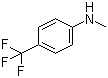 |
| Molecular Formula | C8H8F3N |
| Molecular Weight | 175.15 |
| CAS Registry Number | 22864-65-9 |
| EC Number | 626-543-9 |
| SMILES | CNC1=CC=C(C=C1)C(F)(F)F |
| Density | 1.2±0.1 g/cm3, Calc.*, 1.2394 (Expl.) |
|---|---|
| Index of Refraction | 1.485, Calc.*, 1.4888 (Expl.) |
| Boiling Point | 193.0±40.0 °C (760 mmHg), Calc.*, 105-106 °C (20 mmHg) (Expl.) |
| Flash Point | 70.5±27.3 °C, Calc.*, 98 °C (Expl.) |
| * | Calculated using Advanced Chemistry Development (ACD/Labs) Software. |
| Hazard Symbols |  GHS07 Warning Details GHS07 Warning Details | ||||||||||||||||||||||||||||
|---|---|---|---|---|---|---|---|---|---|---|---|---|---|---|---|---|---|---|---|---|---|---|---|---|---|---|---|---|---|
| Risk Statements | H302-H317 Details | ||||||||||||||||||||||||||||
| Safety Statements | P261-P264-P264+P265-P270-P272-P280-P301+P317-P302+P352-P305+P354+P338-P317-P321-P330-P333+P317-P362+P364-P501 Details | ||||||||||||||||||||||||||||
| Hazard Classification | |||||||||||||||||||||||||||||
| |||||||||||||||||||||||||||||
| SDS | Available | ||||||||||||||||||||||||||||
 chemBlink Chemical Story
|
4-(Trifluoromethyl)-N-methylaniline is an aromatic amine compound that features a trifluoromethyl group (-CF₃) at the 4-position of the benzene ring, and a methyl group attached to the nitrogen of the amine functionality. This compound is part of a broader class of trifluoromethyl-substituted anilines, which are notable for their unique chemical properties derived from the electronegativity and size of the trifluoromethyl group. These properties make such compounds valuable in various chemical synthesis applications, including drug discovery, material science, and agrochemical development. The discovery of 4-(trifluoromethyl)-N-methylaniline is part of the larger trend of incorporating fluorine and its derivatives into organic compounds for their ability to modify electronic properties, solubility, and reactivity. Fluorine substitution is particularly significant in organic chemistry due to the distinctive characteristics it imparts to molecules, including enhanced metabolic stability in pharmaceuticals and altered solubility and hydrophobicity in material science. The synthesis of 4-(trifluoromethyl)-N-methylaniline typically involves introducing a trifluoromethyl group onto a suitable aniline precursor through electrophilic aromatic substitution reactions, with reagents like trifluoromethylating agents often being used. This compound can be characterized by methods like nuclear magnetic resonance (NMR) spectroscopy and mass spectrometry. 4-(Trifluoromethyl)-N-methylaniline has a variety of applications, notably in the pharmaceutical and agrochemical industries. One of its primary uses is as an intermediate in the synthesis of pharmaceuticals. The trifluoromethyl group is known to enhance the metabolic stability of drug molecules, enabling longer retention in the body and potentially reducing the frequency of dosing. Additionally, fluorine substitution often improves a compound’s affinity for biological targets, making it a valuable modification in drug design. For example, derivatives of 4-(trifluoromethyl)-N-methylaniline may be used to synthesize molecules that exhibit enhanced efficacy against diseases such as cancer, infections, or cardiovascular conditions. Moreover, 4-(trifluoromethyl)-N-methylaniline is a key intermediate in the synthesis of agrochemicals, including herbicides and pesticides. The trifluoromethyl group can alter the chemical behavior of the molecule, making it more selective or potent against specific pests or weeds. Fluorine-substituted anilines have been shown to have increased stability and can enhance the effectiveness of agricultural products, allowing for more efficient and longer-lasting control of agricultural pests. The material science industry also benefits from the properties of 4-(trifluoromethyl)-N-methylaniline. Fluorine-containing compounds are widely used in the development of specialty polymers, coatings, and electronic materials. The trifluoromethyl group can modify the solubility, thermal stability, and electronic properties of materials, which makes them valuable in designing high-performance coatings for electronics and other advanced applications. In particular, derivatives of 4-(trifluoromethyl)-N-methylaniline may be explored in the development of organic electronic materials such as organic light-emitting diodes (OLEDs), organic photovoltaics, and semiconductors. Additionally, the compound's ability to participate in further chemical transformations makes it an attractive candidate for use in the synthesis of a wide range of other functionalized organic molecules. Its incorporation into various synthetic pathways allows for the preparation of complex, fluorine-modified compounds that are useful in a wide range of applications across industries. In summary, 4-(trifluoromethyl)-N-methylaniline is a versatile chemical with broad applications in the pharmaceutical, agrochemical, and material science industries. Its trifluoromethyl group imparts enhanced stability and reactivity, making it a valuable building block in the design of bioactive compounds, agricultural chemicals, and advanced materials. As research continues in these fields, the utility of trifluoromethylated anilines like 4-(trifluoromethyl)-N-methylaniline is expected to expand further, offering new solutions to various scientific and industrial challenges. References 2020. Advances in Carbon-Element Bond Construction under Chan-Lam Cross-Coupling Conditions: A Second Decade. *Synthesis*, 52(24). DOI: 10.1055/s-0040-1705971 2013. Rhodium-Catalyzed Asymmetric Amination of Allylic Trichloroacetimidates. *Synthesis*, 45(10). DOI: 10.1055/s-0032-1316921 1969. Synthesis of substituted P,P-diethyl-N-methyl-N,N'-diphenylphosphinimidic amides. *Bulletin of the Academy of Sciences of the USSR, Division of chemical science*, 18(4). DOI: 10.1007/bf00907044 |
| Market Analysis Reports |