
Online Database of Chemicals from Around the World
| Anqing World Chemical Co., Ltd. | China | |||
|---|---|---|---|---|
 | www.worldchem.cn | |||
 | +86 18155670904 | |||
 | flint@worldpharma.cn | |||
 | QQ Chat | |||
| Chemical distributor since 2010 | ||||
| chemBlink Standard supplier since 2021 | ||||
| Shandong Dinghao Biotechnology Co., Ltd. | China | |||
|---|---|---|---|---|
| www.sddhpharm.com | |||
| +86 (0531) 5856-5868 | |||
| lily.zhou@sddhpharm.com | |||
| QQ Chat | |||
| Chemical manufacturer since 2018 | ||||
| chemBlink Standard supplier since 2022 | ||||
| Shanghai Worldyang Chemical Co., Ltd. | China | |||
|---|---|---|---|---|
| www.worldyachem.com | |||
| +86 13651600618 +86 (21) 5679-5779 | |||
 | +86 (21) 5679-5266 | |||
| sales7777@worldyachem.com | |||
| QQ Chat | |||
 | WeChat: 13651600618 | |||
 | WhatsApp:+86 13651600618 | |||
| Chemical manufacturer since 2012 | ||||
| Classification | Flavors and spices >> Synthetic spice >> Lactone and oxygen-containing heterocyclic compound |
|---|---|
| Name | 2',3'-O-(1-methylethylidene)-Uridine 4-oxime 5'-(2-methylpropanoate) |
| Synonyms | [(3aR,4R,6R,6aR)-4-[4-(hydroxyamino)-2-oxopyrimidin-1-yl]-2,2-dimethyl-3a,4,6,6a-tetrahydrofuro[3,4-d][1,3]dioxol-6-yl]methyl 2-methylpropanoate |
| Molecular Structure | 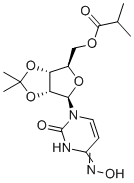 |
| Molecular Formula | C16H23N3O7 |
| Molecular Weight | 369.37 |
| CAS Registry Number | 2346620-55-9 |
| EC Number | 953-132-4 |
| SMILES | CC(C)C(=O)OC[C@@H]1[C@@H]2[C@H]([C@@H](O1)N3C=CC(=NC3=O)NO)OC(O2)(C)C |
| Solubility | Sparingly soluble (0.089 g/L) (25 °C), Calc.* |
|---|---|
| Density | 1.51±0.1 g/cm3 (20 °C 760 Torr), Calc.* |
| * | Calculated using Advanced Chemistry Development (ACD/Labs) Software V11.02 (©1994-2021 ACD/Labs) |
| Hazard Symbols |   GHS02;GHS07 Danger Details GHS02;GHS07 Danger Details |
|---|---|
| Risk Statements | H228-H315-H319 Details |
| Safety Statements | P240-P210-P241-P264-P280-P302+P352-P370+P378-P337+P313-P305+P351+P338-P362+P364-P332+P313 Details |
| Transport Information | UN 1325 |
| SDS | Available |
 chemBlink Chemical Story
|
2',3'-O-(1-methylethylidene)-Uridine 4-oxime 5'-(2-methylpropanoate) is a chemically modified nucleoside derivative based on uridine, a naturally occurring ribonucleoside composed of the nucleobase uracil attached to a ribose sugar. In this compound, specific functional groups have been introduced at several positions of the ribose and nucleobase moieties to alter its chemical properties and potential biological activity. The modification at the 2',3'-hydroxyl groups of the ribose sugar forms a cyclic acetal known as the 1-methylethylidene (isopropylidene) protective group. This protection strategy is commonly used in nucleoside chemistry to mask the vicinal diols during synthetic procedures, improving compound stability and selectivity during subsequent reactions. At the 4-position of the uracil base, the oxime group (–C=NOH) replaces the standard carbonyl oxygen. The oxime functionality introduces a site capable of additional hydrogen bonding and altered electronic characteristics, which can affect interactions with enzymes or nucleic acid targets. The 5'-hydroxyl of the ribose is esterified with 2-methylpropanoic acid (isobutyric acid), forming the corresponding 5'-ester. Esterification at this position can influence the compound's lipophilicity, membrane permeability, and metabolic stability. Such ester prodrugs are often designed to enhance cellular uptake or improve pharmacokinetic profiles. The synthesis of this derivative typically involves stepwise protection and functionalization of the uridine molecule, using standard nucleoside chemistry techniques. Protection of the 2',3'-diol as an isopropylidene acetal prevents side reactions, while selective oxidation and oximation introduce the 4-oxime group. Esterification of the 5'-hydroxyl with 2-methylpropanoic acid or its activated derivatives completes the modification. Compounds of this type are of interest in medicinal chemistry and nucleic acid research, as nucleoside analogs with base and sugar modifications can serve as inhibitors of viral polymerases or other enzymes involved in nucleic acid metabolism. The presence of the 4-oxime group may alter base-pairing properties or resistance to enzymatic degradation. Analytical characterization methods include nuclear magnetic resonance (NMR) spectroscopy to verify substitution patterns, mass spectrometry to confirm molecular weight, and infrared (IR) spectroscopy to detect functional groups such as oximes and esters. Chromatographic techniques such as high-performance liquid chromatography (HPLC) assess purity. Physicochemical properties of this compound reflect its partial protection and esterification, with increased hydrophobicity compared to native uridine, and altered solubility characteristics. These modifications influence its behavior in biological systems and chemical reactions. In summary, 2',3'-O-(1-methylethylidene)-Uridine 4-oxime 5'-(2-methylpropanoate) is a selectively modified uridine nucleoside featuring cyclic acetal protection of the sugar, an oxime substituent on the base, and esterification at the 5'-position. These structural changes are designed to modulate the compound's chemical stability, biological activity, and pharmacokinetic properties, making it a valuable intermediate or candidate in nucleoside-related research. References 2022. Manufacturing Route for Molnupiravir from Uridine. Synfacts, 18(3). DOI: 10.1055/s-0041-1737849 2022. Synthesis of Molnupiravir from Cytidine. Synfacts, 18(3). DOI: 10.1055/s-0041-1737848 2020. A Concise Route to MK-4482 (EIDD-2801) from Cytidine: Part 2. Synlett, 31(19). DOI: 10.1055/a-1275-2848 |
| Market Analysis Reports |