
Online Database of Chemicals from Around the World
| Changzhou Jiuwu Chemical Co., Ltd. | China | |||
|---|---|---|---|---|
 | www.jiuwuchem.com | |||
 | +86 (519) 8512-1086 +86 13775162768 | |||
 | +86 (519) 8512-5369 | |||
 | info@jiuwuchem.cn | |||
 | QQ Chat | |||
| Chemical manufacturer since 2009 | ||||
| chemBlink Standard supplier since 2023 | ||||
| Classification | Biochemical >> Amino acids and their derivatives >> Tryptophan derivatives |
|---|---|
| Name | Fmoc-Trp(7-Cl)-OH |
| Synonyms | (2S)-3-(7-chloro-1H-indol-3-yl)-2-(9H-fluoren-9-ylmethoxycarbonylamino)propanoic acid |
| Molecular Structure | 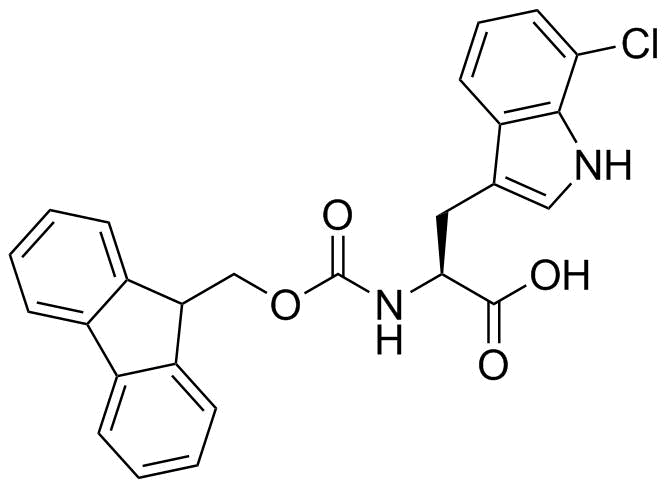 |
| Molecular Formula | C26H21ClN2O4 |
| Molecular Weight | 460.91 |
| Protein Sequence | X |
| CAS Registry Number | 2382374-53-8 |
| SMILES | C1=CC=C2C(=C1)C(C3=CC=CC=C32)COC(=O)N[C@@H](CC4=CNC5=C4C=CC=C5Cl)C(=O)O |
| Density | 1.4±0.1 g/cm3 Calc.* |
|---|---|
| Boiling point | 732.6±60.0 °C 760 mmHg (Calc.)* |
| Flash point | 396.9±32.9 °C (Calc.)* |
| Index of refraction | 1.692 (Calc.)* |
| * | Calculated using Advanced Chemistry Development (ACD/Labs) Software. |
| Hazard Symbols |  GHS07 Warning Details |
|---|---|
| Risk Statements | H302-H315-H319 Details |
| Safety Statements | P501-P270-P264-P280-P302+P352-P337+P313-P305+P351+P338-P362+P364-P332+P313-P301+P312+P330 Details |
| SDS | Available |
 chemBlink Chemical Story
|
Nature can place a chlorine atom on a complex aromatic ring with remarkable positional control. Chemists can then use a protected amino acid to bring the corresponding substitution pattern into a designed peptide. Fmoc-Trp(7-Cl)-OH, CAS 2382374-53-8, connects these two ideas, although an enzymatic reaction on free tryptophan and the preparation of this particular protected reagent are not the same documented event. The compound is an Fmoc-protected L-tryptophan derivative carrying chlorine at position 7 of the indole ring. The chlorine is covalently bonded to an aromatic carbon; it is not a chloride counterion. The alpha-amino group bears the removable Fmoc carbamate, while the carboxyl group remains an acid. The indole nitrogen is not described as Boc-protected in this product, an important distinction from differently protected tryptophan building blocks. Position is part of the identity. A 5-chloro or 6-chloro analogue has the same elemental composition but a different arrangement of atoms. An analytical mass consistent with a chlorinated tryptophan derivative therefore cannot establish the ring position by itself. Structural characterization and a correctly assigned starting material are needed to distinguish positional isomers, just as stereochemical characterization addresses the separate question of the amino-acid configuration. The biological background provides an unusually clear example of positional selectivity. A 2005 structural study of tryptophan 7-halogenase PrnA investigated how an enzyme directs chlorination to the 7 position. The enzyme binds its substrate in an organized environment rather than exposing every aromatic position equally to an uncontrolled reagent. The work concerns enzymatic chlorination of tryptophan, not proof that PrnA directly produces an Fmoc-protected compound. That distinction separates biosynthetic context from a laboratory building block's use. The protected derivative can be selected for peptide synthesis because its amino and carboxyl functions are arranged for controlled chain assembly. After the appropriate deprotection and coupling sequence, the chlorinated side chain becomes part of a larger molecule. The chlorine may be retained while the temporary amino protection is removed; it is the larger product that would be evaluated for its intended function. A ring chlorine changes size and electronic properties relative to the hydrogen it replaces. These differences can motivate structure-activity comparisons, but they do not dictate whether binding becomes stronger, weaker, or unchanged. A protein pocket may accommodate the substituent differently from another pocket, and a change in one assay need not imply improved overall behavior. The experimentally useful feature is a defined variation, not a guaranteed enhancement. Two independent dimensions of selectivity are therefore involved. Regioselectivity determines which ring carbon carries chlorine; chemoselectivity during peptide assembly determines which functional group reacts at a particular stage. Neither substitutes for stereochemical control at the alpha carbon. Treating these as separate questions makes the reagent's long name more informative than a general label such as chlorinated amino acid. Chlorine also provides an analytical illustration of what a measurement can establish. Its isotopes can contribute a recognizable pattern to a mass spectrum, helping support the presence of a chlorine-containing composition. But moving the atom around the ring leaves that elemental composition unchanged. Evidence for the element and evidence for its precise location are complementary, rather than competing, assignments. Its scientific interest lies in how a precise aromatic modification can be carried from a defined building block into a sequence-controlled molecule. The enzyme study explains a natural strategy for positioning chlorine, while synthesis provides a separate route for examining what that position means in a designed peptide. References: 1. Watanabe Chemical. Fmoc-Trp(7-Cl)-OH, product M03718; CAS 2382374-53-8 and specified structure. https://www.watanabechem.co.jp/search/details.php?code=M03718 2. Dong C et al. The structure of tryptophan 7-halogenase (PrnA) suggests a mechanism for regioselective chlorination. Science (2005). https://doi.org/10.1126/science.1116510 |
| Market Analysis Reports |