
Online Database of Chemicals from Around the World
| Longwoods Chemical Company Limited | China | |||
|---|---|---|---|---|
 | www.longwoods.cn | |||
 | +86 (28) 6310-8508 | |||
 | sale@longwoods.cn | |||
 | WhatsApp:+86 156 82536350 | |||
| Chemical distributor since 2022 | ||||
| chemBlink Standard supplier since 2026 | ||||
| Classification | Flavors and spices >> Synthetic spice >> Carboxylic acid and ester perfume >> Aliphatic carboxylate |
|---|---|
| Name | Isobutyl 3-hydroxy-2,2,4-trimethylpentanoate |
| Synonyms | 2-methylpropyl 3-hydroxy-2,2,4-trimethylpentanoate |
| Molecular Structure | 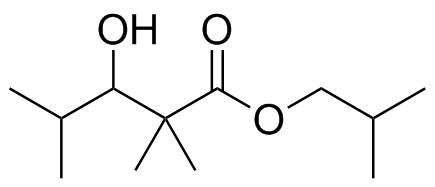 |
| Molecular Formula | C12H24O3 |
| Molecular Weight | 216.32 |
| CAS Registry Number | 244074-78-0 |
| SMILES | CC(C)COC(=O)C(C)(C)C(C(C)C)O |
| Density | 0.9±0.1 g/cm3 Calc.* |
|---|---|
| Boiling point | 290.2±13.0 °C 760 mmHg (Calc.)* |
| Flash point | 109.0±12.6 °C (Calc.)* |
| Index of refraction | 1.444 (Calc.)* |
| * | Calculated using Advanced Chemistry Development (ACD/Labs) Software. |
 chemBlink Chemical Story
|
Isobutyl 3-hydroxy-2,2,4-trimethylpentanoate combines an ester and a free secondary alcohol in a highly branched twelve-carbon molecule. Its ester carbonyl belongs to the five-carbon acid-derived portion. The isobutyl group lies on the alcohol-derived side of the ester bond. This distinction is easy to lose in a translated product name, yet it is essential for identifying the compound. PubChem associates CAS 244074-78-0 with this connectivity and the formula C₁₂H₂₄O₃. The material is documented commercially as a film-forming additive for waterborne coatings. Manufacturers associate the registry number with products intended for industrial paint, including steel-structure coatings. That is evidence of a stated formulation use, rather than independent validation of every performance claim in a brochure. In particular, the registry number does not by itself establish low toxicity, biodegradability or compliance with a particular definition of volatile organic compounds. The formulation problem behind a coalescent is worth separating from those claims. A waterborne latex contains dispersed polymer particles. Removing water brings the particles together, but a durable film also requires them to deform and merge. Coalescing additives can temporarily change how readily the polymer phase undergoes that process. Their usefulness depends on the polymer, temperature and the rest of the formulation. An ingredient that works in one coating cannot be assigned a universal film-forming efficiency from its structural formula. This compound should also be distinguished from 2,2,4-trimethyl-1,3-pentanediol monoisobutyrate, often associated with CAS 25265-77-4. The similar names, twelve-carbon compositions and coating context invite confusion. In one structure, the carbonyl belongs to the hydroxy-substituted acid portion; in the other, it belongs to an isobutyrate attached to a diol-derived framework. Equal elemental compositions do not make those bonds equivalent. Checking which side of the ester carries the carbonyl resolves a distinction that molecular weight alone cannot. Its supported story is therefore both practical and structural: a commercially listed coalescing ingredient, and an example of why the arrangement of an ester matters as much as the total number of carbon atoms. References: 1. PubChem. Isobutyl 3-hydroxy-2,2,4-trimethylpentanoate, CID 536397. https://pubchem.ncbi.nlm.nih.gov/compound/536397 2. RunTai New Materials. RTC-240 coalescing-agent entry. https://www.runtaichem.com/product/coalescing-agent-series/ 3. Hongye Holding Group. SKC-240 coating-additive specification. https://en.hongyechem.com/products_details/44.html |
| Market Analysis Reports |