
Online Database of Chemicals from Around the World
| Changzhou Ditong Chemical Co., Ltd. | China | |||
|---|---|---|---|---|
 | www.edengenechem.com | |||
 | +86 (519) 8829-8848 +86 18118010980 | |||
 | info@edengenechem.com sale@edengenechem.com | |||
 | QQ Chat | |||
 | WeChat: 18118010980 | |||
| Chemical manufacturer since 2006 | ||||
| chemBlink Premium supplier since 2026 | ||||
| Classification | Organic raw materials >> Carboxylic compounds and derivatives >> Carboxylic esters and their derivatives |
|---|---|
| Name | 4-Hydroxybutyl acrylate |
| Synonyms | Acrylic acid 4-hydroxybutyl ester |
| Molecular Structure | 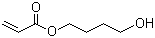 |
| Molecular Formula | C7H12O3 |
| Molecular Weight | 144.17 |
| CAS Registry Number | 2478-10-6 |
| EC Number | 219-606-3 |
| SMILES | C=CC(=O)OCCCCO |
| Density | 1.0±0.1 g/cm3 Calc.*, 1.041 g/mL (Expl.) |
|---|---|
| Melting point | -112 °C (Expl.) |
| Boiling point | 298.1 °C 760 mmHg (Calc.)*, 396.6 °C (Expl.) |
| Flash point | 86.6±15.4 °C (Calc.)*, 130 °C (Expl.) |
| Solubility | water: soluble (Expl.) |
| Index of refraction | 1.448 (Calc.)*, 1.452 (Expl.) |
| * | Calculated using Advanced Chemistry Development (ACD/Labs) Software. |
| Hazard Symbols |   GHS05;GHS07 Danger Details GHS05;GHS07 Danger Details | ||||||||||||||||||||||||||||||||||||||||||||
|---|---|---|---|---|---|---|---|---|---|---|---|---|---|---|---|---|---|---|---|---|---|---|---|---|---|---|---|---|---|---|---|---|---|---|---|---|---|---|---|---|---|---|---|---|---|
| Risk Statements | H302-H312-H315-H317-H318-H319-H332-H335 Details | ||||||||||||||||||||||||||||||||||||||||||||
| Safety Statements | P261-P264-P264+P265-P270-P271-P272-P280-P301+P317-P302+P352-P304+P340-P305+P351+P338-P305+P354+P338-P317-P319-P321-P330-P332+P317-P333+P317-P337+P317-P362+P364-P403+P233-P405-P501 Details | ||||||||||||||||||||||||||||||||||||||||||||
| Hazard Classification | |||||||||||||||||||||||||||||||||||||||||||||
| |||||||||||||||||||||||||||||||||||||||||||||
| SDS | Available | ||||||||||||||||||||||||||||||||||||||||||||
 chemBlink Chemical Story
|
4-Hydroxybutyl acrylate is a hydroxyl-functional acrylate monomer with the molecular formula C7H12O3. It contains both a reactive acrylate group and a terminal hydroxyl group, which makes it a versatile building block in polymer chemistry. This bifunctional nature enables it to participate in both radical polymerization and condensation-type reactions. The compound is a clear, colorless liquid with moderate viscosity and a mild odor, and it exhibits good miscibility with water and common organic solvents. The compound is typically synthesized via the esterification of acrylic acid with 1,4-butanediol. In industrial settings, the process often employs acid catalysts such as p-toluenesulfonic acid or heterogeneous ion-exchange resins under azeotropic reflux to remove water and drive the reaction to completion. The resulting ester, 4-hydroxybutyl acrylate, is purified by distillation or extraction, depending on process design. Efficient production processes have been developed to maximize yield and minimize byproduct formation, with considerations for the thermal sensitivity of the acrylate group. The commercial interest in 4-hydroxybutyl acrylate has grown due to its ability to introduce both hydrophilicity and functionality into polymer structures. Its hydroxyl group serves as a reactive site for post-polymerization modifications, including crosslinking, chain extension, and urethane formation. As a result, the compound is widely used as a comonomer in the synthesis of waterborne acrylic dispersions, radiation-curable resins, and functionalized coatings. One of the primary applications of 4-hydroxybutyl acrylate is in the production of resins for coatings, adhesives, and sealants. When incorporated into polymer chains, the hydroxyl group improves substrate adhesion, flexibility, and weather resistance. The acrylate functionality allows for rapid UV or thermal curing, making it suitable for automotive and industrial coatings. Furthermore, its presence enhances pigment wetting and film formation in aqueous coating formulations. Another important use of 4-hydroxybutyl acrylate is in the development of hydrophilic or amphiphilic block copolymers through controlled radical polymerization techniques such as RAFT (Reversible Addition–Fragmentation Chain Transfer) polymerization. These polymers are investigated for drug delivery systems, nanostructured materials, and surfactant-like applications due to their self-assembly behavior in aqueous media. The hydroxyl groups also provide anchor points for covalent binding or further functionalization with biologically active or stimuli-responsive moieties. In the field of polyurethane chemistry, 4-hydroxybutyl acrylate can act as a chain extender or soft segment modifier. The hydroxyl group reacts readily with isocyanates to form urethane linkages, enabling the formation of tailor-made polymers with controlled mechanical properties and crosslinking densities. This has led to applications in elastomers, foams, and hydrogels. Safety considerations for handling 4-hydroxybutyl acrylate include its potential to cause skin and eye irritation and its sensitizing properties upon prolonged exposure. As with many acrylates, it should be handled in well-ventilated areas using personal protective equipment. Storage stability is improved by adding polymerization inhibitors such as hydroquinone or its derivatives and by avoiding exposure to heat and light. 4-Hydroxybutyl acrylate plays a significant role in modern polymer and materials chemistry due to its dual reactivity and ease of incorporation into various polymer architectures. It enables the design of functional materials with enhanced performance characteristics, making it an important intermediate in coatings, adhesives, biomedical materials, and specialty polymers. References Yang J I (2007) Production of 4‑Hydroxybutyl Acrylate and Its Reaction Kinetics over Amberlyst 15 Catalyst. Canadian Journal of Chemical Engineering 85(1):1–8 DOI: 10.1002/cjce.5450850108 Moraru M D, Kiss A A, Bildea C S (2022) Design and control of novel reaction–separation–recycle processes for the production of 4‑hydroxybutyl acrylate. Chemical Engineering Research & Design 177 801–814 DOI: 10.1016/j.cherd.2021.11.040 Buksa H, et al. (2023) Synthesis and Characterization of Charge‑Stabilized Poly(4‑hydroxybutyl acrylate) Latex by RAFT Aqueous Dispersion Polymerization: A New Precursor for Reverse Sequence Polymerization‑Induced Self‑Assembly. Macromolecules 56(11):4532–4545 DOI: 10.1021/acs.macromol.3c00534 |
| Market Analysis Reports |