
Online Database of Chemicals from Around the World
| AllessaSyntec GmbH & Co. KG | Germany | |||
|---|---|---|---|---|
 | www.allessasyntec.com | |||
 | +49 (69) 3054-7334 | |||
 | +49 (69) 3051-7206 | |||
 | steffen.partzsch@allessasyntec.com | |||
| Chemical manufacturer | ||||
| chemBlink Standard supplier since 2009 | ||||
| Alfa Chemistry | USA | |||
|---|---|---|---|---|
| www.alfa-chemistry.com | |||
| +1 (516) 734-6573 | |||
| +1 (516) 927-0118 | |||
| support@alfa-chemistry.com | |||
| Chemical manufacturer since 2005 | ||||
| chemBlink Standard supplier since 2012 | ||||
| Natural Micron Pharm Tech Co., Ltd. | China | |||
|---|---|---|---|---|
| nmpharmtech.com | |||
| +86 (0538) 535-2278 | |||
| info@nmpharmtech.com | |||
| Chemical manufacturer since 2012 | ||||
| chemBlink Standard supplier since 2025 | ||||
| Classification | Organic raw materials >> Ether compounds and their derivatives |
|---|---|
| Name | 4,4'-Bis(methoxymethyl)diphenyl ether |
| Synonyms | Bis(alpha-methoxy-p-tolyl) ether |
| Molecular Structure | 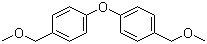 |
| Molecular Formula | C16H18O3 |
| Molecular Weight | 258.31 |
| CAS Registry Number | 2509-26-4 |
| EC Number | 219-722-4 |
| SMILES | COCC1=CC=C(C=C1)OC2=CC=C(C=C2)COC |
| Density | 1.1±0.1 g/cm3 Calc.* |
|---|---|
| Boiling point | 336.6±37.0 °C 760 mmHg (Calc.)* |
| Flash point | 113.0±23.8 °C (Calc.)* |
| Index of refraction | 1.544 (Calc.)* |
| * | Calculated using Advanced Chemistry Development (ACD/Labs) Software. |
| Hazard Symbols |  GHS07 Warning Details GHS07 Warning Details |
|---|---|
| Risk Statements | H302-H315-H319-H335 Details |
| Safety Statements | P261-P280-P301+P312-P302+P352-P305+P351+P338 Details |
| SDS | Available |
 chemBlink Chemical Story
|
4,4'-Bis(methoxymethyl)diphenyl ether is an organic compound classified as an aryl ether derivative, characterized by two phenyl rings connected via an ether linkage, each substituted with a methoxymethyl group at the para-position. This compound is part of a broader class of diphenyl ethers, which have attracted considerable attention due to their thermal stability, chemical resistance, and versatile applications in polymer chemistry and materials science. The discovery of aryl ether compounds dates back to the early development of organic synthesis in the 19th century. Diphenyl ether itself was first synthesized in the mid-1800s through the Ullmann ether synthesis, a copper-mediated coupling reaction that allowed for the formation of aryl-aryl bonds. Since then, structural modifications such as alkylation and acylation have been introduced to tailor diphenyl ethers for specific applications. The incorporation of methoxymethyl substituents at the para-positions was one such innovation, developed in the second half of the 20th century. These substituents enhance solubility and reactivity, offering greater utility in the preparation of functional materials. 4,4'-Bis(methoxymethyl)diphenyl ether has found use as a monomer or intermediate in the synthesis of high-performance polymers and resins. Its bis(methoxymethyl) functionality enables cross-linking reactions and further chemical transformations. In polymer chemistry, it is frequently utilized to prepare polyaryl ether ketones (PAEKs) and related polymers that are known for their exceptional mechanical strength, thermal resistance, and chemical inertness. These properties make such materials ideal for aerospace, automotive, and electronic applications. The compound also serves as a useful intermediate in the production of thermosetting resins. When reacted with phenolic or amine hardeners, the methoxymethyl groups act as methylol equivalents, leading to the formation of a dense, cross-linked network upon curing. This attribute has been leveraged in the development of coatings and adhesives that demand superior environmental stability and strong adhesive performance. In the field of materials science, 4,4'-Bis(methoxymethyl)diphenyl ether plays a role in the fabrication of advanced composite materials. Its structural features promote uniform dispersion within polymer matrices and contribute to the resulting materials’ enhanced mechanical properties. Research has also explored its use in modifying the dielectric properties of polymer films, where the rigid diphenyl ether core imparts dimensional stability, and the methoxymethyl groups allow for fine-tuning of polarity and cross-linking density. Synthetic methods for producing 4,4'-Bis(methoxymethyl)diphenyl ether generally involve the etherification of 4,4'-dihydroxydiphenyl ether with formaldehyde derivatives under controlled basic or acidic conditions. The methoxymethylation step is usually achieved via reaction with chloromethyl methyl ether or dimethoxymethane, often in the presence of a Lewis acid catalyst. Purification typically involves crystallization or column chromatography due to the compound’s relatively low volatility and solid-state stability. Toxicological data for 4,4'-Bis(methoxymethyl)diphenyl ether are limited, as it is used primarily in industrial settings with restricted exposure. However, as with other aryl ether derivatives, proper handling and adherence to safety protocols are essential. Methoxymethyl groups are known to release formaldehyde upon thermal decomposition or hydrolysis, necessitating caution during processing and curing operations. Environmental persistence is another aspect considered during the application of this compound. Like many aromatic ethers, its degradation under natural conditions is slow, and incineration or chemical recycling is generally preferred for waste management. Despite these limitations, the compound's benefits in performance materials continue to drive its use in specialty chemical and engineering applications. 4,4'-Bis(methoxymethyl)diphenyl ether exemplifies how structural modification of a simple diphenyl ether framework can yield a versatile chemical intermediate. Through its reactivity and stability, it contributes to the development of advanced materials with wide-ranging technological significance. References 2002. C16. Landolt-Börnstein - Group IV Physical Chemistry. DOI: 10.1007/10639283_17 |
| Market Analysis Reports |