
Online Database of Chemicals from Around the World
| Jiangsu Fuyuan New Material Co., Ltd. | China | |||
|---|---|---|---|---|
 | www.js-fuyuan.com | |||
 | +86 (25) 8436-4996 | |||
 | info@jsfuyuanchem.com | |||
| Chemical distributor since 2016 | ||||
| chemBlink Standard supplier since 2026 | ||||
| Classification | Organic raw materials >> Organic fluorine compound |
|---|---|
| Name | 1,1-Difluoroethylene/tetrafluoroethylene/1,1,2,3,3,3-hexafluoropropeneterpolymer |
| Molecular Structure | 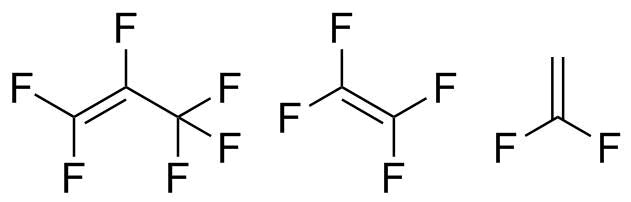 |
| Molecular Formula | C7H2F12 |
| Molecular Weight | 314.07 |
| CAS Registry Number | 25190-89-0 |
| EC Number | 607-638-4 |
| SMILES | C=C(F)F.FC(F)=C(F)C(F)(F)F.FC(F)=C(F)F |
| Hazard Classification | |||||||||
|---|---|---|---|---|---|---|---|---|---|
| |||||||||
 chemBlink Chemical Story
|
CAS 25190-89-0 identifies a terpolymer made from vinylidene fluoride, tetrafluoroethylene and hexafluoropropylene. Unlike the small molecules in many chemical catalogs, this CAS number does not describe one molecule with a single molecular weight. It describes a fluoropolymer whose properties depend on monomer ratios, molecular-weight distribution, branching, curing chemistry and processing history. That is why its chemical story is best told through polymer architecture rather than a conventional structural formula. The three fluorinated monomers contribute complementary features. Vinylidene fluoride introduces -CH2-CF2- units and helps provide elastomeric character. Tetrafluoroethylene contributes highly fluorinated -CF2-CF2- segments associated with chemical and thermal resistance. Hexafluoropropylene introduces bulky trifluoromethyl substitution that disrupts crystallization and helps keep the material rubber-like. By adjusting composition, manufacturers can create fluoroelastomers that remain flexible while resisting fuels, oils, solvents and elevated temperatures better than many ordinary hydrocarbon rubbers. Such materials are commonly cured into crosslinked elastomer networks before demanding service. Crosslinking prevents the polymer chains from flowing like a thermoplastic while preserving reversible deformation. The resulting fluorocarbon elastomers are useful for seals, gaskets and other components exposed to aggressive chemical environments. The exact cure package and grade matter greatly, so performance data for one commercial formulation should not automatically be transferred to every polymer carrying the same CAS number. Regulatory records provide unusually concrete examples of use. The U.S. FDA lists tetrafluoroethylene-hexafluoropropylene-vinylidene fluoride copolymers under CAS 25190-89-0 in food-contact notifications. FCN 127 describes a modified form used as a gasket or seal for food-processing equipment, while FCN 1121 describes the copolymer as a processing additive for food-contact polymers under specified conditions. FDA also maintains a cumulative estimated dietary intake entry for this polymer. The substance also appears in U.S. EPA testing-consent regulations for dry non-melt fluoroelastomer resin or gum, and ECHA lists it as a REACH-registered substance. These records show how a single polymer identity can span both materials engineering and regulatory assessment. The important chemical idea is the deliberate frustration of crystallinity. A chain made only from highly regular fluorinated units can become too crystalline for elastomeric behavior. Incorporating different comonomers, especially the bulky HFP unit, disrupts regular packing while preserving extensive fluorination. CAS 25190-89-0 therefore illustrates how polymer chemists obtain a useful compromise: the chemical resistance associated with C-F-rich structures together with the flexibility required of an elastomer. References: 1. U.S. FDA, FCN 127, CAS 25190-89-0. 2. U.S. FDA, FCN 1121, tetrafluoroethylene-hexafluoropropylene-vinylidene fluoride copolymers. 3. U.S. FDA CEDI database, CAS 25190-89-0. 4. ECHA Substance Information, CAS 25190-89-0. 5. 40 CFR 799.5025, fluoroelastomer testing consent orders. |
| Market Analysis Reports |