
Online Database of Chemicals from Around the World
| Simagchem Corporation | China | |||
|---|---|---|---|---|
 | www.simagchem.com | |||
 | +86 13806087780 | |||
 | +86 (592) 268-0237 | |||
 | sale@simagchem.com | |||
| Chemical manufacturer since 2002 | ||||
| chemBlink Standard supplier since 2008 | ||||
| Guilin Peptide Technology Limited | China | |||
|---|---|---|---|---|
| www.novel-polylysine.com | |||
| +86 (773) 299-7535 | |||
| huiyisu@126.com | |||
| Chemical manufacturer since 2011 | ||||
| chemBlink Standard supplier since 2013 | ||||
| Hangzhou Leap Chem Co., Ltd. | China | |||
|---|---|---|---|---|
| www.leapchem.com | |||
| +86 (571) 8771-1850 | |||
| market19@leapchem.com | |||
 | QQ Chat | |||
| Chemical manufacturer since 2006 | ||||
| chemBlink Standard supplier since 2015 | ||||
| Qingdao Wanyuan Mountain Biontech Co., Ltd. | China | |||
|---|---|---|---|---|
| www.bionutrichem.com | |||
| +86 15092119928 | |||
| cuiningning@bionutrichem.com | |||
| QQ Chat | |||
| Chemical distributor since 2018 | ||||
| chemBlink Standard supplier since 2022 | ||||
| Shanghai Haohong Biomedical Technology Co., Ltd. | China | |||
|---|---|---|---|---|
| www.leyan.com | |||
| +86 4008210725 | |||
| malulu@leyan.com | |||
| QQ Chat | |||
| Chemical manufacturer since 2011 | ||||
| chemBlink Standard supplier since 2022 | ||||
| Autech Industry Co., Limited | China | |||
|---|---|---|---|---|
| www.autechindustry.com | |||
| +86 (151) 6531-0911 | |||
| sales@autechindustry.com | |||
| Chemical manufacturer since 2010 | ||||
| chemBlink Standard supplier since 2024 | ||||
| Shandong Liyoung Biotechnology Co., LTD. | China | |||
|---|---|---|---|---|
| www.lybiochem.com | |||
| +86 17852851861 | |||
| info@liyoungbio.com | |||
 | WeChat: liyangshengwu | |||
 | WhatsApp:+86 17852851861 | |||
| Chemical manufacturer since 2010 | ||||
| chemBlink Standard supplier since 2025 | ||||
| Classification | Biochemical >> Amino acids and their derivatives >> Glutamic acid derivative |
|---|---|
| Name | L-Glutamic acid polymer |
| Synonyms | Polyglutamic acid; alpha-L-Glutamic acid polymer; gamma-L-Polyglutamic acid; gamma-Poly(L-Glutamic acid) |
| Molecular Structure | 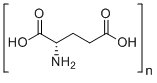 |
| Molecular Formula | (C5H9NO4)x |
| Molecular Weight | 50000-100000 |
| Protein Sequence | E |
| CAS Registry Number | 25513-46-6 |
| EC Number | 801-964-2 |
| SMILES | C(CC(=O)O)[C@@H](C(=O)O)N |
| Density | 1.4±0.1 g/cm3, Calc.* |
|---|---|
| Melting point | 199 °C (decomp.) (Expl.) |
| Index of Refraction | 1.522, Calc.* |
| Boiling Point | 333.8±32.0 °C (760 mmHg), Calc.*, 94-97 °C (3 mmHg) (Expl.) |
| Flash Point | 155.7±25.1 °C, Calc.* |
| * | Calculated using Advanced Chemistry Development (ACD/Labs) Software. |
| Hazard Symbols |  GHS07 Warning Details GHS07 Warning Details |
|---|---|
| Risk Statements | H319-H335-H315 Details |
| Safety Statements | P261-P264-P271-P280-P302+P352-P304+P340+P312-P305+P351+P338-P332+P313-P337+P313-P362-P403+P233-P405-P501 Details |
| SDS | Available |
 chemBlink Chemical Story
|
L-Glutamic acid polymer is a versatile compound composed of repeating units of L-glutamic acid, an amino acid commonly found in proteins. This polymer is formed through the polymerization of L-glutamic acid, and it has gained attention in various fields due to its unique properties and potential applications in biotechnology, medicine, and materials science. Its structure, consisting of the monomeric L-glutamic acid units linked together by peptide bonds, gives it functional characteristics that make it suitable for use in a wide range of applications. The discovery of L-glutamic acid polymer can be traced back to the study of proteins and peptides, where researchers began investigating the polymerization of amino acids to form chains that mimic natural biological polymers. L-glutamic acid, being a naturally occurring amino acid, was one of the first candidates to be studied for its ability to form such polymers. Scientists initially focused on understanding the behavior of this polymer in biological systems, especially its interaction with enzymes and its potential as a carrier of biological information. Over time, as polymer chemistry advanced, researchers were able to synthesize L-glutamic acid polymer more efficiently and understand its various physical and chemical properties. L-glutamic acid polymer finds numerous applications due to its biocompatibility and unique functional characteristics. One of the most significant uses of L-glutamic acid polymer is in drug delivery systems. The polymer’s ability to be chemically modified allows it to be tailored for the controlled release of therapeutic agents. For example, L-glutamic acid polymers can be used to encapsulate drugs, providing a mechanism to slowly release the drug over time, thereby improving therapeutic efficacy and reducing side effects. The biocompatible nature of L-glutamic acid polymer makes it particularly useful in medical applications, as it can be safely used in the human body without inducing immune reactions. In addition to drug delivery, L-glutamic acid polymer is also employed in tissue engineering. Its biocompatibility and ability to form hydrogels make it suitable for use in creating scaffolds for cell growth. These scaffolds can support the regeneration of damaged tissues, particularly in applications like wound healing and cartilage repair. Researchers have explored the use of L-glutamic acid polymers in creating biomaterials that mimic the extracellular matrix, providing a conducive environment for cell attachment and growth. Another area where L-glutamic acid polymer is finding application is in the food industry. The polymer’s ability to form gels and retain moisture has made it useful in the formulation of food products, particularly in the creation of low-calorie or functional foods. It can also be used as a stabilizing agent in processed foods, where it helps maintain texture and shelf life. The food industry values L-glutamic acid polymer for its ability to enhance the properties of food without affecting its flavor, making it an ideal ingredient in food formulations. L-glutamic acid polymer also has potential applications in cosmetics and personal care products. It can be incorporated into creams, lotions, and other skin care products due to its ability to form a moisturizing film on the skin. Additionally, its biocompatibility ensures that it can be used in products designed for sensitive skin, where other synthetic polymers might cause irritation. The polymer’s hydrophilic nature makes it effective in providing long-lasting hydration to the skin, which is a sought-after quality in cosmetics. In materials science, L-glutamic acid polymer is studied for its potential use in biodegradable plastics. Researchers have been exploring ways to use biopolymers like L-glutamic acid polymer as a sustainable alternative to petroleum-based plastics. Due to its biodegradability and renewable nature, it offers a promising solution to the growing environmental concerns associated with plastic waste. L-glutamic acid polymers can be used in the production of biodegradable packaging materials, offering a more eco-friendly option in various industries. The ongoing research into L-glutamic acid polymer continues to explore new and innovative applications, particularly in fields like regenerative medicine, drug delivery, and sustainable materials. As scientists continue to refine the synthesis and modification of L-glutamic acid polymers, it is likely that its uses will expand even further. References 2020. Bioactive Peptides and Carbohydrates from Natural Products: A Source of Functional Foods and Nutraceuticals. Bioactive Natural products in Drug Discovery. DOI: 10.1007/978-981-15-1394-7_10 1990. Evaluation of side-chain contributions to α-helix stability. Peptides. DOI: 10.1007/978-94-010-9060-5_208 1979. Polymers produced by heating an amino acid mixture in sea water enriched with transition elements. Origins of life, 9(4). DOI: 10.1007/bf00932493 |
| Market Analysis Reports |