
Online Database of Chemicals from Around the World
| Hangzhou Chuan Shuo Technology Co., Ltd. | China | |||
|---|---|---|---|---|
 | www.transol.cn | |||
 | +86 (571) 8760-9021 | |||
 | qian@transol.cn | |||
| Chemical manufacturer since 2017 | ||||
| chemBlink Standard supplier since 2025 | ||||
| Classification | Pharmaceutical intermediate >> Heterocyclic compound intermediate >> Pyrimidine compound >> Alcohol |
|---|---|
| Name | Hydroxybenzomorpholine |
| Synonyms | 3,4-dihydro-2H-1,4-benzoxazin-6-ol |
| Molecular Structure | 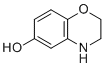 |
| Molecular Formula | C8H9NO2 |
| Molecular Weight | 151.16 |
| CAS Registry Number | 26021-57-8 |
| EC Number | 247-415-5 |
| SMILES | C1COC2=C(N1)C=C(C=C2)O |
| Density | 1.2±0.1 g/cm3 Calc.* |
|---|---|
| Boiling point | 334.7±42.0 °C 760 mmHg (Calc.)* |
| Flash point | 156.2±27.9 °C (Calc.)* |
| Index of refraction | 1.582 (Calc.)* |
| * | Calculated using Advanced Chemistry Development (ACD/Labs) Software. |
| Hazard Symbols |   GHS07;GHS09 Warning Details GHS07;GHS09 Warning Details | ||||||||||||||||
|---|---|---|---|---|---|---|---|---|---|---|---|---|---|---|---|---|---|
| Risk Statements | H302-H319-H411 Details | ||||||||||||||||
| Safety Statements | P264-P264+P265-P270-P273-P280-P301+P317-P305+P351+P338-P330-P337+P317-P391-P501 Details | ||||||||||||||||
| Hazard Classification | |||||||||||||||||
| |||||||||||||||||
| SDS | Available | ||||||||||||||||
 chemBlink Chemical Story
|
Hydroxybenzomorpholine is a chemical compound that refers to a benzomorpholine structure containing at least one hydroxyl group as a substituent on the aromatic ring. The benzomorpholine scaffold is a fused bicyclic structure made up of a benzene ring and a morpholine ring, where the morpholine is attached directly to the aromatic system. Compounds of this type may exist in several regioisomeric forms depending on the position of the hydroxyl substituent on the benzene ring and the position of substitution on the morpholine nitrogen or oxygen. While the term hydroxybenzomorpholine does not refer to a single unique compound, one commonly referenced structure in the literature is 6-hydroxy-2,3-dihydro-1,4-benzoxazine, also referred to as 6-hydroxy-1,4-benzomorpholine. This compound includes a hydroxyl group at the 6-position of the aromatic ring, enhancing its reactivity and hydrogen bonding capacity. Hydroxybenzomorpholine derivatives have attracted attention in medicinal and synthetic chemistry due to their structural similarity to pharmacologically active compounds. The benzomorpholine core is present in several bioactive molecules that display properties such as anti-inflammatory, antimicrobial, and anticancer activity. Substituted benzomorpholines, including hydroxy variants, have been explored as intermediates in drug development, especially in the design of central nervous system (CNS)-active agents. The synthesis of hydroxybenzomorpholine compounds generally involves cyclization reactions starting from aminophenols and haloalkyl derivatives. A common synthetic route includes the reaction of an ortho-aminophenol with an epoxide or a chloroalkyl derivative to form the morpholine ring fused to the aromatic system. Selective hydroxylation can be achieved via directed electrophilic substitution or through functional group manipulation after ring construction. From a chemical standpoint, hydroxybenzomorpholine derivatives are typically solid at room temperature and exhibit moderate solubility in polar organic solvents. The hydroxyl group influences the compound’s acid-base and solubility properties, making it amenable to further functionalization via etherification, esterification, or oxidation. Spectroscopically, these compounds can be identified and characterized by nuclear magnetic resonance (NMR), infrared (IR) spectroscopy, and mass spectrometry (MS), with hydroxyl stretching frequencies and aromatic proton shifts being key diagnostic features. In terms of applications, hydroxybenzomorpholine compounds have primarily been used in the synthesis of biologically active molecules and as reference standards in analytical chemistry. In some research contexts, they are used as ligands or intermediates in the preparation of coordination complexes for catalysis or material science applications. Although no hydroxybenzomorpholine compound is currently approved as a therapeutic agent, several analogs are under investigation in the field of medicinal chemistry. Environmental or toxicological data specific to hydroxybenzomorpholine are limited, but due to the presence of phenolic and morpholine functionalities, such compounds are likely to exhibit some level of biological activity and environmental persistence. Therefore, their use and disposal should follow standard laboratory safety and environmental protocols. In summary, hydroxybenzomorpholine refers to a class of substituted benzomorpholine compounds containing a hydroxyl group on the aromatic ring. These compounds are of interest in organic synthesis and medicinal chemistry for their structural features and potential biological activity. Although their industrial and pharmaceutical use is currently limited, they serve as valuable intermediates and scaffolds in chemical research. References 2020. Fluorophores, Get On My Nerves! Synfacts, 16(7). DOI: 10.1055/s-0040-1706823 2018. The Chemical and Products Database, a resource for exposure-relevant data on chemicals in consumer products. Scientific Data, 5. DOI: 10.1038/sdata.2018.125 2006. Combined Inventory of Ingredients Employed in Cosmetic Products. Zenodo. DOI: 10.5281/zenodo.2624118 |
| Market Analysis Reports |