
Online Database of Chemicals from Around the World
| Shanghai Worldyang Chemical Co., Ltd. | China | |||
|---|---|---|---|---|
 | www.worldyachem.com | |||
 | +86 13651600618 +86 (21) 5679-5779 | |||
 | +86 (21) 5679-5266 | |||
 | sales7777@worldyachem.com | |||
 | QQ Chat | |||
 | WeChat: 13651600618 | |||
 | WhatsApp:+86 13651600618 | |||
| Chemical manufacturer since 2012 | ||||
| Classification | API >> Nervous system medication >> Antiepileptic and anticonvulsant |
|---|---|
| Name | Topilutamide |
| Synonyms | 2-hydroxy-2-methyl-N-[4-nitro-3-(trifluoromethyl)phenyl]-3-[(2,2,2-trifluoroacetyl)amino]propanamide |
| Molecular Structure | 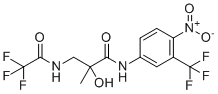 |
| Molecular Formula | C13H11F6N3O5 |
| Molecular Weight | 403.23 |
| CAS Registry Number | 260980-89-0 |
| EC Number | 813-250-8 |
| SMILES | CC(CNC(=O)C(F)(F)F)(C(=O)NC1=CC(=C(C=C1)[N+](=O)[O-])C(F)(F)F)O |
| Density | 1.6±0.1 g/cm3, Calc.* |
|---|---|
| Index of Refraction | 1.512, Calc.* |
| Boiling Point | 555.6±50.0 °C (760 mmHg), Calc.* |
| Flash Point | 289.8±30.1 °C, Calc.* |
| * | Calculated using Advanced Chemistry Development (ACD/Labs) Software. |
| Hazard Symbols |   GHS07;GHS09 Warning Details GHS07;GHS09 Warning Details | ||||||||||||
|---|---|---|---|---|---|---|---|---|---|---|---|---|---|
| Risk Statements | H319-H411 Details | ||||||||||||
| Safety Statements | P264+P265-P273-P280-P305+P351+P338-P337+P317-P391-P501 Details | ||||||||||||
| Hazard Classification | |||||||||||||
| |||||||||||||
| SDS | Available | ||||||||||||
 chemBlink Chemical Story
|
Topilutamide, also known by its chemical name (2α,5α,17β)-2,17-Dimethyl-17-hydroxyandrostan-3-one, is a synthetic androgen receptor antagonist. This compound has been primarily studied for its therapeutic potential in dermatological applications, particularly in addressing androgen-related conditions like hair loss and acne. Its development reflects ongoing research into selective androgen receptor modulators (SARMs) that aim to provide targeted treatments with reduced systemic side effects. The discovery of topilutamide is rooted in efforts to design topical agents capable of modulating androgenic activity in localized tissues. Androgens, such as dihydrotestosterone (DHT), play a critical role in various physiological and pathological processes, including the regulation of hair follicle activity and sebaceous gland function. Excessive androgenic activity is linked to conditions such as androgenetic alopecia (male and female pattern baldness) and acne. Researchers sought compounds that could antagonize these effects locally without significant systemic absorption, minimizing the risks associated with traditional anti-androgen therapies. Topilutamide works by binding to androgen receptors in the skin, preventing the activation of these receptors by endogenous androgens like DHT. This localized inhibition can reduce the hyperactivity of sebaceous glands and mitigate the miniaturization of hair follicles associated with androgenetic alopecia. Its formulation as a topical treatment ensures that its effects are primarily confined to the application site, reducing the likelihood of systemic hormonal disruptions. One of the most significant applications of topilutamide is in the treatment of androgenetic alopecia. Clinical studies have demonstrated that regular topical application of the compound can slow hair loss and, in some cases, stimulate regrowth in affected individuals. Its efficacy in this context has made it a valuable alternative or adjunct to other treatments like finasteride or minoxidil. Additionally, its favorable safety profile makes it suitable for long-term use. Beyond hair loss, topilutamide has shown promise in treating acne, a condition often exacerbated by androgen-induced stimulation of sebaceous glands. By reducing sebum production, the compound can help decrease the severity of acne lesions, offering relief to individuals resistant to conventional therapies. Future research on topilutamide focuses on optimizing its formulation for enhanced delivery and efficacy. Studies are also exploring its potential in other androgen-mediated conditions, such as hirsutism and seborrheic dermatitis. As interest in selective androgen receptor modulators grows, topilutamide represents a significant step forward in developing targeted, effective treatments with minimal systemic effects. References 2009. Use of the Rey-Osterrieth Complex Figure Test for neurotoxicity evaluation of mixtures in children. NeuroToxicology. DOI: 10.1016/j.neuro.2009.09.003 2002. Fluridil, a Rationally Designed Topical Agent for Androgenetic Alopecia: First Clinical Experience. Dermatologic Surgery. DOI: 10.1046/j.1524-4725.2002.02017.x 2019. List of PFAS identified in REACH. DOI: 10.5281/zenodo.7426856 |
| Market Analysis Reports |