
Online Database of Chemicals from Around the World
| Suzhou Biosyntech Co., Ltd. | China | |||
|---|---|---|---|---|
 | www.biosyntech-suzhou.com | |||
 | +86 13921151340 +86 (512) 6300-1269 | |||
 | sales2@biosyntech-suzhou.com sales@biosyntech-suzhou.com | |||
 | QQ Chat | |||
| Chemical distributor since 2019 | ||||
| chemBlink Standard supplier since 2020 | ||||
| Classification | Organic raw materials >> Heterocyclic compound >> Indoles |
|---|---|
| Name | 5-Bromo-3-(3-((tert-butyldiphenylsilyl)oxy)-2,2-dimethylpropyl)-2-iodo-1H-indole |
| Synonyms | [3-(5-bromo-2-iodo-1H-indol-3-yl)-2,2-dimethylpropoxy]-tert-butyl-diphenylsilane |
| Molecular Structure | 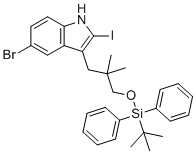 |
| Molecular Formula | C29H33BrINOSi |
| Molecular Weight | 646.47 |
| CAS Registry Number | 2641451-43-4 |
| SMILES | CC(C)(C)[Si](C1=CC=CC=C1)(C2=CC=CC=C2)OCC(C)(C)CC3=C(NC4=C3C=C(C=C4)Br)I |
| Density | 1.5±0.1 g/cm3 Calc.* |
|---|---|
| Boiling point | 621.1±55.0 °C 760 mmHg (Calc.)* |
| Flash point | 329.5±31.5 °C (Calc.)* |
| Index of refraction | 1.644 (Calc.)* |
| * | Calculated using Advanced Chemistry Development (ACD/Labs) Software. |
| Hazard Symbols |  GHS07 Warning Details GHS07 Warning Details |
|---|---|
| Risk Statements | H302-H315-H319 Details |
| Safety Statements | P501-P270-P264-P280-P302+P352-P337+P313-P305+P351+P338-P362+P364-P332+P313-P301+P312+P330 Details |
| SDS | Available |
 chemBlink Chemical Story
|
5-Bromo-3-(3-((tert-butyldiphenylsilyl)oxy)-2,2-dimethylpropyl)-2-iodo-1H-indole is a synthetically engineered organic compound built upon the indole scaffold. It incorporates multiple substituents that are strategically positioned for use in organic synthesis, particularly in medicinal chemistry or natural product synthesis. The structure of the compound reflects a highly functionalized molecule tailored for selective reactivity and controlled protection of functional groups. The base structure of the molecule is 1H-indole, a bicyclic aromatic system composed of a benzene ring fused to a pyrrole ring. This indole core is functionalized at three different positions with chemically distinct groups. At the 5-position of the indole ring, a bromine atom is introduced, and at the 2-position, an iodine atom is present. These halogen atoms serve as synthetic handles for cross-coupling reactions such as Suzuki, Sonogashira, or Buchwald-Hartwig couplings, allowing for site-selective derivatization of the molecule. Halogenated indoles are valuable intermediates in the construction of complex bioactive molecules and are frequently used to introduce diversity in drug discovery campaigns. The 3-position of the indole ring is substituted with a bulky aliphatic chain: a 3-((tert-butyldiphenylsilyl)oxy)-2,2-dimethylpropyl group. This segment includes several important features. The terminal tert-butyldiphenylsilyl (TBDPS) group is a commonly used protecting group for alcohols. It provides significant steric hindrance and high stability under both acidic and basic conditions, making it suitable for multistep synthetic sequences. The oxygen atom in the chain forms an ether linkage with the TBDPS group, and this protecting strategy preserves the hydroxyl functionality while preventing unwanted side reactions during chemical transformations elsewhere in the molecule. The aliphatic chain also contains a quaternary carbon center bearing two methyl groups at the 2-position, making the chain highly branched and sterically bulky. This branching can influence the solubility, conformational flexibility, and accessibility of the molecule in biological or chemical environments. It can also play a role in receptor binding or in controlling the reactivity of adjacent functional groups by creating steric shielding. The dual halogenation pattern (iodo and bromo) allows for selective sequential functionalization. Typically, iodine is more reactive in cross-coupling reactions due to its lower bond dissociation energy compared to bromine. This permits a chemoselective approach in synthesis, where the iodine can be reacted first under milder conditions, followed by transformation of the bromine-substituted position under more forcing conditions. Such selectivity is useful in stepwise modification strategies, especially in the construction of complex polyaryl or heteroaryl systems. From a synthetic perspective, the molecule may be prepared by initial halogenation of an indole precursor, followed by N-protection or selective substitution at position 3 with a suitably functionalized alkyl halide or sulfonate ester containing the TBDPS-protected alcohol. The presence of both electron-withdrawing (bromo and iodo) and electron-donating groups (ether chain) on the indole ring can influence its electronic properties, which in turn affect its reactivity and interactions in both synthetic and biological contexts. This compound is not commonly found in natural systems but is rather a product of rational design for use in laboratory research. It may be employed as a synthetic intermediate in the total synthesis of alkaloids or complex indole-based drug candidates. Its combination of halogens, protecting groups, and a stable heterocyclic core makes it a valuable building block in modular synthesis, enabling chemists to perform highly selective transformations with downstream biological relevance. |
| Market Analysis Reports |