
Online Database of Chemicals from Around the World
| Wuhan Kemi-works Chemical Co., Ltd. | China | |||
|---|---|---|---|---|
 | www.kemiworks.net | |||
 | +86 (27) 8573-6489 | |||
 | +86 (27) 8573-6485 | |||
 | info@kemiworks.net sales@kemiworks.com | |||
| Chemical manufacturer | ||||
| chemBlink Premium supplier since 2011 | ||||
| Classification | Catalysts and additives >> Polyethylene glycol derivative |
|---|---|
| Name | Poly(ethylene glycol) diacrylate |
| Synonyms | 2-prop-2-enoyloxyethyl prop-2-enoate |
| Molecular Structure | 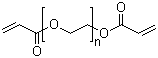 |
| Molecular Formula | (C3H3O).(C2H4O)n.(C3H3O2) |
| CAS Registry Number | 26570-48-9 |
| EC Number | 607-960-5 |
| SMILES | C=CC(=O)OCCOC(=O)C=C |
| Index of Refraction | 1.453 |
|---|---|
| Boiling Point | 66-68 °C (2 mmHg) |
| Hazard Symbols |   GHS05;GHS07 Danger Details GHS05;GHS07 Danger Details | ||||||||||||||||||||||||||||||||||||||||||||
|---|---|---|---|---|---|---|---|---|---|---|---|---|---|---|---|---|---|---|---|---|---|---|---|---|---|---|---|---|---|---|---|---|---|---|---|---|---|---|---|---|---|---|---|---|---|
| Risk Statements | H315-H317-H318-H319 Details | ||||||||||||||||||||||||||||||||||||||||||||
| Safety Statements | P261-P264-P264+P265-P272-P280-P302+P352-P305+P351+P338-P305+P354+P338-P317-P321-P332+P317-P333+P317-P337+P317-P362+P364-P501 Details | ||||||||||||||||||||||||||||||||||||||||||||
| Hazard Classification | |||||||||||||||||||||||||||||||||||||||||||||
| |||||||||||||||||||||||||||||||||||||||||||||
| SDS | Available | ||||||||||||||||||||||||||||||||||||||||||||
 chemBlink Chemical Story
|
Poly(ethylene glycol) diacrylate (PEGDA) is a notable chemical compound recognized for its significant role in polymer chemistry and materials science. This compound, a derivative of poly(ethylene glycol) with two acrylate groups, is highly valued for its versatility and utility in various applications, particularly in the synthesis of hydrogels and advanced polymeric materials. The discovery of PEGDA emerged from efforts to develop more functional and adaptable crosslinking agents for polymers. Scientists aimed to create a compound that could efficiently crosslink polymers while retaining desirable properties such as hydrophilicity and biocompatibility. PEGDA was introduced as a result of these research efforts, offering a powerful tool for modifying polymer networks and creating materials with specific properties. Poly(ethylene glycol) diacrylate is predominantly used in the formation of hydrogels, which are three-dimensional networks capable of absorbing and retaining large amounts of water. The acrylate groups in PEGDA enable the formation of crosslinked networks when polymerized, resulting in hydrogels with enhanced mechanical properties, elasticity, and swelling behavior. These characteristics make PEGDA-based hydrogels ideal for a range of biomedical applications. In tissue engineering, PEGDA hydrogels are used as scaffolds that support cell growth and tissue regeneration. The hydrophilic nature of PEGDA-based hydrogels mimics the natural extracellular matrix, providing an environment conducive to cell proliferation and differentiation. This application is crucial for developing advanced treatments in regenerative medicine, including the repair and replacement of damaged tissues. PEGDA is also employed in controlled drug delivery systems. The ability of PEGDA-based hydrogels to encapsulate and release drugs in a controlled manner makes them suitable for creating delivery systems that provide sustained and targeted release. This property enhances the efficacy of drug therapies and minimizes side effects, contributing to improved patient outcomes. In addition to biomedical applications, PEGDA is used in the field of materials science to produce various advanced polymeric materials. Its ability to form crosslinked networks with desirable properties makes it suitable for applications in coatings, adhesives, and composites. These materials benefit from PEGDA's contributions to mechanical strength, flexibility, and resistance to environmental factors. Research into PEGDA continues to explore new applications and improvements in its synthesis and functionality. Scientists are investigating modifications to PEGDA to tailor its properties for specific uses, expanding its utility in both existing and emerging fields. This ongoing research aims to enhance the performance of PEGDA-based materials and discover new applications that leverage its unique characteristics. In summary, poly(ethylene glycol) diacrylate is a valuable compound with diverse applications in hydrogels, drug delivery systems, and advanced materials. Its role in crosslinking polymers and forming hydrophilic networks makes it an essential substance in both biomedical and industrial contexts. References 2024 Radical polymerization of alkenyl boronates and C-B bond transformation: polymer synthesis through side-chain replacement for overcoming synthetic limitations. Polymer Journal, 56(9). DOI: 10.1038/s41428-024-00935-4 2024 Advances in hyperbranched polymer chemistry. Iranian Polymer Journal, 33(10). DOI: 10.1007/s13726-024-01379-6 2024 Recombinant collagen coating 3D printed PEGDA hydrogel tube loading with differentiable BMSCs to repair bile duct injury. Colloids and surfaces. B, Biointerfaces, 241. DOI: https://pubmed.ncbi.nlm.nih.gov/38954937 |
| Market Analysis Reports |