
Online Database of Chemicals from Around the World
| Topscience Co. Ltd. | China | |||
|---|---|---|---|---|
 | www.tsbiochem.com | |||
 | +86 (400) 820-0310 | |||
 | +86 (021) 3469-2979 | |||
 | sales@tsbiochem.com | |||
| Chemical manufacturer since 2013 | ||||
| chemBlink Standard supplier since 2012 | ||||
| Classification | Biochemical >> Inhibitor >> Cell cycle |
|---|---|
| Name | RP-6306 |
| Synonyms | (Rac)-RP-6306; 2-amino-1-(3-hydroxy-2,6-dimethylphenyl)-5,6-dimethylpyrrolo[2,3-b]pyridine-3-carboxamide |
| Molecular Structure | 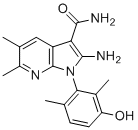 |
| Molecular Formula | C18H20N4O2 |
| Molecular Weight | 324.38 |
| CAS Registry Number | 2719793-90-3 |
| SMILES | CC1=C(C(=C(C=C1)O)C)N2C(=C(C3=C2N=C(C(=C3)C)C)C(=O)N)N |
| Hazard Symbols |  GHS07 Warning Details GHS07 Warning Details |
|---|---|
| Risk Statements | H302-H315-H319 Details |
| Safety Statements | P501-P270-P264-P280-P302+P352-P337+P313-P305+P351+P338-P362+P364-P332+P313-P301+P312+P330 Details |
| SDS | Available |
 chemBlink Chemical Story
|
RP-6306, also known as lunresertib, is an investigational small-molecule inhibitor developed to target PKMYT1 (membrane-associated tyrosine- and threonine-specific cdc2-inhibitory kinase 1), a kinase involved in cell cycle regulation and DNA damage response. The discovery of RP-6306 emerged from efforts to identify synthetic lethal interactions in cancer cells, particularly those harboring specific genetic alterations. The development of RP-6306 was driven by the need for targeted therapies in cancers exhibiting genomic alterations such as CCNE1 amplification or mutations in FBXW7 and PPP2R1A. These alterations can lead to dysregulation of the cell cycle, making tumor cells more reliant on PKMYT1 for survival. Inhibition of PKMYT1 by RP-6306 exploits this vulnerability, leading to selective tumor cell death. RP-6306 was identified through a CRISPR-based discovery platform that screened for genes whose inhibition would selectively kill cancer cells with specific genetic alterations. This approach led to the identification of PKMYT1 as a synthetic lethal partner to CCNE1 amplification and loss of FBXW7 and PPP2R1A function. The compound was optimized for potency and selectivity, resulting in an orally bioavailable inhibitor with an IC50 of approximately 14 nM. Preclinical studies demonstrated that RP-6306 effectively inhibits PKMYT1 activity and induces DNA damage in tumor cells with the targeted genetic alterations. In xenograft models, particularly those with CCNE1 amplification, RP-6306 treatment resulted in significant tumor growth inhibition, highlighting its potential as a therapeutic agent in these contexts. RP-6306 is currently undergoing clinical evaluation in Phase 1 trials. These studies aim to assess the safety, tolerability, and preliminary efficacy of RP-6306 as a monotherapy and in combination with other agents, such as camonsertib, an ATR inhibitor. Early results indicate that RP-6306 is well-tolerated and shows promising anti-tumor activity, particularly in gynecologic cancers with the relevant genetic alterations. The ongoing clinical trials are designed to identify the optimal dosing regimen and to further evaluate the therapeutic potential of RP-6306 in combination with other targeted therapies. The findings from these studies will provide critical information on the viability of PKMYT1 inhibition as a treatment strategy in cancers with specific genetic profiles. RP-6306 represents a novel approach in cancer therapy by targeting PKMYT1, a kinase involved in cell cycle regulation and DNA damage response. Its development underscores the importance of identifying and exploiting synthetic lethal interactions in cancer cells to develop targeted therapies. The outcomes of the current clinical trials will determine the future role of RP-6306 in the treatment of cancers with specific genetic alterations. References 2022. CCNE1 amplification is synthetic lethal with PKMYT1 kinase inhibition. Nature, 606(7916). DOI: 10.1038/s41586-022-04638-9 2022. Discovery of an Orally Bioavailable and Selective PKMYT1 Inhibitor, RP-6306. Journal of Medicinal Chemistry, 65(15). DOI: 10.1021/acs.jmedchem.2c00552 |
| Market Analysis Reports |